AQL Table & Sample Size Chart [2026] — Free AQL 2.5 Calculator
Read the AQL table, pick your sample size, and get instant Ac/Re numbers with our free 2026 chart & calculator www. cloudspects.
Read the AQL table, pick your sample size, and get instant Ac/Re numbers with our free 2026 chart & calculator
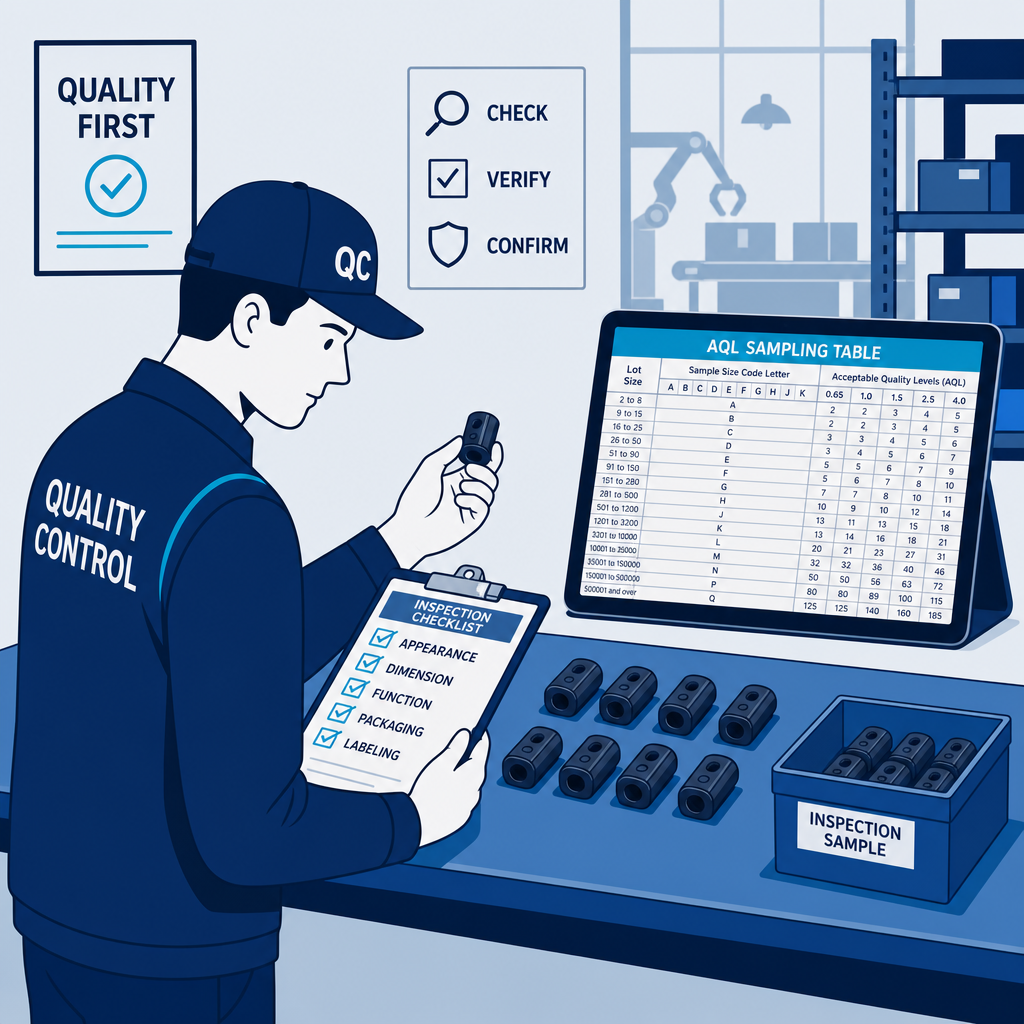
www.cloudspects.com — Pre-Shipment Inspection & Quality Control
🧮 Use the Live AQL Calculator
Enter your order size and AQL level. The calculator gives you the sample size and pass/fail limits instantly.
The tables behind that calculator are the ANSI/ASQ Z1.4 sampling plans (ISO 2859-1 in international use). If you only need the numbers, our free ANSI ASQ Z1.4 calculator returns the sample size and Ac/Re limits for any lot size and AQL level.
📋 AQL 2.5 Level II quick lookup
Most China inspections use AQL 2.5 at normal Level II. Here is the lot-size-to-sample-size table importers ask for most:
| Lot size (units) | Sample size | AQL 2.5 Ac / Re |
|---|---|---|
| 281 - 500 | 50 | Ac 3 / Re 4 |
| 501 - 1,200 | 80 | Ac 5 / Re 6 |
| 1,201 - 3,200 | 125 | Ac 7 / Re 8 |
| 3,201 - 10,000 | 200 | Ac 10 / Re 11 |
| 10,001 - 35,000 | 315 | Ac 14 / Re 15 |
| 35,001 - 150,000 | 500 | Ac 21 / Re 22 |
For the full explanation of how these numbers work, read the AQL 2.5 answer pack or plug your own batch into the AQL calculator.
If you import products from China, you have probably heard of AQL sampling. But how does it actually work? And how do you read those tables that inspectors use?
AQL stands for Acceptable Quality Limit. It is a sampling method based on the ISO 2859-1 standard. Third-party inspectors use it to check if a batch of products meets your quality requirements.
This guide explains AQL sampling step by step. You will learn how to pick your sample size, read the AQL table, and apply the rules to your own shipments.
What Is AQL Sampling?
AQL sampling means you inspect a sample from each batch. You do not check every single product. Instead, you pick a certain number of items at random and check them against your quality standards.
The AQL number tells you the maximum number of defective items you are willing to accept. For example, AQL 2.5 means you accept up to 2.5 defective items per 100 inspected.
Common AQL levels used by importers:
- AQL 0.0 — Zero defects allowed. Used for safety-critical or visual checks.
- AQL 1.0 — High quality. Used for electronics, precision parts.
- AQL 2.5 — Standard quality. Used for most consumer products.
- AQL 4.0 — Basic quality. Used for simple products with low risk.
Step 1: Determine Your Sample Size Using the Code Letter Table
The first step is to find your sample size code letter. This depends on two things:
- Batch size — How many units are in the shipment
- Inspection level — Usually Level II for normal inspection
Here is the ISO 2859-1 sample size code letter table for normal inspection (Level II):
| Batch Size | Code Letter | Sample Size |
|---|---|---|
| 2 – 8 | A | 2 |
| 9 – 15 | B | 3 |
| 16 – 25 | C | 5 |
| 26 – 50 | D | 8 |
| 51 – 90 | E | 13 |
| 91 – 150 | F | 20 |
| 151 – 280 | G | 32 |
| 281 – 500 | H | 50 |
| 501 – 1,200 | J | 80 |
| 1,201 – 3,200 | K | 125 |
| 3,201 – 10,000 | L | 200 |
| 10,001 – 35,000 | M | 315 |
| 35,001 – 150,000 | N | 500 |
To use this table: find your batch size in the left column. Read across to get the code letter. Then look up the sample size in the right column.
Example: If your shipment has 2,000 units, find "1,201 – 3,200" on the table. Your code letter is K. Your sample size is 125 units.
Step 2: Read the Accept / Reject Table
Once you know your sample size, you need to decide how many defects are allowed. This is where the accept/reject table comes in.
Here is the AQL accept/reject table for normal inspection. It shows the number of defects allowed for each AQL level:
| Sample Size | Code Letter | AQL 1.0 Ac / Re |
AQL 2.5 Ac / Re |
AQL 4.0 Ac / Re |
|||
|---|---|---|---|---|---|---|---|
| 20 | F | 0 / 1 | 1 / 2 | 2 / 3 | |||
| 32 | G | 0 / 1 | 1 / 2 | 3 / 4 | |||
| 50 | H | 1 / 2 | 2 / 3 | 5 / 6 | |||
| 80 | J | 1 / 2 | 3 / 4 | 7 / 8 | |||
| 125 | K | 2 / 3 | 5 / 6 | 10 / 11 | |||
| 200 | L | 3 / 4 | 7 / 8 | 14 / 15 | |||
| 315 | M | 5 / 6 | 10 / 11 | 21 / 22 | |||
The table shows Ac (Accept) and Re (Reject) numbers. If the number of defects found is equal to or below Ac, the batch passes. If it reaches Re, the batch fails.
Step 3: Worked Examples
Let us walk through a few examples to make it clear.
Example 1: Small Shipment
Batch size: 200 units
Inspection level: Level II, Normal
AQL: 2.5
From the code letter table: batch 151–280 = code letter G, sample size 32.
From the accept/reject table: code G, AQL 2.5 = Ac 1, Re 2.
Result: Inspect 32 units. If you find 0 or 1 defect, the batch passes. If you find 2 or more defects, the batch fails.
Example 2: Medium Shipment
Batch size: 3,000 units
Inspection level: Level II, Normal
AQL: 1.0 for major defects, 2.5 for minor defects
From the code letter table: batch 1,201–3,200 = code letter K, sample size 125.
For AQL 1.0: Ac 2, Re 3. For AQL 2.5: Ac 5, Re 6.
Result: Inspect 125 units. Up to 2 major defects pass. Up to 5 minor defects pass. If either limit is exceeded, the batch fails.
Example 3: Large Shipment
Batch size: 20,000 units
Inspection level: Level II, Normal
AQL: 2.5
From the code letter table: batch 10,001–35,000 = code letter M, sample size 315.
From the accept/reject table: code M, AQL 2.5 = Ac 10, Re 11.
Result: Inspect 315 units. Up to 10 defects are allowed. At 11 defects, the batch is rejected.
Normal vs Reduced vs Tightened Inspection
ISO 2859-1 has three inspection levels. You switch between them based on past results:
- Normal inspection — The starting point. Use this for most shipments.
- Reduced inspection — Smaller sample size. Only use this after 10 consecutive batches have passed. This saves time and money but has more risk.
- Tightened inspection — Larger sample size. Use this when a batch fails. Stay on tightened until 5 consecutive batches pass.
Important:
If your supplier has consistent quality problems, do not stay on reduced inspection. Switch to tightened inspection to catch more defects. Most third-party inspectors will recommend the right level for your situation.
Common Mistakes Importers Make
- Picking the wrong AQL level — Using AQL 4.0 for electronics is too loose. Use AQL 1.0 or even 0.65 for critical products.
- Not specifying AQL in the contract — Your supplier needs to know what AQL level you expect. Include it in your inspection agreement.
- Ignoring the inspection level — Level II is standard for most products. But if your product has high safety risks, use Level III (more samples).
- Not separating defect types — Critical, major, and minor defects should have different AQL limits. Most inspectors use AQL 0 for critical, 1.0–2.5 for major, and 2.5–4.0 for minor.
Need help setting up your AQL inspection plan?
CloudSpects uses ISO 2859-1 for all product inspections. We help you choose the right sample size and AQL level for your products. $169 per man-day, English reports in 24–48 hours.
AQL sampling might look complicated at first. But once you understand the two tables, it is simple. Find your batch size, get your code letter, read your sample size, and apply your AQL limit.
Use this guide when you plan your next inspection. It will help you get the right sample size and the right level of quality control for your shipment.
#AQLSampling #ProductInspection #QualityControl #ISO2859 #ImportFromChina #CloudSpects
Related Articles
- AQL Chart and Table: How to Read the AQL Sampling Chart for Product Inspection
- AQL Calculator: How to Calculate Sample Size and Acceptance Number for Product Inspection
- AQL Sampling Explained: How Many Products Should You Inspect?
Frequently asked questions
What Is AQL Sampling?
AQL sampling means you inspect a sample from each batch. You do not check every single product. Instead, you pick a certain number of items at random and check them against your quality standards.