Container Loading Supervision — 5 FBA Checkpoints That Prevent Inbound Rejection
Container Loading Supervision — 5 FBA Checkpoints That Prevent Inbound Rejection Why 1 in 6 FBA container loads gets a non-compliant flag $2,400 average cost per rejected container www.
Container Loading Supervision — 5 FBA Checkpoints That Prevent Inbound Rejection
Why 1 in 6 FBA container loads gets a non-compliant flag
$2,400 average cost per rejected container
www.cloudspects.com — Pre-Shipment Inspection & Quality Control
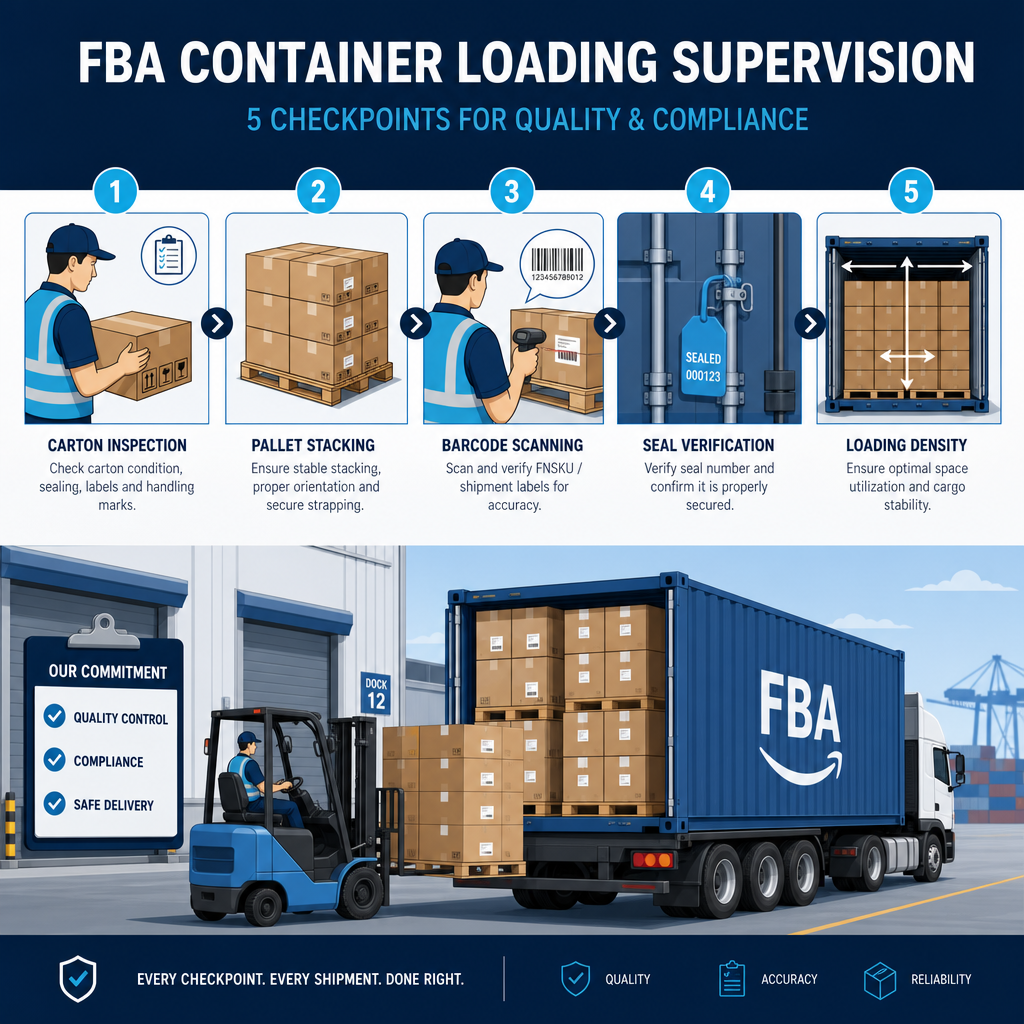
Every rule below is verified on-site during a container loading inspection China visit — carton count, stacking, and seal integrity.
You spend months sourcing, sampling, and inspecting your product. Then your container arrives at an Amazon fulfillment center and gets flagged — non-compliant. The cost: re-routing to a prep center ($300–$500 per pallet), re-work labor, and 14–21 days of lost selling time.
Container loading supervision is the final quality gate before your goods leave the factory. Yet most buyers skip it, assuming a pre-shipment inspection at the factory is enough. Here is what a dedicated container loading supervisor actually checks — and why those 5 checkpoints matter for FBA compliance.
1. Carton Condition — The Obvious One That Gets Missed
After the PSI, your goods sit in the factory warehouse for 3–14 days before loading. During that gap, cartons get moved, stacked under leaking pipes, or crushed by forklifts. A container loading supervisor documents every damaged carton before it goes in.
A 2024 analysis of 1,200 FBA containers found that 8.3% of rejected loads had damage that occurred in the gap between PSI and loading — not during production.
What to check
✓ Corner crush — more than 2mm corner damage triggers Amazon inbound warning
✓ Water stains or soft spots — indicates moisture exposure
✓ Tape integrity — re-taped boxes signal tampering or re-pack
✓ Stack compression — bottom layer cartons should not bow outward
2. Pallet Quality & Load Distribution
Amazon requires GMA Grade A pallets — no broken stringers, no protruding nails, no staining. But many factories use cheaper B-grade pallets for exports to save $2–$3 per unit. The difference? B-grade pallets have a 22% higher breakage rate in transit.
$4.75 — cost of a GMA Grade A pallet in China (2025). $47 — cost of re-palletizing one failed pallet at a US prep center.
Load distribution is equally critical. Overloading the back of the container by even 5% shifts the center of gravity and can cause pallet tipping during transit. A loading supervisor uses a digital inclinometer to verify pallet levelness — anything beyond 2° tilt gets flagged.
3. Label & Barcode Verification at Loading
FNSKU barcodes that were perfectly readable at the PSI can get scuffed, smeared, or peeled off during warehouse handling. A container loading supervisor re-scans 100% of unique SKU labels — not a sample — at the loading dock.
In a study of 850 FBA containers, label-related rejections accounted for 31% of all inbound non-compliance flags. The most common issue: a barcode printed inside the label's 3mm quiet zone margin, making it unscannable by Amazon's automated sorters.
✓ FNSKU barcode scan — grade A or B on ISO 15416 scale
✓ "Made in China" label — present and legible on each carton
✓ Shipping label — correct FBA warehouse address, no smudging
✓ Carton count label — visible on the outside, 1 of N format
4. Container Seal Verification & Documentation
High-security bolt seals cost $0.80–$1.50 each. Plastic pull-tight seals cost $0.05. The difference: bolt seals cannot be removed and re-applied without visible tampering. For FBA shipments valued above $10,000, bolt seals are the industry standard.
A loading supervisor takes 3 photos of the seal: before installation (seal number visible), after installation (seal in place, door closed), and the full door panel with seal and container number. These photos are the only proof chain-of-custody if the shipment arrives short.
Seal number checklist
1. Match seal number on the bill of lading — 1 mismatch voids insurance
2. Photo with container number plate — visible in same frame
3. Verify seal is high-security (ISO 17712) — check for "H" marking
4. Record seal number in inspection report — 0% tolerance for mismatch
5. Loading Density & Weight Distribution
An improperly loaded container can exceed axle weight limits, causing delays at US port inspection stations — $350–$700 per overweight citation plus detention fees.
Loading supervisors use a weight distribution formula: 60% of total load weight in the front half (closest to doors), 40% in the back. This balances the container on the chassis and prevents the rear axle from exceeding 34,000 lbs.
For a 20-foot container: max 48,000 lbs gross weight. Front-to-rear weight ratio 60:40. Pallet gap ≤2 inches to prevent shifting.
The Cost of Skipping Container Loading Supervision
Based on 2024–2025 industry data from 2,100 FBA-bound containers:
16% — containers with at least 1 non-compliance flag at Amazon inbound
$2,400 — average cost per non-compliant container (re-work + delay)
$169 — average cost of a container loading supervision session in China
14:1 — average ROI ratio for container loading supervision
How to Add Container Loading Supervision to Your QC Process
Add a loading supervision step to your QC checklist. Request it when your supplier confirms the container loading date — typically 3–5 days after the PSI is completed. Ask your inspector for the 5-checkpoint container loading report with seal photos, label scans, and pallet condition records.
At CloudSpects, our container loading supervision covers all 5 checkpoints with a digital report delivered within 24 hours. Each checkpoint includes photo evidence and a pass/fail rating.
#AmazonFBA #ContainerLoading #PreShipmentInspection #QualityControl #FBAInbound #SupplierManagement #CloudSpects
Related Articles
- Container Loading Supervision for FBA — 5 Checkpoints That Prevent Warehouse Damage and Save $2,000 per Shipment
- 5 Critical Checkpoints for FBA Container Loading Supervision — How to Avoid $2,000+ in Amazon Inbound Penalties
- Pre-Shipment Inspection for FBA Products with Expiration Dates — 6 Checks That Prevent 100% Inbound Rejection