A Missing Mark Costs 10 Percent: The Country-of-Origin Label Your Q4 Container Needs
🏷️ The Cheapest Part of Your Order Is the One Customs Reads First Of every QC item on a Q4 order, the country-of-origin mark looks like the least important: a few words on a panel that no shopper ever reads.
🏷️ The Cheapest Part of Your Order Is the One Customs Reads First
Of every QC item on a Q4 order, the country-of-origin mark looks like the least important: a few words on a panel that no shopper ever reads. It also happens to be the only defect on this list with a published price tag. Under 19 CFR 134.2, articles that are not marked as the rules require are subject to additional duties of 10 percent of the final appraised value, unless they are exported or destroyed under Customs supervision before the entry liquidates. On a $60,000 entry, that is $6,000 — for a line of text the factory prints for a fraction of a cent. We run this check on every China pre-shipment inspection because it is the one defect a buyer can still fix while the goods are inside China. 🚢
It rarely goes wrong through ignorance. It goes wrong in the last three weeks of a rush order, when the sticker roll arrives with lighter adhesive and the mark lands under the lid lip because that is where the die fell.
📜 What the Rule Actually Says
The requirement is older and more specific than most importers assume. 19 CFR 134.11 restates section 304 of the Tariff Act of 1930 (19 U.S.C. 1304): every article of foreign origin, or its container, must be marked in a conspicuous place, as legibly, indelibly and permanently as the article will permit, in a way that shows an ultimate purchaser the English name of the country of origin — at the time of importation.
Three words in that sentence decide most marking cases. 📌 Conspicuous is defined in 19 CFR 134.1(k) as capable of being easily seen with normal handling of the article or container — not "present somewhere in the packaging". The ultimate purchaser framing is why a mark on the master carton alone is not a defence when the retail box is what the buyer opens. And permanently is where sticker marking lives or dies: 19 CFR 134.45(b) requires pressure-sensitive labels to sit in a conspicuous place and stay secure until delivery to the ultimate purchaser.
There is also a trap for sellers who build a US-facing brand. Under 19 CFR 134.46, if "United States", "American", "U.S.A." or the name of any US city appears on the article, the origin marking has to appear in close proximity, preceded by "Made in" or "Product of". "Designed in California" on its own is exactly that situation. And 19 CFR 134.51 is the enforcement step most importers have never read: when articles are found not legally marked, CBP notifies the importer to mark the goods or redeliver them.
🔬 Six Marking Checks We Run in the Factory
| # | Check | Field method | What a fail looks like |
|---|---|---|---|
| 1 | Mark exists on every unit | Open cartons across pallets, inspect the retail unit and the master carton separately, not just one sample box | Mark on the master carton only; retail unit blank |
| 2 | Conspicuous under normal handling | Pick the unit up the way a customer would, then look for the mark without searching | Mark printed under the lid lip, behind a sleeve, on the underside of the base |
| 3 | Permanence | Thumb rub plus ten strokes with a damp cloth, then inspect for lift or smear at the edges | Sticker lifts at one corner; ink smears off a painted panel |
| 4 | Wording | Read the printed text against the rule: full English name of the country of origin | Flag icon or "CN" only; a country name in a non-English language |
| 5 | No misleading US or third-country reference | Scan the panel for "USA", "American", US city names or a different country name, and check for a compliant "Made in" line at the same location | "Designed in California" with no origin line nearby |
| 6 | Mark survives labelling and packing | Place the FNSKU or retail barcode where it will actually sit and re-check the mark; check the repack scenario with the factory's own cartons | Barcode label lands on top of the origin mark; repacking hides it |
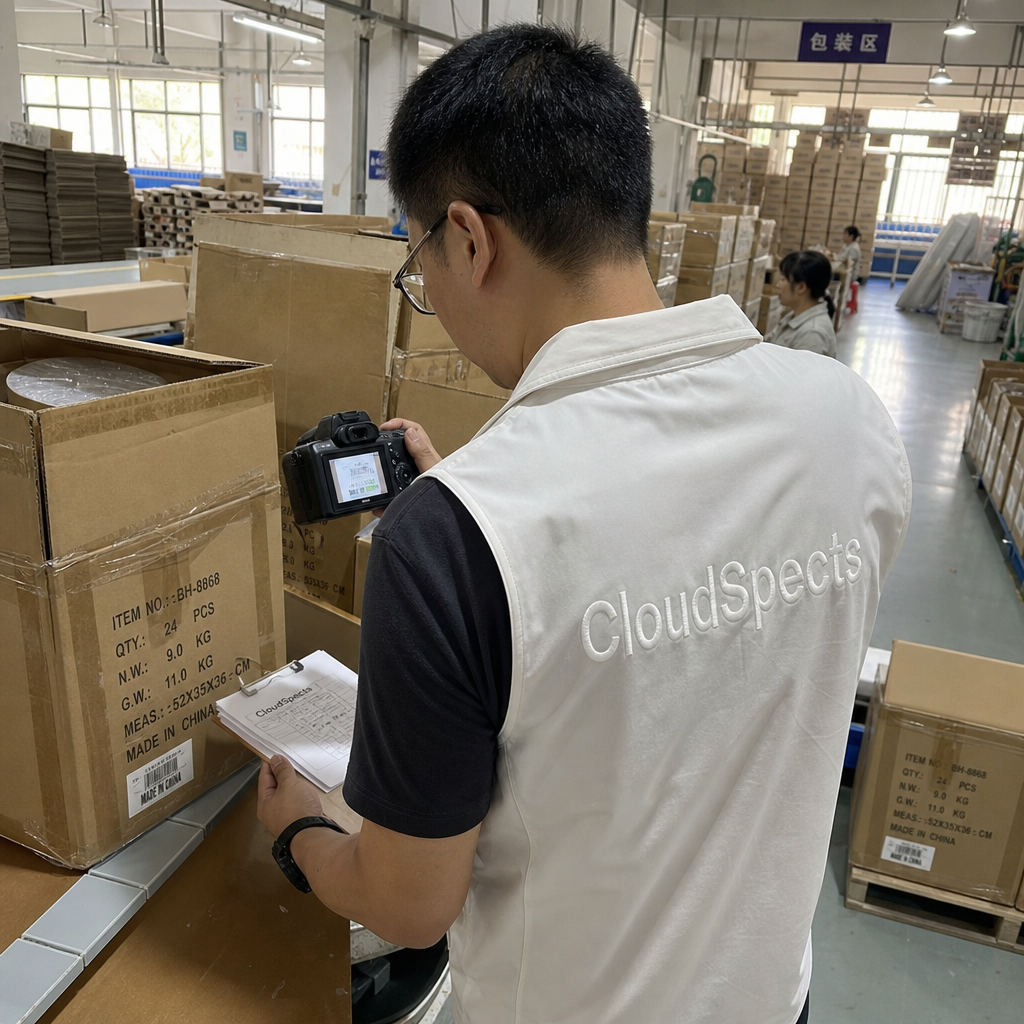
Check six is the one sellers forget, and the one that bites in an FBA workflow: the barcode is applied on the line, and where it lands is nobody's decision unless it is written into the spec. We photograph the mark with the carton code and artwork revision in the same frame, so the report names the print run to recall. 📸
We sample marking against AQL 2.5, level II as a default — 125 units on a 1,201 to 3,200 piece lot, 200 on larger runs — and treat a missing origin mark on a retail unit as a major, because it is a print or assembly feature rather than a random flaw. Sample sizes by lot size are on the AQL calculator. 🧮
💸 The Case That Cost More Than the Labels
A 2026 order from our files: 4,600 insulated travel tumblers, 575 cartons, FOB $4.20 — about $19,300 of goods. The retail panel read "Designed in California" with no origin line within sight, the 19 CFR 134.46 situation. Sampling of 200 units found 38 with the origin sticker under the lid lip, 26 with the label lifting at a corner after a damp-cloth rub, 11 marked only on the master carton, and 3 where the FNSKU sheet had been applied over the origin line on the inner unit.
The maths is what convinced the buyer. Relabelling inside China cost 4,600 replacement stickers, a packaging shift change and two man-days of inspection at $169 each — under $400 plus a day of production time. The alternative is the 10 percent additional duty if the entry is found not legally marked and the goods are not exported under Customs supervision before liquidation: roughly $1,930 on a $19,300 order, plus a hold that keeps the goods out of your holiday window. Neither outcome is caused by the label; both are decided by who applies it and where. 📉
❓ FAQs
Is the country-of-origin mark required on the retail box or on the product?
The rule speaks to the article or its container, and the test is whether the ultimate purchaser can see the English name of the country of origin. On a unit that ships in a retail box the customer opens, a master-carton mark alone is usually not enough; we check both panels during the visit.
Can a sticker be used for country-of-origin marking?
Yes, but 19 CFR 134.45(b) requires pressure-sensitive labels to sit in a conspicuous place and stay secure through storage, display and delivery. In humid containers and cold months corners lift, which is why the damp-cloth rub is part of our standard sequence.
What does the 10 percent figure apply to?
19 CFR 134.2 sets additional duties of 10 percent of the final appraised value where goods are not marked as required, unless they are exported or destroyed under Customs supervision before liquidation. It is a duty, not a fine, so it lands in your landed cost.
We print "Designed in California" on the box. Is that a problem?
Only if the origin line is missing. Under 19 CFR 134.46, when a US name, "American", "U.S.A." or a US city appears, the country of origin must be shown in close proximity, preceded by "Made in" or "Product of". Adding that line to the artwork is cheap; adding it later is impossible.
How late can a marking defect be caught?
Only up to the point the container leaves. Marking is a print and assembly feature, so a pre-shipment visit is the last moment where relabelling costs a shift rather than a duty — which is why we photograph the mark, the carton code and the artwork revision together and report typically within ~24 hours of the visit.
🧭 Where Marking Fits in the Rest of Your QC
Marking looks trivial, is testable in minutes, and has a number attached to it. Across 2,000+ inspections a year the pattern is consistent: physical failures get argued about, and print failures get paid for. CloudSpects checks the origin line, the wording, the sticker adhesive and the barcode placement on the same visit as the dimensional and functional checks, with each mark photographed next to its carton code. ✅
If your Q4 or Q1 order has new artwork, a first-time sticker supplier or a retail box that lists a US address, send the artwork file with the booking so the panel is checked against 19 CFR 134 during the visit, and route anything unusual through the contact page. Rates per man-day are on the pricing page.
Frequently asked questions
Is the country-of-origin mark required on the retail box or on the product?
The rule speaks to the article or its container, and the test is whether the ultimate purchaser can see the English name of the country of origin. On a unit that ships in a retail box the customer opens, a master-carton mark alone is usually not enough; we check both panels during the visit.
Can a sticker be used for country-of-origin marking?
Yes, but 19 CFR 134.45(b) requires pressure-sensitive labels to sit in a conspicuous place and stay secure through storage, display and delivery. In humid containers and cold months corners lift, which is why the damp-cloth rub is part of our standard sequence.
What does the 10 percent figure apply to?
19 CFR 134.2 sets additional duties of 10 percent of the final appraised value where goods are not marked as required, unless they are exported or destroyed under Customs supervision before liquidation. It is a duty, not a fine, so it lands in your landed cost.
We print "Designed in California" on the box. Is that a problem?
Only if the origin line is missing. Under 19 CFR 134.46, when a US name, "American", "U.S.A." or a US city appears, the country of origin must be shown in close proximity, preceded by "Made in" or "Product of". Adding that line to the artwork is cheap; adding it later is impossible.
How late can a marking defect be caught?
Only up to the point the container leaves. Marking is a print and assembly feature, so a pre-shipment visit is the last moment where relabelling costs a shift rather than a duty — which is why we photograph the mark, the carton code and the artwork revision together and report typically within ~24 hours of the visit.