Alibaba Trade Assurance Wants Evidence, Not Screenshots: The QC File a Claim Needs
Most claims we hear about start the same way: a buyer who has already paid the balance, a factory insisting the goods are “within tolerance”, and a folder of screenshots.
Most claims we hear about start the same way: a buyer who has already paid the balance, a factory insisting the goods are “within tolerance”, and a folder of screenshots. The screenshots prove what was promised. They almost never prove what was found — on how many units, on which date, measured with what. That gap is where the money sits. 🧾
A claim reviewer is not reading a story. They are comparing two things: what the order said, and the condition of a defined population of goods on a date, established by a method anyone can repeat. That is the exact shape of a third-party pre-shipment inspection, which is why we run it at the factory, before the balance and before the container — while the goods are still in the seller’s control and rework is still cheap.
🔍 What a claim reviewer is actually comparing
Two files that look similar at a glance do very different work. This table is the one we walk importers through before they write a single sentence of their claim:
| What most buyers send | What it actually proves | What it leaves open |
|---|---|---|
| Chat messages promising “100% A grade, no scratches” | The promise existed | Nothing about the goods that were actually produced |
| Phone photos of the worst unit on a desk | At least one unit exists like that | How many, out of how many, and whether it left the factory that way |
| The factory’s own QC sheet showing “passed” | The factory reached its own conclusion | Whether the sample came from the sealed lot, or from the newest cartons on top |
| A dated third-party report with sampling math | The condition of a defined lot on a date, by a repeatable method | Very little — this is the row that holds up |
| A sealed, signed sample | What “correct” meant in the first place | Unless it was sealed at approval and signed by both sides, it is one more opinion |
Note the pattern: the weak files describe a feeling, the strong files describe a population. “They cheated me” is a story. “We drew 200 units from the sealed lot on September 12, found 4 critical and 17 major defects, and here are the carton numbers” is a claim.
📐 Sampling: the number that makes a claim the right size
The reason a professional report can be argued with is that it declares how the sample was drawn. At AQL 2.5, general inspection level II (ISO 2859-1), the sample scales with the lot and nothing else:
| Lot size | Sample drawn | Accept / Reject |
|---|---|---|
| 501 – 1,200 units | 80 | 5 / 6 |
| 1,201 – 3,200 units | 125 | 7 / 8 |
| 3,201 – 10,000 units | 200 | 10 / 11 |
The acceptance number is not a warranty, and treating it as one is how buyers get surprised. A lot can pass sampling and still contain defects — what passing buys you is a documented, defensible statement of what was found in the units that were inspected. Check your own lot size against our AQL calculator before you argue about numbers, because the first thing the other side will question is the sample.
🧪 Classify defects before you argue about them
A claim that says “everything was bad” gives the reviewer counts with no scale. Split the findings into three classes and the report starts making decisions for you:
Critical — a safety, legal or functionality-killing defect: live terminals, a cord safety device missing, a battery compartment a child can open, a load-bearing weld that fails. One is usually enough to stop the shipment. Major — the customer would return it or leave a one-star review: a dead switch, a structural gap, a coating so thin it rusts in a season, a wrong label. Minor — visible to a careful eye, unlikely to trigger a return: a light scuff on a non-visible face, a slightly loose polybag, cosmetic variation inside tolerance.
Two consequences follow, and both matter in a claim. First, a critical defect is a different conversation from a major one, and mixing them lets the other side argue about the cheapest item on your list. Second, the counts per class are what let a buyer ask for a specific remedy instead of a general refund — 4 critical and 17 major in a 200-unit sample is a rework demand on a defined set of cartons, not an argument about taste.
📸 Photos that survive review
Photos are the part of a file that gets believed or dismissed fastest. The differences are boring and decisive:
Originals only, never re-compressed images from a chat app, and never edited. The carton number in the same frame as the defect, so a photo points at a specific box rather than at the product category. The FNSKU label of that same carton in shot, which is what ties the unit to your listing. A measuring tool or scale in frame with its reading legible — a caliper showing 347.8 mm next to the bracket it does not fit settles a dimensional claim, while a close-up of a bracket alone does not. Whole-carton shots as well as close-ups, so the reviewer can see the packing method the factory used. And a date, because an undated defect photo invites the question of when it was taken.
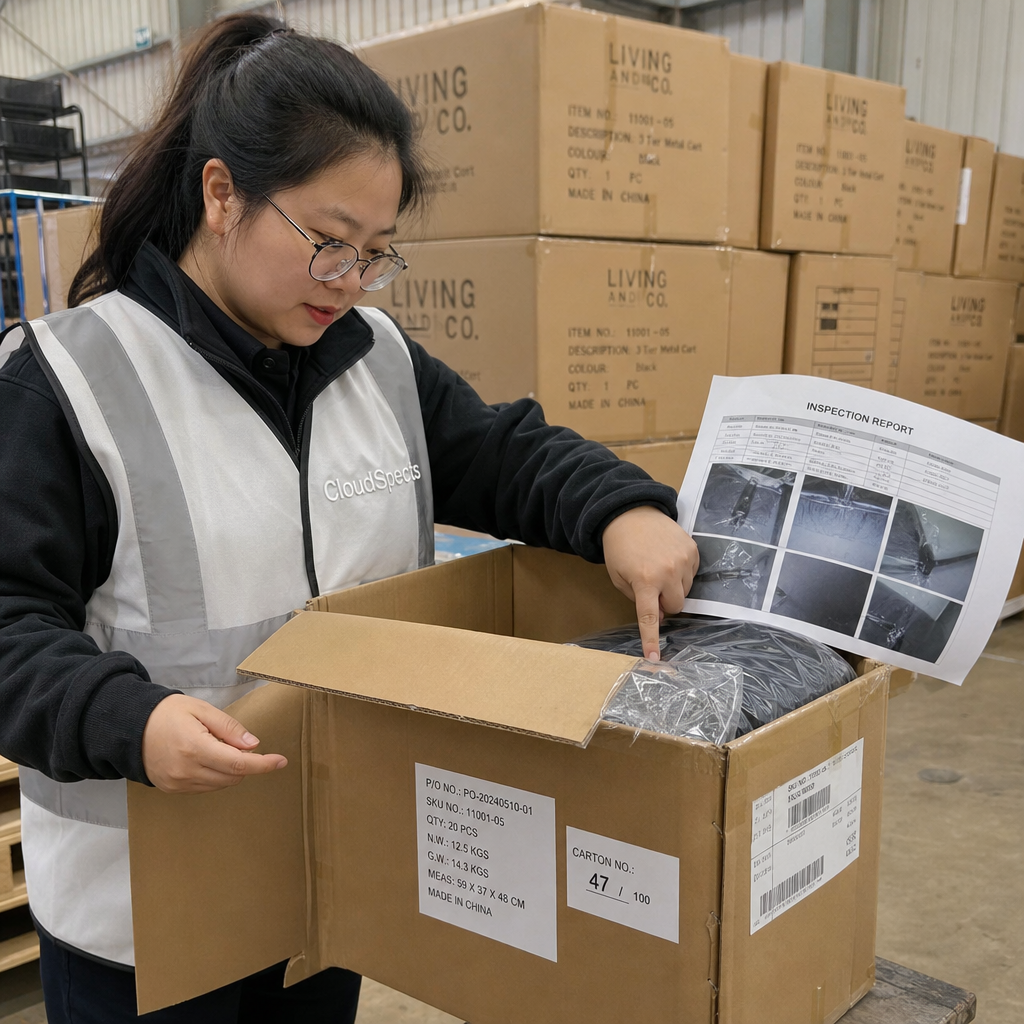
Our inspectors photograph the carton number and the defect in the same frame on every lot we inspect, and we hand over the unedited originals rather than a curated selection — a file of forty to a hundred and twenty photos per shipment is normal, and it is the raw sequence that makes the report hard to wave away. 🔎
🧾 The fields that make a report usable
If the report does not state these, it is a description rather than evidence: PO number and SKU; the lot size and how the lot was defined, meaning which cartons or pallets were in scope; the sample size and code letter; defects by class with counts and photographs; the method, including the AQL level, the gauges and any functional tests run; the date and the inspector; the factory name and address; and the verdict. Then the part owners underestimate — the file has to still exist in a year, in a form a new production manager can read after the people involved have left. Every CloudSpects report is written to be handed to a third party, because that is usually who ends up reading it. 📁
⏱️ Timing is the part you cannot fix later
The same defect is worth different amounts on different days. Caught at the factory before loading, it costs a rework shift and the factory usually absorbs it, because the goods are still theirs and the balance has not moved. Caught after arrival, the same defect costs you freight both ways, a sorting bill, storage, the rework, and the listing damage while customers wait. Caught by your customer, it costs all of that plus reviews that stay.
So the practical rule is not “inspect” but “inspect at the point where the report still describes the goods as shipped”. A report taken before the container is loaded describes the lot. A report taken after a month at sea describes the lot plus everything that happened to it — and that ambiguity is where claims quietly die. ⏳
⚖️ The three endings, and which one you get
In practice claims end one of three ways: rework at the factory before loading, where cost stays with the supplier; a price adjustment or cost share, where you keep the goods and the number is negotiated from the count; or return and replacement, which is the slowest and the one most likely to end in a partial settlement because both sides have already spent money on freight. Which ending is available is decided by when you inspected, not by how well you argue later. And because the evidence requirements differ by order type and claim path, read the flow that applies to your order before you assemble the file — we produce the report and the photo set; the route it travels is yours to choose. 🧭
❓ FAQs
Is a third-party inspection report accepted as evidence in an Alibaba dispute?
It is the only neutral, dated account of the goods most buyers can produce, so it does the two things a claim needs: it fixes the condition of a defined population on a specific date, and it states the method anyone can repeat. Whether it moves money depends on your agreement and on the claim path for that order type, which is why the report and the purchase-order clauses are read together.
What if the factory refuses an inspection before I release the balance?
Treat the refusal as information. A supplier who will not allow a third party to count and photograph the sealed lot before payment is telling you what the argument will look like after payment. Some factories push back only on the notice period, which is solvable; a flat refusal on access is not.
Can I use a report taken after the goods arrived?
You can, but you are now describing condition after ocean transit, terminal handling and a truck ride, so the other side has a plausible alternative explanation for every defect. Cushioning damage, handling scuffs and moisture are genuinely ambiguous at that point. A pre-loading report removes that whole argument.
Do I need a laboratory test as well?
Only where the claim is about a property you cannot see: material composition, coating thickness in microns, electrical safety, chemical or food-contact compliance. Those need a lab sample and a test report. Everything visual, dimensional, functional and packaging-related is established on site, which is the cheaper half.
Does this work for small orders?
It works better, because small orders are where documentation is thinnest and where one bad batch is a large share of your cash. Sampling and reporting scale with visits rather than PO value, so a few hundred units get the same structured file as a full container.
💵 Pricing and how to book
Inspections are $169 per man-day, plus travel where the factory sits outside our usual Guangdong, Zhejiang and Jiangsu routes, and we have completed 2,000+ inspections for importers selling on Amazon and beyond. A report is typically with you within about 24 hours of the visit, with the unedited photo set attached. Send the PO, the factory address and your ship date and we will tell you which visit slot still leaves room to fix what we find — see inspection pricing, check the sample size on the AQL calculator, or contact us for a same-day quote.
Frequently asked questions
Is a third-party inspection report accepted as evidence in an Alibaba dispute?
It is the only neutral, dated account of the goods most buyers can produce, so it does the two things a claim needs: it fixes the condition of a defined population on a specific date, and it states the method anyone can repeat. Whether it moves money depends on your agreement and on the claim path for that order type, which is why the report and the purchase-order clauses are read together.
What if the factory refuses an inspection before I release the balance?
Treat the refusal as information. A supplier who will not allow a third party to count and photograph the sealed lot before payment is telling you what the argument will look like after payment. Some factories push back only on the notice period, which is solvable; a flat refusal on access is not.
Can I use a report taken after the goods arrived?
You can, but you are now describing condition after ocean transit, terminal handling and a truck ride, so the other side has a plausible alternative explanation for every defect. Cushioning damage, handling scuffs and moisture are genuinely ambiguous at that point. A pre-loading report removes that whole argument.
Do I need a laboratory test as well?
Only where the claim is about a property you cannot see: material composition, coating thickness in microns, electrical safety, chemical or food-contact compliance. Those need a lab sample and a test report. Everything visual, dimensional, functional and packaging-related is established on site, which is the cheaper half.
Does this work for small orders?
It works better, because small orders are where documentation is thinnest and where one bad batch is a large share of your cash. Sampling and reporting scale with visits rather than PO value, so a few hundred units get the same structured file as a full container.