Looks Fine to Whom? The Limit Sample Board That Settles Cosmetic Defects
Two people looked at the same shelf and both were right. One felt a paint nib with a thumbnail; the other called it a detail nobody sees at arm's length.
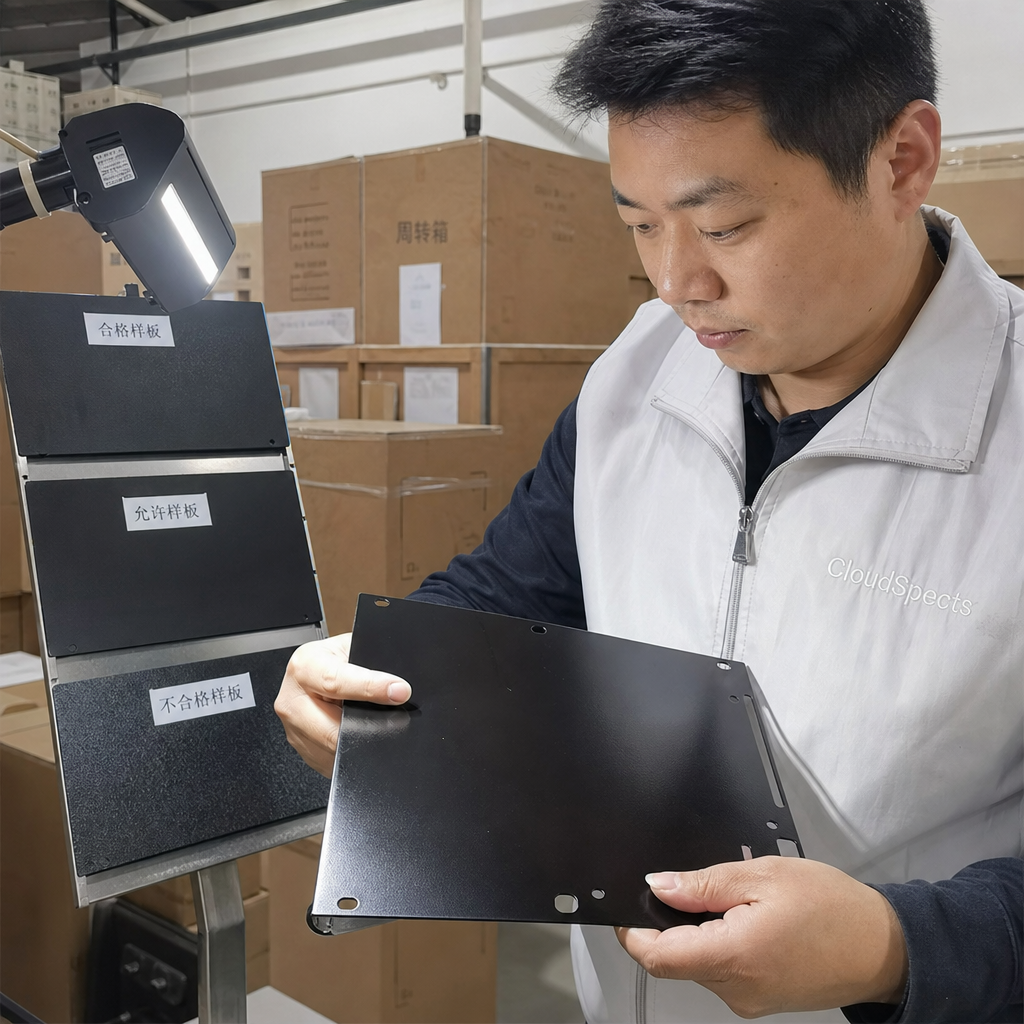
Two people looked at the same shelf and both were right. One felt a paint nib with a thumbnail; the other called it a detail nobody sees at arm's length. The order sat for three days while emails went back and forth — and the factory was not being difficult, it simply had no agreed picture of "acceptable". That is the gap a limit sample board closes. The pages behind china pre-shipment inspection explain how a batch is sampled and judged; this article is about the visual half of that judgement, the half that usually has no written standard at all.
We inspect 2,000+ orders a year from $169 per man-day, and the most common cause of a disputed verdict is not a bad inspector or a dishonest factory. It is a specification that says smooth finish instead of no scratch longer than 15 mm, invisible at 60 cm. A report within 24 hours is worthless if nobody agrees what counts as a defect.
🎯 Five Reasons the Same Batch Gets Two Verdicts
| What is missing | What happens on the line | What it costs you |
|---|---|---|
| No physical reference | Inspector and factory QC each compare against memory or an old photo | Days of email, re-inspection, sometimes a needless rework bill |
| No defect classes | "Minor" cosmetic issues get argued one by one | You negotiate 40 small items instead of one standard |
| Different light | Window light, warehouse tube light and a phone torch show different surfaces | Same unit passes in one room, fails in the other |
| No viewing distance or time | One person stares 20 cm away for a minute, the other glances at arm's length | The verdict depends on who walked in first |
| Shift and site drift | Night shift, second plant, new spray booth | A standard that lived in someone's head never travelled |
📸 Three Samples, Not Two
Most teams keep one approved sample. That is enough for function and nowhere near enough for surface quality, because the argument is always about the middle of the range:
Approve — a unit from the signed-off pre-production run, sealed and dated. Limit — the worst unit you will accept: the longest scratch, the largest sink mark, the dullest patch of sheen. Reject — the first unit that is genuinely not acceptable, so the difference between limit and reject is visible rather than theoretical. Anything past it is a defect by definition, which removes most of the debate.
🧪 Six Parts of a Board That Survives a Factory
One: limit samples for every surface the customer will see — front, top, lid, handle, print area. Two: a written defect class for each, in numbers, not adjectives. Three: a colour reference, whether a chip, a plaque or a measured reading. Four: agreed viewing conditions, printed on the sheet. Five: sample codes, so the inspector writes "opposite limit L-02" instead of describing a smudge in three languages. Six: a rule for what the board does not cover — safety, function, electrical and regulated claims are never settled on a cosmetic board.
💡 What You Can and Cannot Standardise
| Standardise with limit samples | Never settle with a limit sample |
|---|---|
| Scratch length and depth, under a defined light | Sharp edges, burrs, pinch points |
| Weld bead appearance, spatter, dressing | Anything electrical, thermal or load-bearing |
| Paint and powder texture, orange peel, gloss bands | Child-safety geometry on regulated products |
| Colour drift, in measured units against a reference | Labelling claims required by a regulator |
| Mould flow lines, sink marks, ejection marks, gate blush | Anything the customer can be injured by |
| Print registration, stitch density, upholstery pull | Dimensions that a mating part depends on |
🔧 Viewing Conditions: The Half Nobody Writes Down
A scratch is a lighting event as much as a surface event. Fix five variables on the sheet and the verdict stabilises: light source and colour temperature, the angle the unit is held at, the distance from the eye, the time spent looking, and whether the surface is cleaned first. Our default is a neutral source around 5,000 K, unit tilted to face the light, viewed at roughly 60 cm for about ten seconds, wiped dry first. Change the room and you have changed the standard — which is how a batch passes on Monday and fails on Wednesday.
🗂️ Custody: Five Rules That Keep the Board Real
Two sets, always: one at the factory on the line, one in your file, both signed and dated. Seal and label each piece with its code, product code, revision and date. Photograph every piece with a scale and the code in frame, because photographs settle arguments when a sample has gone missing. Replace the board when the process changes — new mould, new paint supplier, new plant. And never let the factory keep the only set: a standard that exists only at the supplier is one you cannot enforce.
🏷️ Wiring It Into the Brief and the PO
The board only pays off when paperwork points at it. Write into the QC brief: the sample codes, the viewing conditions, which defects are critical, major and minor, and the disposition for each. Because cosmetic defects are counted as majors or minors, the acceptance arithmetic still comes from the sampling plan — the calculator at our AQL tool shows the accept and reject numbers for your lot size, and per-visit pricing is here. Then put two lines in the PO: a cosmetic standard defined by the signed limit samples attached as an annex, and rework or allowance at the factory's cost for anything past the reject sample. Questions on how that is worded go to our contact page.
📊 One Order: Three Days Lost, Then One Visit
A 3,600-unit matte-black metal wall shelf order, FOB $11.20, had no visual standard beyond "matte black, no visible defects". Our sample of 125 units under AQL 2.5 found 11 with scratches 20 to 35 mm, nine with sink marks, seven with sheen patches, and six with a dull face. The factory answered, reasonably, that all of it was cosmetic and within tolerance, and the argument ran three days. We built three boards from that batch — approve, limit, reject — wrote the viewing conditions, and the visit reopened: 96 units went back for re-spray, the rest were released against a documented code. The rework cost roughly $1,180 plus two days of line time. The next three runs arrived with no cosmetic argument, and first-pass re-inspection on that product moved from about 92 percent to 98 percent.
🤝 Where an Inspector Actually Helps
A third party cannot invent your taste. What we can do is photograph the disputed unit at a measured distance under a stated light, measure the scratch, read the gloss, name the code from your board, and put all of it in a report — so the argument becomes a comparison instead of an opinion. That is also how a rework claim survives a factory that has already been paid.
❓ FAQs
What is a limit sample in quality inspection?
A limit sample is the worst unit the buyer will accept for a defined cosmetic characteristic, kept next to an approved sample and a reject sample. It converts a written adjective such as smooth into a physical reference both sides can point at, which makes a cosmetic verdict repeatable across shifts and visits.
Can a limit sample override a product specification?
No. A limit sample covers appearance only. Safety, electrical, thermal, load-bearing and any regulated labelling claim stay governed by the written specification and the applicable standard, and an inspector should never release a unit that fails those because it matches a cosmetic sample.
How many limit samples do we need per product?
One approved, one limit and one reject for every surface the customer sees or touches, plus a colour reference. On a simple single-surface product that means three pieces; on a five-surface product with print and a handle, expect twelve to fifteen pieces plus the colour reference.
Do limit samples expire?
They need review whenever the process changes: new mould, new paint or powder supplier, new plant, new shift pattern. Materials also age, so replace boards at least annually and keep the retired set as a dated record rather than discarding it.
How do we photograph a cosmetic defect so it holds up in a claim?
Use a fixed light source and distance, include a scale, and get the sample code and unit number in the frame with the defect. A close-up with no scale or identifier is easy to dispute: the factory can argue it shows a different unit under different light.
Frequently asked questions
What is a limit sample in quality inspection?
A limit sample is the worst unit the buyer will accept for a defined cosmetic characteristic, kept next to an approved sample and a reject sample. It converts a written adjective such as smooth into a physical reference both sides can point at, which makes a cosmetic verdict repeatable across shifts and visits.
Can a limit sample override a product specification?
No. A limit sample covers appearance only. Safety, electrical, thermal, load-bearing and any regulated labelling claim stay governed by the written specification and the applicable standard, and an inspector should never release a unit that fails those because it matches a cosmetic sample.
How many limit samples do we need per product?
One approved, one limit and one reject for every surface the customer sees or touches, plus a colour reference. On a simple single-surface product that means three pieces; on a five-surface product with print and a handle, expect twelve to fifteen pieces plus the colour reference.
Do limit samples expire?
They need review whenever the process changes: new mould, new paint or powder supplier, new plant, new shift pattern. Materials also age, so replace boards at least annually and keep the retired set as a dated record rather than discarding it.
How do we photograph a cosmetic defect so it holds up in a claim?
Use a fixed light source and distance, include a scale, and get the sample code and unit number in the frame with the defect. A close-up with no scale or identifier is easy to dispute: the factory can argue it shows a different unit under different light.