Made in a Cold Factory: 6 Winter Faults Your Q1 Order Will Hide
❄️ Your Q1 order is probably being made in a building nobody heats. Cold-weather production is the most common reason an order looks flawless in November and fails in February — and the faults it leaves are measurable.
❄️ Your Q1 order is probably being made in a building nobody heats. Cold-weather production is the most common reason an order looks flawless in November and fails in February — and the faults it leaves are measurable. That list rides along with a standard pre-shipment inspection in China from $169 per man-day.
🌡️ Why the same factory makes different goods in January
Three things change when the temperature drops, and none appear on your spec sheet. Adhesives stop curing. Hot-melt for edge banding and carton glue, laminating film and label adhesive all have a working temperature — most hot melts need a surface above roughly 10 °C to wet out properly, and an unheated assembly bay in Zhejiang in January sits below that. Plastics get brittle. PVC, PP and ABS all lose impact strength as they cool, so a clip or hose cuff that bends in June snaps in January. Labour changes. The weeks before the holiday are the most rushed production of the year, and third shift is usually the newest crew on the floor. The batch then passes a warm visual check and fails in a heated warehouse where nobody can prove where the fault came from.
🧪 Fault 1: adhesive and edge banding that releases
Pull a finished panel corner, then tape-test the banding seam and flex the joint after a full day of ambient cure. Alongside it we record three numbers: plant temperature at shift start, line speed and glue pot temperature. Hot-melt run 15 °C cold looks perfect on the line and lets go in a warm container. Ask for a cure-in-place sample — panels banded this morning, left in the same cold room, tested tomorrow.
🧊 Fault 2: brittle plastics and cold-snap failures
Impact failures are seasonal: a mounting bracket or snap-fit lid that survives a one metre drop at 25 °C can shatter at 5 °C. Two checks settle it — cold-flex the cable jackets and hoses and look for whitening at the bend, then drop-test the packed unit at the temperature the goods will actually meet in transit. If your shipment sails in December, testing at room temperature proves nothing about the units in the container.
🎨 Fault 3: coating that is dry but not cured
A low-temperature paint or powder booth produces a finish that is tack-free in five minutes and not fully cross-linked for days. Scratch it, bend it, cross-cut it — un-cured coating fails a fingernail and a tape test, then smears or blisters in a customer's hand. Colour drifts too, because the same paint sprayed in a colder booth reads differently against your signed standard, which is why we measure with the standard sample in the frame instead of judging by eye. And check the ventilation: a booth closed up for warmth traps solvent.
💧 Fault 4: condensation the moment the container warms
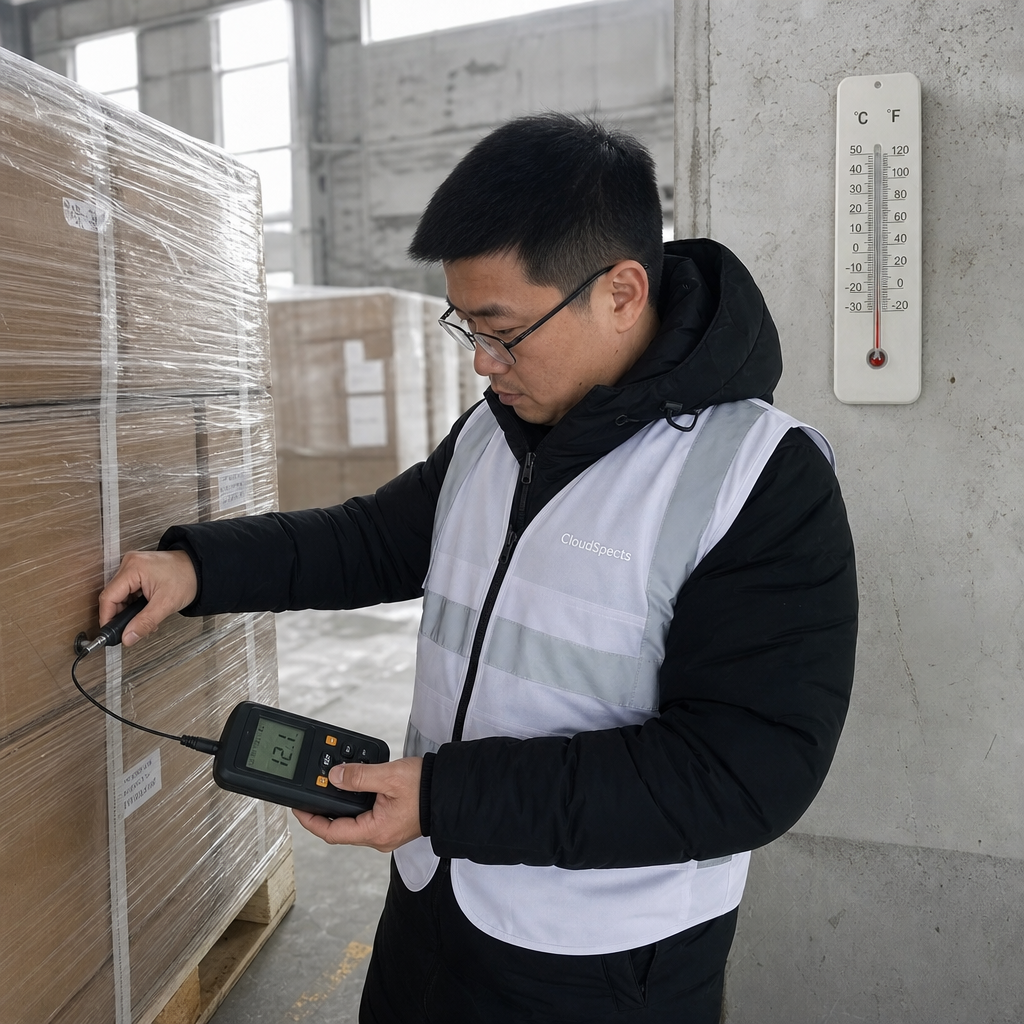
Cold cargo in a warm climate is a moisture pump. Goods packed in a 5 °C warehouse cross the equator in a container whose inner surfaces swing far warmer than the cargo; water condenses on cartons and steel, and the doors open on damp board and mouldy fabric three to five weeks later. The checks that matter before the doors close: cargo moisture content, poly bag gauge and seal, moisture barrier, and desiccant quantity and placement — on top of the load, not tucked at the bottom. We meter the cargo moisture and photograph the reading.
🔋 Fault 5: batteries and electronics in a cold plant
Lithium packs lose capacity when cold and should never be charged below freezing; a cold-charged cell can plate lithium and fail weeks later — exactly the intermittent complaint that wrecks a listing's rating. On a winter visit we run endurance tests after a warm-up rather than on a cold-start unit, and log pack voltage before and after. Then the static question: dry heated air plus synthetic workwear turns an assembly bench into a generator, so we verify that ESD straps, mats and bench grounds are connected rather than merely hanging on the wall.
⚡ Fault 6: the pre-holiday rush, and the date code that proves it
Every unit made in the final weeks before the holiday should carry a date code that maps to a line and a shift. That is how we separate calm October production from the December crunch — and how one bad week does not get to judge a whole shipment. We ask for finished goods by date code, sample across them and compare defect rates between weeks. Temp workers, fresh moulds and overtime never show up on a spec sheet, but they show up in the codes.
📋 The winter brief: six numbers on one page
Write the winter version of your inspection order before the first cold batch, not after the first complaint. It is one page, and it ends the argument that always follows a February return:
| Fault | What we measure | Why a warm check misses it |
|---|---|---|
| Edge banding / adhesive release | Plant and surface temperature, glue pot temperature, 24-hour cure, seam tape test | Bond looks perfect on the line; only a full cure shows the release |
| Cold-snap plastics | Cold flex on jackets and hoses, drop test at transit temperature | A 25 °C drop test passes units that shatter at 5 °C |
| Un-cured coating | Cross-cut, bend and fingernail checks; colour against the signed standard | Tack-free is not cured; a closed booth hides trapped solvent |
| Container condensation | Cargo moisture reading, bag seal, barrier, desiccant placement | Nothing looks wrong until the cargo warms up mid-voyage |
| Cold battery / static damage | Voltage before and after warm-up run, ESD strap and mat continuity | Cold-start passes; cold-charge and static failures surface later |
| Pre-holiday rush | Date code by week and shift, defect rate per code | A whole-lot average hides one bad week |
💰 A 4,800-set order where the cold batch nearly shipped
Case: 4,800 stacking storage drawer sets at $12.40 FOB = $59,520, produced in an unheated plant in the final weeks before the holiday. Two man-days on site, $338, found edge banding releasing on 6.4% of sampled panels after a 24-hour ambient cure, a desiccant plan that put nothing above 40% of the load, and 22 units failing a cold drop test that had passed at room temperature. The factory re-cured and re-banded 310 sets in three days. Left alone, those faults land as retail returns at $26.99 each, plus removal fees, plus air replacements. The comparison is never $338 against nothing — it is $338 against the retail value of everything that escapes, and our reports come back typically ~24 hours after the visit, fast enough to hold the container. After 2,000+ inspections, the winter visits are the least glamorous and the most profitable ones we run.
Book the visit for the coldest week of the run, and check sampling questions against our AQL calculator before you sign off. Rates are on the pricing page, and scoping a cold-weather visit takes one message on the contact page.
❓ FAQs
Can a factory really produce worse goods in winter?
Yes — usually the process rather than the people. Adhesives, coatings and plastics all have minimum working temperatures, and an unheated plant drops below them for part of the shift. The goods still look right on the line; the failure shows after a full cure or a cold drop test.
What temperature should the plant be for my order?
Whatever your process needs, written down. For most hot-melt and water-based processes that means keeping the working surface above roughly 10 °C and letting finished goods cure there, rather than moving them into a cold store. Ask the factory to log shift-start temperature with the inspection booking.
How do I stop condensation damage on cold-packed cargo?
Treat it as a loading-day check: meter cargo moisture, confirm bag seals and the moisture barrier, and put desiccant on top of the load as well as inside the cartons. Once the doors close you cannot fix it — the damage shows weeks later as damp board and mould.
Should I test cold-start or after warm-up for electronics?
Both are useful, but record which one you ran. Functional and endurance tests should run after a warm-up so the result reflects the product; charging a battery below freezing is a failure mode you should never accept, so log pack voltage before and after.
Does a winter inspection cost more?
No. It is a standard man-day from $169 and these checks fit inside your normal pre-shipment scope. The only real constraint is timing: book it for the coldest week of production, not the week that is convenient.
Frequently asked questions
Can a factory really produce worse goods in winter?
Yes — usually the process rather than the people. Adhesives, coatings and plastics all have minimum working temperatures, and an unheated plant drops below them for part of the shift. The goods still look right on the line; the failure shows after a full cure or a cold drop test.
What temperature should the plant be for my order?
Whatever your process needs, written down. For most hot-melt and water-based processes that means keeping the working surface above roughly 10 °C and letting finished goods cure there, rather than moving them into a cold store. Ask the factory to log shift-start temperature with the inspection booking.
How do I stop condensation damage on cold-packed cargo?
Treat it as a loading-day check: meter cargo moisture, confirm bag seals and the moisture barrier, and put desiccant on top of the load as well as inside the cartons. Once the doors close you cannot fix it — the damage shows weeks later as damp board and mould.
Should I test cold-start or after warm-up for electronics?
Both are useful, but record which one you ran. Functional and endurance tests should run after a warm-up so the result reflects the product; charging a battery below freezing is a failure mode you should never accept, so log pack voltage before and after.
Does a winter inspection cost more?
No. It is a standard man-day from $169 and these checks fit inside your normal pre-shipment scope. The only real constraint is timing: book it for the coldest week of production, not the week that is convenient.