Sample or Screen Every Unit? The Math That Decides Your QC Plan
Sample the lot, or screen every single unit? The answer is arithmetic, not taste. A sample is a statistical bet with a published acceptance rule; a full screen is a labour line item with a cost per unit.
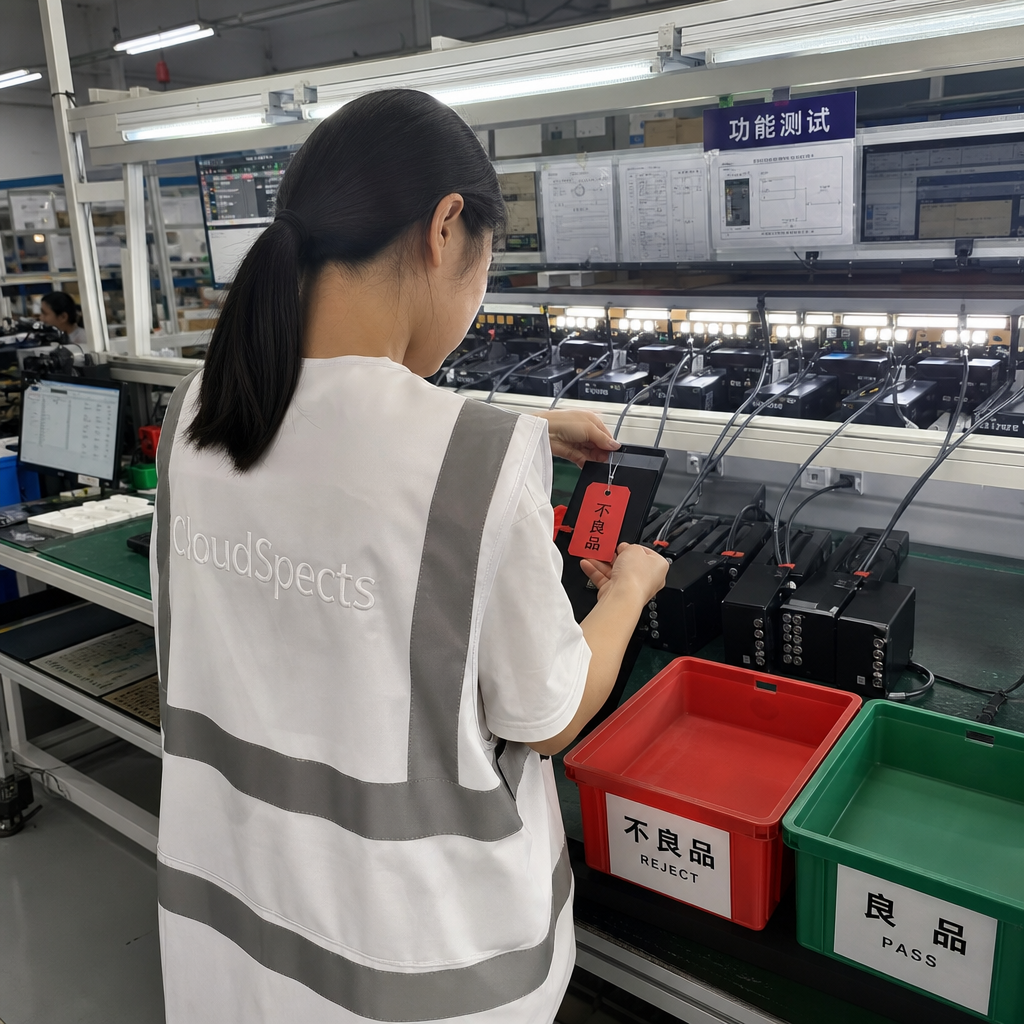
Sample the lot, or screen every single unit? The answer is arithmetic, not taste. A sample is a statistical bet with a published acceptance rule; a full screen is a labour line item with a cost per unit. CloudSpects runs both every week in China, and the coverage you choose is what gets priced on our China pre-shipment inspection page.
The short version, before the maths: if one escaped unit costs more than it costs to test twenty units, screen every unit. If it costs less, a properly drawn sample is the better trade.
🎯 What a sample actually promises
AQL 2.5 at general inspection level II is the plan most importers write into a purchase order. It fixes the sample size from the lot size and sets an acceptance number. What it does not do is promise a clean lot, and the gap between those two things is where the surprise lives.
| Lot size | Sample at AQL 2.5, Level II | Accept | If the lot truly runs 3% defective |
|---|---|---|---|
| 501 – 1,200 | n = 80 | 5 | ~2.4 defectives in the sample — the plan passes |
| 1,201 – 3,200 | n = 125 | 7 | ~3.8 defectives — the plan passes |
| 3,201 – 10,000 | n = 200 | 10 | ~6.0 defectives — the plan passes |
A 3% fault rate is a bad lot by anyone's measure, and all three plans will normally accept it. Sampling is a filter with a calibrated leak, so the useful question is never "did it pass?" but "what did passing still let through?"
🔢 The four numbers you need before you choose
One: the defect rate you would actually bet on. Not the rate you hope for — the rate your last three lots produced, or the rate a during-production visit measured at 20–30% of the build. One sample of 125 units gives a point estimate rather than a guarantee, so plan with it as a range.
Two: what one escape costs you. Landed FOB cost, plus the customer's refund, plus return handling, plus removal or disposal, plus the review it leaves behind. For a $12 item that is often $16–19 all-in; for a $60 item it climbs past $75.
Three: what it costs to screen one unit. Not a feeling — a stopwatch. A functional screen for a small product runs around 100 units per inspector-hour; anything needing a charge, a cycle or a load takes longer. At $169 per man-day, a hundred units an hour works out to roughly $0.21 per unit tested.
Four: how many bad units the sample plan would release. Multiply the defect rate by the quantity. That figure is the exposure the plan is carrying, and it is the number a full screen has to beat to earn its hours.
⚖️ Three coverage plans, three price tags
| Plan | What it proves | Cost on a 3,000-unit lot |
|---|---|---|
| AQL 2.5 sample only | Condition, key dimensions and a function check on 125–200 units | 1–2 man-days, $169–$338 |
| Sample plus a 100% screen on critical characteristics | Every unit function-tested; appearance and packaging sampled | About 15 inspector-hours, roughly $320 |
| 100% screen on everything | Every unit touched for function, finish, accessories and packing | 30+ inspector-hours, $640 and up, plus days |
The middle row wins most often. Screen the two or three characteristics that kill a listing — power-on and function, battery, connector, seal — and sample everything else. Sampling appearance across 200 units catches a bad print run about as reliably as screening 3,000 of them, because a printing fault is not intermittent.
🧰 Five lots that should be screened unit by unit
Intermittent faults. A joint that fails on the third press, a sensor that reads dry when wet, a switch that sticks once in twenty cycles. These hide behind small samples and reappear as one-star reviews three weeks after launch.
Anything a child can reach, or anything mains-powered. The cost of one escaped unit is not the refund. It is the incident.
Mixed date codes or unverifiable serials. If two production runs, or a second line, sit inside the same carton, a sample cannot tell you the ratio between them.
High unit value. When the item is worth $60 and the screen costs $0.40, there is no discussion to have.
Small lots under about 500 units. On a 300-unit lot the sample is 32–50 units and the acceptance number is tiny, so a small defect cluster flips the verdict. Touching all 300 is a rounding error against the freight.
⏱️ What screening costs in hours, not opinions
Screening is priced in inspector-hours and paid for in scheduling. A 6,000-unit screen at 100 units an hour is 60 hours — a week of one inspector's time. What you cannot do is compress 60 hours of testing into one shift and call the result a full screen.
📦 Case: 4,400 rechargeable work lights
A 4,400-unit lot of rechargeable COB work lights out of Zhejiang, FOB $12.40, which is $54,560 sitting at the factory. Round-trip transport and handling on one returned unit runs about $17 with the $12.40 write-off inside it.
A during-production visit at 22% of the build measured a 3.1% rate of an intermittent switch fault: the light powers on, drops out under load, then works again when the inspector tries it a second time. On a sample plan alone that lot would very likely ship, because at 3.1% the expected defectives in a 200-unit sample sit near 6 against an accept number of 10. The exposure was 4,400 × 3.1%, roughly 136 units — about $2,300 in refunds, removal and handling.
We screened function and battery on all 4,400 units at two benches running 200 units an hour combined: 22 inspector-hours, about $465. The screen flagged 129 units, all matching the DPI pattern, and the factory reworked them inside its own production window with nine days to spare before the vessel. Appearance and packaging stayed on a 200-unit AQL 2.5 sample. Total spend on the lot was two man-days of DPI and pre-shipment work plus under half a man-day of screening, against an exposure roughly five times that size.
❓ FAQs
Does a passed AQL 2.5 inspection mean the lot is clean?
No. The plan does what it says: on a 3% defective lot of 1,201 to 3,200 units, a 125-unit sample expects about 3.8 defectives against an accept number of 7, so the lot normally passes with the faults still inside it. A pass means the lot is consistent with the agreed quality level, not that it is free of defects.
How many units can one inspector screen in an hour?
For a small product with a simple functional check, around 100 units per inspector-hour is a fair planning number. Anything that needs a charge cycle, a load test or a paired pairing test takes longer, and we quote those screens in hours rather than in units so the number is honest.
When is a 100% screen a waste of money?
When the escape cost is low and the process is stable: a cheap accessory, a mature factory, no safety exposure, no intermittent fault pattern in the last three lots. In that case the screen costs more than the expected escapes, and the same budget buys a second visit during production instead.
Can you screen part of a lot rather than all of it?
Yes, and that is usually the right answer. We apply a 100% screen to the two or three characteristics that kill a listing - power and function, battery, connector, seal - while appearance, print and packaging stay on an AQL 2.5 sample. It is a two-tier plan, and it is what most of our Q4 lots actually run.
When should a full screen be booked?
When the lot is about 70% complete, not on the afternoon before loading. A 6,000-unit screen at 100 units an hour is 60 inspector-hours, and that many hours cannot be compressed into one shift without missing exactly the intermittent faults the screen exists to find.
💰 Pricing and how to book
CloudSpects has completed 2,000+ factory inspections for Amazon sellers and direct importers. The rate is $169 per man-day in China and the written report typically reaches you within about 24 hours of the visit. Send the specification, the quantity and the one characteristic you cannot afford to miss through the contact page, and we will tell you which of the three plans fits the lot — including the lots where the honest answer is "sample only". Standard coverage sits on the pricing page, and if sampling is what your plan calls for, size it yourself with the AQL calculator.
Frequently asked questions
Does a passed AQL 2.5 inspection mean the lot is clean?
No. The plan does what it says: on a 3% defective lot of 1,201 to 3,200 units, a 125-unit sample expects about 3.8 defectives against an accept number of 7, so the lot normally passes with the faults still inside it. A pass means the lot is consistent with the agreed quality level, not that it is free of defects.
How many units can one inspector screen in an hour?
For a small product with a simple functional check, around 100 units per inspector-hour is a fair planning number. Anything that needs a charge cycle, a load test or a paired pairing test takes longer, and we quote those screens in hours rather than in units so the number is honest.
When is a 100% screen a waste of money?
When the escape cost is low and the process is stable: a cheap accessory, a mature factory, no safety exposure, no intermittent fault pattern in the last three lots. In that case the screen costs more than the expected escapes, and the same budget buys a second visit during production instead.
Can you screen part of a lot rather than all of it?
Yes, and that is usually the right answer. We apply a 100% screen to the two or three characteristics that kill a listing - power and function, battery, connector, seal - while appearance, print and packaging stay on an AQL 2.5 sample. It is a two-tier plan, and it is what most of our Q4 lots actually run.
When should a full screen be booked?
When the lot is about 70% complete, not on the afternoon before loading. A 6,000-unit screen at 100 units an hour is 60 inspector-hours, and that many hours cannot be compressed into one shift without missing exactly the intermittent faults the screen exists to find.