The Battery a Toddler Could Swallow: 6 Coin-Cell Checks for Q4 Gift Orders
🎁 The Gift Item on Your Q4 Sheet Is a Compliance Product Now Three thousand LED candles. A pallet of remote-controlled toys.
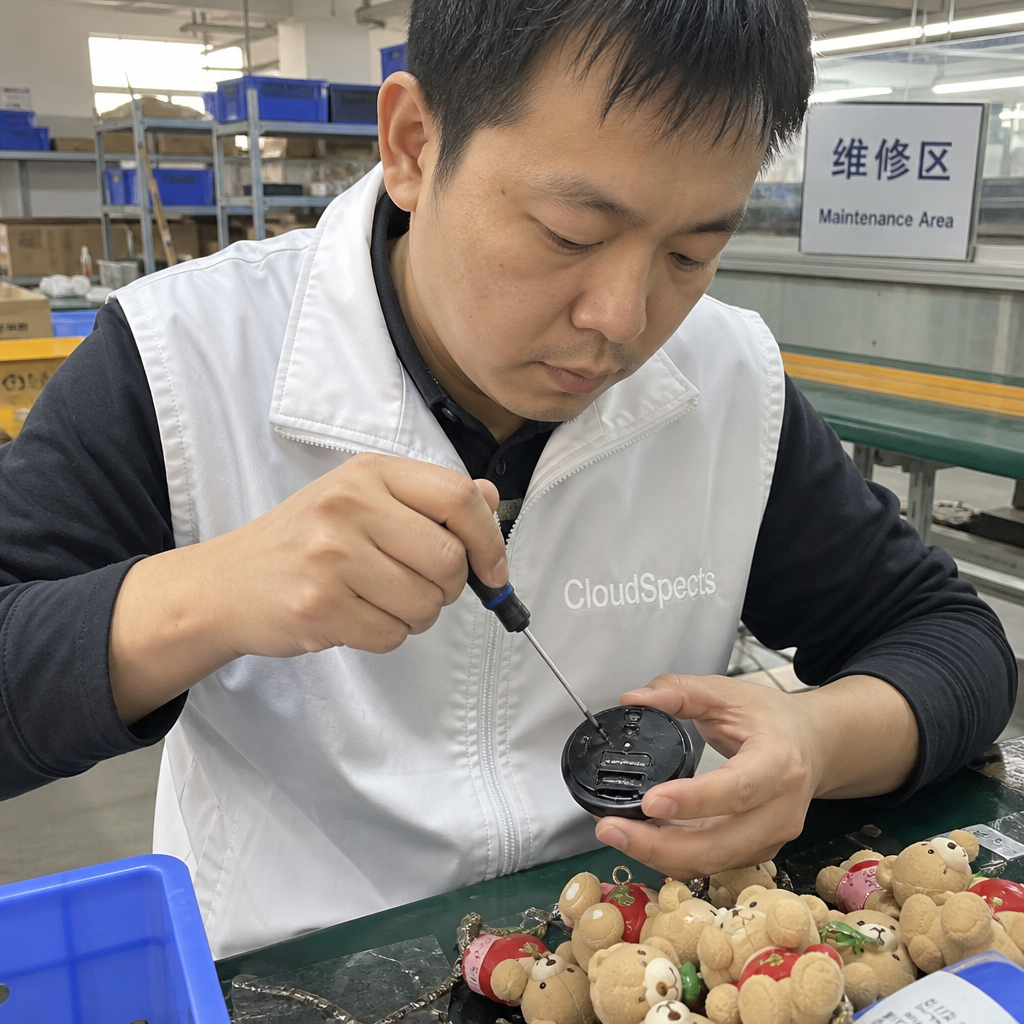
🎁 The Gift Item on Your Q4 Sheet Is a Compliance Product Now
Three thousand LED candles. A pallet of remote-controlled toys. Keychain lights, singing plush, a novelty clock with a coin cell taped inside. Nothing about the product changed this year — what changed is the paperwork behind it. Since 23 October 2023, any consumer product containing a button cell or coin battery must meet 16 CFR 1263, the rule CPSC wrote under Reese's Law (88 FR 65295).
The cheapest place to prove you shipped a compliant lot is the factory floor, before the cartons close. That is the visit our inspectors run as a pre-shipment inspection in China: samples come off sealed cartons, the battery compartment gets abused the way a two-year-old would abuse it, and you find out while the goods are still in the building — not after a safety complaint lands on your listing.
🚨 The Rule, Stripped to the Parts a Factory Can Fail
Here is what the regulation asks for, and what that looks like on the floor.
| Requirement (source: 88 FR 65295) | On paper | What we verify at the factory |
|---|---|---|
| §1263.3 — a product containing button or coin batteries must comply with ANSI/UL 4200A (approved 30 August 2023) | test report or declaration from the factory | compartment must not open under normal use: it needs a tool, or two independent motions, to release |
| §1263.4(b)(1) — the principal display panel carries the warning label; the icon is at least 8 mm (0.3 in) across | retail packaging artwork | the printed panel, icon measured with calipers, not eyeballed |
| §1263.4(b)(2) — if space is tight, the icon (at least 20 mm) goes on the principal panel and the text on the secondary panel | artwork pair | both panels checked on the actual finished carton |
| §1263.4(a)(5) — the signal word "WARNING" in black letters on an orange background, sans serif capitals, preceded by the safety alert symbol | artwork | contrast, letter case and symbol alignment on the printed box |
| §1263.4(b)(3) — the statements "Keep in original package until ready to use" and the disposal instruction must be addressed | artwork | wording present, legible, and not lost inside a fold or a barcode block |
| §1263.1(c) — toys are exempt only if they already meet 16 CFR 1250 battery accessibility and labelling | toy test report | exemption claimed in writing with evidence, not assumed because the buyer said toy |
Two exemptions get misused in quotes. Zinc-air button cells are excluded outright because CPSC determined they do not present an ingestion hazard (§1263.1(d)). And a toy is not exempt just because a child plays with it — the exemption runs through 16 CFR 1250, a document you either hold or you do not.
🔧 Checks 1–3: The Compartment, Where the Real Harm Lives
The scope is blunt: the rule exists to stop children six and younger from swallowing a cell, so the compartment is where we spend the most time.
Check 1 — the thumb test. Open the retail box, take the unit out, and try to open the battery door with fingers and fingernails only, the way a curious child would. If the door lifts with a thumbnail, that is a critical, not a cosmetic major. Photograph the door, the coin used to open it if any, and the deflection of the plastic tab in one frame.
Check 2 — the two motions. A compliant design usually needs a screwdriver, or a press-and-slide sequence that a small hand cannot hold. We count the release actions on ten units and note any unit where one motion is enough. Suppliers love to "simplify the tooling" in week three of a Q4 run; this is where that simplification shows up.
Check 3 — abuse, then retry. We drop the packed retail box ten times from one metre onto concrete, then attempt the thumb test again. A latch that survives a clean assembly line can still pop after a carton is thrown onto a pallet twice. Any unit that opens afterwards goes into the report as a critical, serialised and photographed.
🏷️ Checks 4–6: Wording, Permanence and the Spare Cell
Check 4 — permanence. The rules require warning statements to be clearly visible, prominent, legible and permanently marked, in contrasting colour, in English. Twenty firm wipes with an alcohol pad across the warning block: artwork that ghosts off on wipe twelve is a print problem, cheaper to fix at the printer than at a 3PL.
Check 5 — instructions. The rule covers the manuals that ship with the product too, so a handsome insert proves nothing if the safety statement is missing. We read five shipping manuals, not the artwork PDF.
Check 6 — the spare cell. Factories routinely toss two spare cells into a plain poly bag. Once those cells ship with a consumer product, the packaging rules follow them: the warning label and icon travel with the battery packaging. A generic bag with no icon is the most common finding in this checklist — and the cheapest to fix, which is exactly why it gets forgotten.
📊 The Math on a Missed Coin Cell
A recent Q4 run: 3,400 LED gift candles, FOB $6.40, order value $21,760. AQL 2.5 Level II sampling on sealed cartons — n=200. Seven units opened with a thumbnail after the drop sequence. Eleven cartons carried last season's artwork, missing the disposal statement. Four bags of spare cells had no warning icon at all.
Rework: 260 units re-latched, artwork replaced on 11 cartons, spares re-bagged and re-labelled — three days at the factory, two man-days of inspection to verify the fix (1.2% majors on the retest, all cosmetic). At $169 per man-day, with reports typically within 24 hours, the intervention lands near $338 plus factory downtime.
The alternative is not a fine. It is a removal, a relabel programme you pay for twice, and a listing sitting behind a safety complaint while a buyer decides whether to trust you again. Across 2,000+ inspections a year, the pattern is consistent: compliance gaps are always cheaper to fix before the container doors close.
📦 Five Lines for Your PO
Put this in the purchase order and the argument is over before it starts. One: the battery compartment requires a tool or two independent motions and must not open after the standard abuse sequence. Two: retail artwork carries the full warning set of §1263.4, with the icon dimensioned in millimetres. Three: spare cells only in compliant packaging. Four: English instructions in every retail box. Five: balance released against a third-party inspection report, not against a photo from the line.
Sampling this yourself? The AQL calculator shows what a 3,400-unit lot needs. Want the visit planned around your sailing date? Send us the dates early — peak-season calendars fill from the front.
❓ FAQs
Does 16 CFR 1263 apply if I only sell on Amazon?
Yes. The rule attaches to consumer products in the United States market, and marketplace listings are exactly where safety complaints surface fastest. The channel does not change the requirement; it only changes how quickly a failure becomes public.
Can CloudSpects certify UL 4200A compliance?
No, and be careful with anyone who says they can. Compliance with ANSI/UL 4200A is a product test that belongs with an accredited laboratory. What we do is verify the physical evidence on the floor: compartment security, the drop-then-retry test, label wording and permanence, spare-cell packaging, and whether the documents your supplier is claiming actually exist.
What is the most common coin-cell finding you see?
Artwork, by a wide margin. The product is often fine while the printed box is a season behind, missing the disposal statement or the correct icon size. It is also the one finding a printer can fix in a week, which is why we flag it early rather than at final packing.
How many units do you sample at the factory?
For a lot in the 3,201 to 10,000 range we sample 200 units at AQL 2.5 Level II as a baseline, then add targeted units for the compartment abuse test. Sampling tables confuse a lot of buyers, so we publish the numbers rather than asking you to trust them: the AQL calculator on our site shows the code letter and acceptance figures for your quantity.
How fast do we get the report?
Typically within 24 hours of the visit, with photographs numbered to each defect and a clear critical, major, minor split. That timing leaves room for a rework and a retest before your cut-off, which is the whole point of inspecting before the cartons close.
Frequently asked questions
Does 16 CFR 1263 apply if I only sell on Amazon?
Yes. The rule attaches to consumer products in the United States market, and marketplace listings are exactly where safety complaints surface fastest. The channel does not change the requirement; it only changes how quickly a failure becomes public.
Can CloudSpects certify UL 4200A compliance?
No, and be careful with anyone who says they can. Compliance with ANSI/UL 4200A is a product test that belongs with an accredited laboratory. What we do is verify the physical evidence on the floor: compartment security, the drop-then-retry test, label wording and permanence, spare-cell packaging, and whether the documents your supplier is claiming actually exist.
What is the most common coin-cell finding you see?
Artwork, by a wide margin. The product is often fine while the printed box is a season behind, missing the disposal statement or the correct icon size. It is also the one finding a printer can fix in a week, which is why we flag it early rather than at final packing.
How many units do you sample at the factory?
For a lot in the 3,201 to 10,000 range we sample 200 units at AQL 2.5 Level II as a baseline, then add targeted units for the compartment abuse test. Sampling tables confuse a lot of buyers, so we publish the numbers rather than asking you to trust them: the AQL calculator on our site shows the code letter and acceptance figures for your quantity.
How fast do we get the report?
Typically within 24 hours of the visit, with photographs numbered to each defect and a clear critical, major, minor split. That timing leaves room for a rework and a retest before your cut-off, which is the whole point of inspecting before the cartons close.