The Failure-Multiplier Framework — Why Inspection Cost Is More Than a Percentage of COGS
The Failure-Multiplier Framework Why Inspection Cost Is More Than a Percentage of COGS A 5% defect rate at the factory becomes 23% effective cost when you include the multiplier www.
The Failure-Multiplier Framework
Why Inspection Cost Is More Than a Percentage of COGS
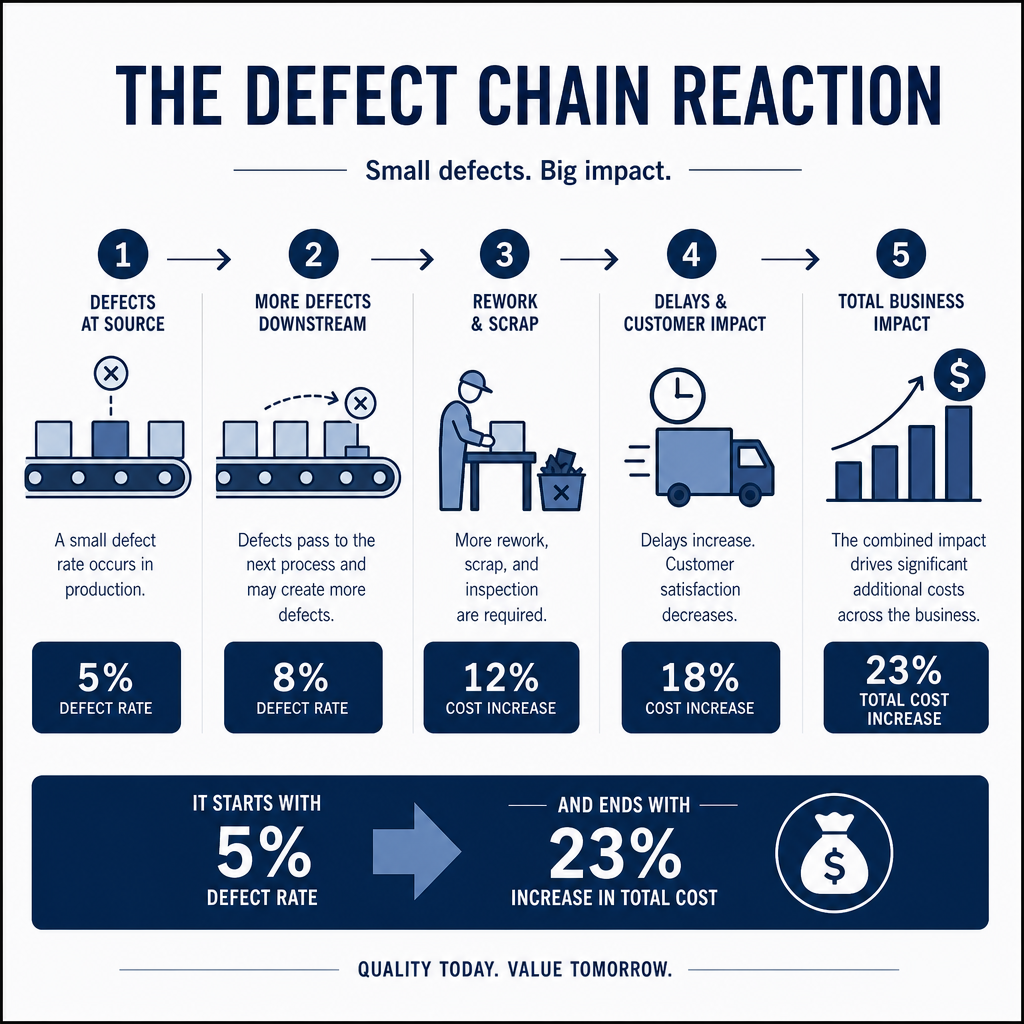
A 5% defect rate at the factory becomes 23% effective cost when you include the multiplier
www.cloudspects.com — Pre-Shipment Inspection & Quality Control
The Problem With "Inspection Is 5% of COGS"
Every FBA seller has heard the rule of thumb: budget 3-5% of COGS for quality inspection. This framework is misleading because it treats inspection as a flat cost line item rather than an insurance premium against a cascading loss chain.
The failure-multiplier framework reveals the real equation: a 5% defect rate at the factory does not cost you 5% of your inventory value. It costs you 23% when you factor in return shipping, Amazon disposition fees, lost sales rank, and customer acquisition cost for replacement units.
5% factory defect rate → 23% effective cost — a 4.6x failure multiplier.
Breaking Down the Failure Multiplier
1. The Direct Product Cost (5%)
If 5% of your $10,000 order is defective, you have $500 in bad product at manufacturing cost. This is the number most sellers stop at — and it is the smallest number in the chain.
2. The Amazon Disposition and Restocking Fee (Adds 8%)
Amazon charges removal fees of $0.50-1.50 per unit for defective inventory, plus a $0.40/unit inbound defect fee if the defect is caught at receiving. For a $10,000 order at $10/unit, that is 50 defective units at $1.80 each = $90 — nearly 1% of total order value added on top.
3. The Lost Sales Rank Penalty (Adds 10-15%)
Defective units that reach customers generate negative reviews. A single drop from 4.5 to 4.0 stars reduces conversion by 12% on average. For a listing doing $10,000/month, that is $1,200/month in lost revenue until the rating recovers — often 2-3 months of suppressed sales.
5% — Direct product loss (defective unit cost)
8% — Disposition + restocking + inbound fees
10-15% — Lost sales from rating damage + rank drop
How This Changes the Inspection Decision
When you stop thinking of inspection as a 3-5% line item and start treating it as insurance against a 4.6x failure multiplier, the decision becomes obvious. An inspection costing $279 on a $10,000 order (2.8% of COGS) prevents a potential $2,300 loss chain — a return of 8.2x on the inspection fee.
And this is before factoring in opportunity cost: the 2-3 weeks of supply chain delay from discovering defects post-shipment versus pre-shipment. The failure-multiplier framework shows that sellers who cut inspection to save 2.8% are actually risking 23% of their effective inventory cost.
How to Apply the Failure-Multiplier Framework
Stop evaluating inspection as "% of COGS." Instead, calculate: (Unit price × Order quantity × Failure rate × 4.6) = Expected loss without inspection. Compare that to the inspection quote. If inspection prevents half the defects (conservative), you break even on an inspection that costs 8-10% of COGS.
At CloudSpects, we help sellers apply this framework with transparent pricing — no hidden multipliers, just the real cost of catching defects before they compound.
Note: The 4.6x failure multiplier is an average across hardlines and softlines. Electronics have a higher multiplier (6.2x) due to higher return rates and stricter Amazon performance thresholds.
#AmazonFBA #InspectionCost #FailureMultiplier #QualityControl #PreShipmentInspection #FBASeller #CloudSpects
Related Articles
- Inspection Cost: Stop Budgeting by % of COGS — Use the Failure-Multiplier Framework
- How to Read an FBA Pre-Shipment Inspection Report — 3 Numbers That Matter More Than the Pass/Fail Result
- Amazon FBA Return Rate by Product Category — 2025 Data on Which Defects Cost You the Most and How Pre-Shipment Inspection Cuts Losses by 73%