The Show Line: 7 Things Factories Do on Inspection Day (and How a Good Inspector Shuts Them Down)
Ask any buyer who has inspected in China for a few years and you will hear a version of the same sentence: the line you are about to see is not the line that ran last week .
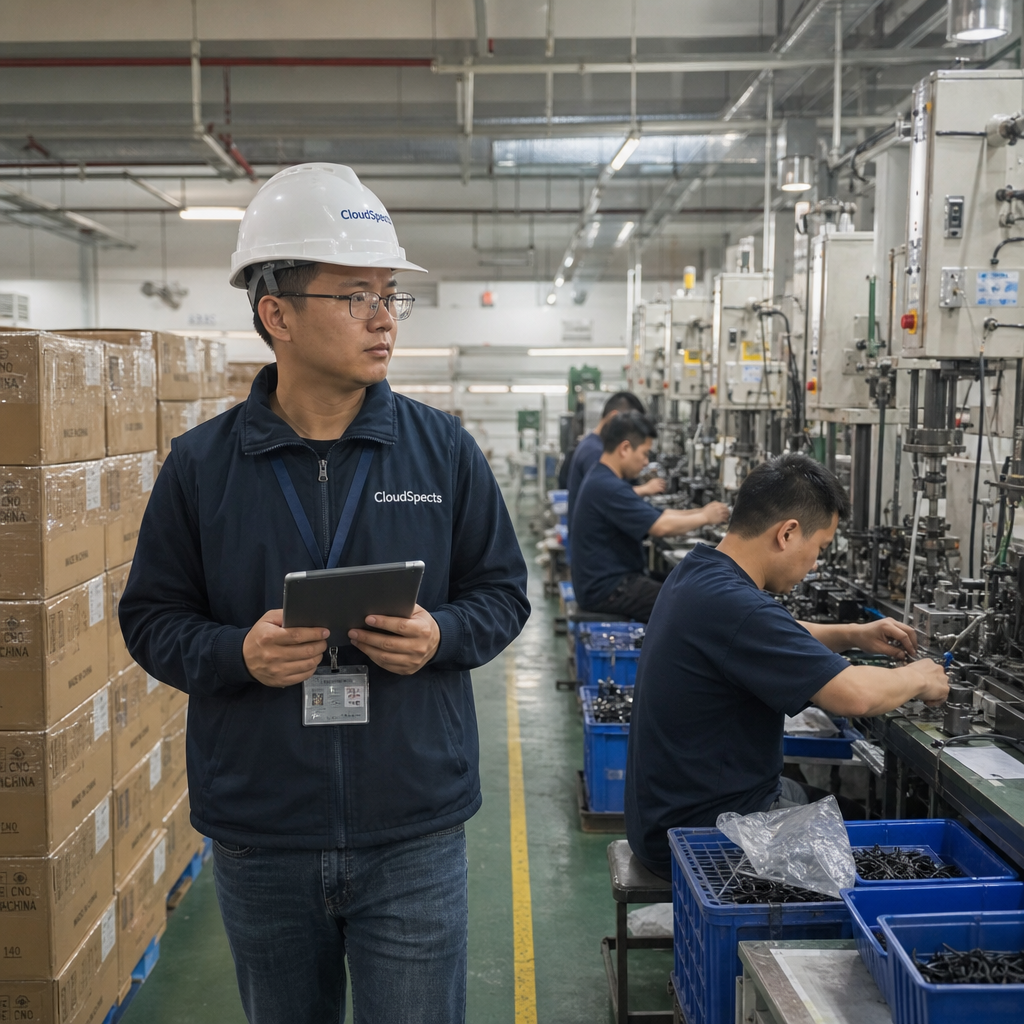
Ask any buyer who has inspected in China for a few years and you will hear a version of the same sentence: the line you are about to see is not the line that ran last week. Inspection day is a performance, and almost all of it is legal. Below are the seven moves we see most often across 2,000+ inspections a year, and the counter-measure our inspectors use against each one. 🎭🧾
Why Inspection Day Becomes a Performance
A factory is not lying when it puts its three fastest operators on station one, or when it sweeps the floor the night before your visit. It is optimising for the visit, because a failed inspection delays a payment and a container. That behaviour is rational.
It is also why the value of a third-party inspection comes from how the sample is drawn, not from how attentive the inspector looks while standing next to a machine. The most expensive assumption in sourcing is "if the units I am shown are good, the units in the cartons are good." Those are two different populations, and only one of them is shipping. 🔍
The 7 Moves, and What Each One Is Really Protecting
| Move | What it looks like on the floor | What defeats it |
|---|---|---|
| 1. The show line | One aisle cleaned, re-staffed and re-tooled overnight; a helper walks you to the same three stations | The sample is drawn from sealed cartons in finished-goods storage, chosen by carton number — not from the units staged in front of you |
| 2. Borrowed units | The "sample" arrives in a box an operator carries in, not off the pallet | The inspector opens, counts and re-seals cartons himself, and photographs the carton label with its batch code before the first unit comes out |
| 3. Batch mixing | Units from an earlier run — sometimes another buyer's cancelled order — fill the gaps in your purchase order | Batch codes, production dates and carton counts are read against the PO line by line. Three pallets from a different run is a finding, not a rounding error |
| 4. "The machine just broke" | The one test that would expose the defect is unavailable that day | Inspectors carry their own instruments — multimeter, torque wrench, steel tape, scale, moisture meter — and the factory's equipment is never the source of record |
| 5. Worker substitution | A night shift or an off-site crew produces the units you inspected | Line-side headcount and stations are photographed at arrival; unfamiliar cartons, fresh mould marks or a jump in batch numbering get flagged as subcontracting |
| 6. Retail sample swap | The sealed sample on the office shelf is not the sample that was approved | Two samples are signed and sealed at approval, one kept by each side. Inspection day is judged against ours |
| 7. The signature push | Hospitality, a gift, a driver waiting, and "the vessel sails Friday" | Findings are recorded as photographs plus measurements with timestamps. Nothing is edited out, and the report goes out within 24 hours of the visit |
Three Rules That Make the Counter-Moves Work 🔧
⏰ Unpredictable timing. The single most effective tool is arriving when the factory expected you the following morning, or on a different shift. We do not announce the exact hour, and we do not let the factory choose which line we start on. Staging happens in the evening; an inspector who arrives early sees yesterday's line.
🎯 Random entry into the sample. AQL 2.5 Level II on a 4,000-unit order means 200 units, and the only thing that makes those 200 meaningful is that nobody at the factory knew which cartons they would come from. We draw by carton number across pallets and layers, open the carton, count what is inside, and re-seal it — with the carton label photographed before opening. Run your own numbers with the AQL calculator to see what your lot size actually requires.
📸 Evidence that survives the argument. Every dimensional check is photographed with the measuring instrument in the same frame, and the raw files are kept unedited. This is the difference between "we think the hole pattern is off" and a report the factory cannot dispute — which is also what makes a rework conversation short. If you have ever had a supplier answer a defect claim with "our own QC passed it," you have already met the reason this matters.
What the Performance Costs When It Wins
A 4,600-unit order of 12V portable car vacuums, FOB $16.80 per unit, $77,280 total. The factory staged line one with its twelve newest assembly stations and put the inspector's table next to the office. Our inspector instead walked to finished-goods storage and pulled cartons by number across four pallets.
Of 200 units drawn and tested: 12 units pulled 3.1 to 3.4 kPa at the nozzle against a 5.0 kPa specification — the motor had a different nameplate and a visibly smaller housing; 9 units developed an impeller rattle within 60 seconds of continuous run; 8 units were shipped without the filter that the packing list listed as included; 4 units had a loose DC socket that failed a simple wiggle test. And three of the four pallets carried batch codes from a run five months earlier, with the carton production dates reprinted on top.
The supplier reworked 310 units over two days and we re-verified at 1.3% majors. Two man-days cost $338. The realistic counterfactual on a mixed batch of that size is an 11% return rate — roughly 506 returns at $16.80, about $8,500 in refunds before removal fees and the reviews a dead vacuum earns in the first month. That is the arithmetic that makes the discovery on the pallet, and not the cleanliness of line one, the thing worth paying for.
FAQs
What is a show line in a Chinese factory?
A show line is a production aisle prepared for a buyer's visit: fastest operators moved onto it, newest machines positioned there, floor swept overnight. It is not sabotage, it is scheduling. The units on that line are not automatically the units in the finished-goods cartons, which is exactly why a third-party inspector samples cartons rather than the staged line.
Can I just tell the factory not to stage the line?
You can, and it changes nothing, because the staging happens the evening before you arrive. What works is procedural: cartons chosen from sealed finished-goods stock by carton number, opened and re-sealed by the inspector, with the label and batch code photographed before any unit comes out.
How do I know the inspector was not simply shown the good units?
Check three things in the report: where on the floor the sample came from, the batch codes and production dates printed beside each group of photographs, and whether the photographs are unedited originals with visible timestamps. A report that shows clean units and no carton labels was a staged sample.
How long does an inspection take when the factory is not cooperating?
A standard pre-shipment inspection is one man-day, typically six to eight working hours on site, with the report within 24 hours of the visit. If a factory blocks access to finished-goods storage or to test equipment, that refusal is written into the report as a finding instead of being argued about on the floor.
Does staging happen on small orders too?
More often, because a small order is easier to assemble by hand for a visit. We have stood in orders under 2,000 units where the office sample did not match the run at all, and the batch codes were the only thing that proved it.
Book an Inspection That Cannot Be Staged
CloudSpects runs China-based inspections from $169 per man-day, with the report typically within 24 hours of the visit and everything written in English. See what a pre-shipment inspection covers and send us the PO and shipment date — we will tell you what sample size your order needs and when to book it.
Frequently asked questions
What is a show line in a Chinese factory?
A show line is a production aisle prepared for a buyer's visit: fastest operators moved onto it, newest machines positioned there, floor swept overnight. It is not sabotage, it is scheduling. The units on that line are not automatically the units in the finished-goods cartons, which is exactly why a third-party inspector samples cartons rather than the staged line.
Can I just tell the factory not to stage the line?
You can, and it changes nothing, because the staging happens the evening before you arrive. What works is procedural: cartons chosen from sealed finished-goods stock by carton number, opened and re-sealed by the inspector, with the label and batch code photographed before any unit comes out.
How do I know the inspector was not simply shown the good units?
Check three things in the report: where on the floor the sample came from, the batch codes and production dates printed beside each group of photographs, and whether the photographs are unedited originals with visible timestamps. A report that shows clean units and no carton labels was a staged sample.
How long does an inspection take when the factory is not cooperating?
A standard pre-shipment inspection is one man-day, typically six to eight working hours on site, with the report within 24 hours of the visit. If a factory blocks access to finished-goods storage or to test equipment, that refusal is written into the report as a finding instead of being argued about on the floor.
Does staging happen on small orders too?
More often, because a small order is easier to assemble by hand for a visit. We have stood in orders under 2,000 units where the office sample did not match the run at all, and the batch codes were the only thing that proved it.