Visual QC Passed, Compliance Failed: 6 Lab Tests That Catch What a Factory Visit Can't
The container sailed with a 'PASSED' stamp on the report. Ten days later the same seller was staring at an Amazon email that started with the word gated — and 6,000 plush toys sat in a fulfillment center nobody could sell.
The container sailed with a 'PASSED' stamp on the report. Ten days later the same seller was staring at an Amazon email that started with the word gated — and 6,000 plush toys sat in a fulfillment center nobody could sell. This is the gap that costs more than any bad batch of stitching: visual QC and compliance testing are different jobs, and mixing them up is how an otherwise careful FBA seller ends up with unsellable inventory. 🧸
The Two Jobs: What a Factory Visit Can and Cannot Prove
A pre-shipment inspection is a snapshot of workmanship against your spec: sample size, AQL 2.5, dimensions, color, function, cartons, labels. It answers 'did the factory build what you ordered, this batch?' — and across more than 2,000+ inspections it catches the defects that create returns and bad reviews.
But some requirements cannot be checked with a caliper or a flashlight. Chemical content, flammability, electrical safety under fault conditions and food-contact migration need instruments, controlled environments and accredited methods. No inspector on earth can look at a kids' jacket and tell you the lead level by eye — that is a laboratory question. 🔬
| Check | What it proves | Where it runs |
|---|---|---|
| Workmanship & dimensions | Built to spec, this batch | Factory floor (visual QC) |
| Function & AQL sampling | Defect rate within tolerance | Factory floor (visual QC) |
| Packaging & FNSKU labels | Amazon-ready cartons | Factory floor (visual QC) |
| Lead, phthalates, heavy metals | Meets CPSIA / Prop 65 limits | ISO 17025 laboratory |
| Flammability | Meets 16 CFR 1610 / UL 94 | ISO 17025 laboratory |
| Electrical & battery safety | FCC / UL / UN38.3 compliance | Accredited test lab |
The Six Lab Tests That Matter Most for FBA Sellers
Which tests your product needs depends on category, market and whether the listing is gated. These six cover the cases we see most in China sourcing:
1. Lead and heavy metals (CPSIA / Prop 65). Children's products, jewelry, painted or printed surfaces. A surface swipe or total-content digest tells you if the paint on that toy's face exceeds 90 ppm lead. ✅
2. Phthalates. Soft plastic, teethers, inflatables, anything a child mouths. Eight restricted phthalates are tested by GC-MS — invisible to a visual check.
3. Flammability. Sleepwear, costumes, plush toys, textiles (16 CFR 1610) and some plastics (UL 94). The fabric that 'feels fine' can fail a burn test by a wide margin.
4. Electrical safety and EMC. Anything plugged in, charged or battery-powered — FCC Part 15 for emissions, UL 62368-1 or UL 60335 for safety, UN38.3 for lithium cells. ⚡
5. Food-contact migration. Kitchenware, drinkware, silicone, cutting boards. FDA 21 CFR or EU 10/2011 migration testing measures what actually leaches into food — not what the supplier claims on the box.
6. Material composition and restricted substances. REACH SVHC screening, formaldehyde in wood or textiles, AZO dyes in apparel. Material substitutions are the most common 'silent' defect we find — a lab test is the only honest referee.
When Amazon Forces the Issue: Gated Categories
Amazon gates categories where non-compliance hurts customers: toys, baby, cosmetics, food-contact, electronics with batteries, and more. To ungat a listing you must upload documents — often a children's product certificate (CPC), a general certificate of conformity (GCC), or an FCC Supplier's Declaration of Conformity. ⚠️
Those documents must be backed by real testing on the product you are actually selling, from an accredited lab, in the right legal entity's name. A supplier PDF from a lab in a different country, naming a different company or an older model, will be rejected — and now your inventory is in the building but not in the catalog.
How We Run Lab Sampling Inside a Normal Inspection
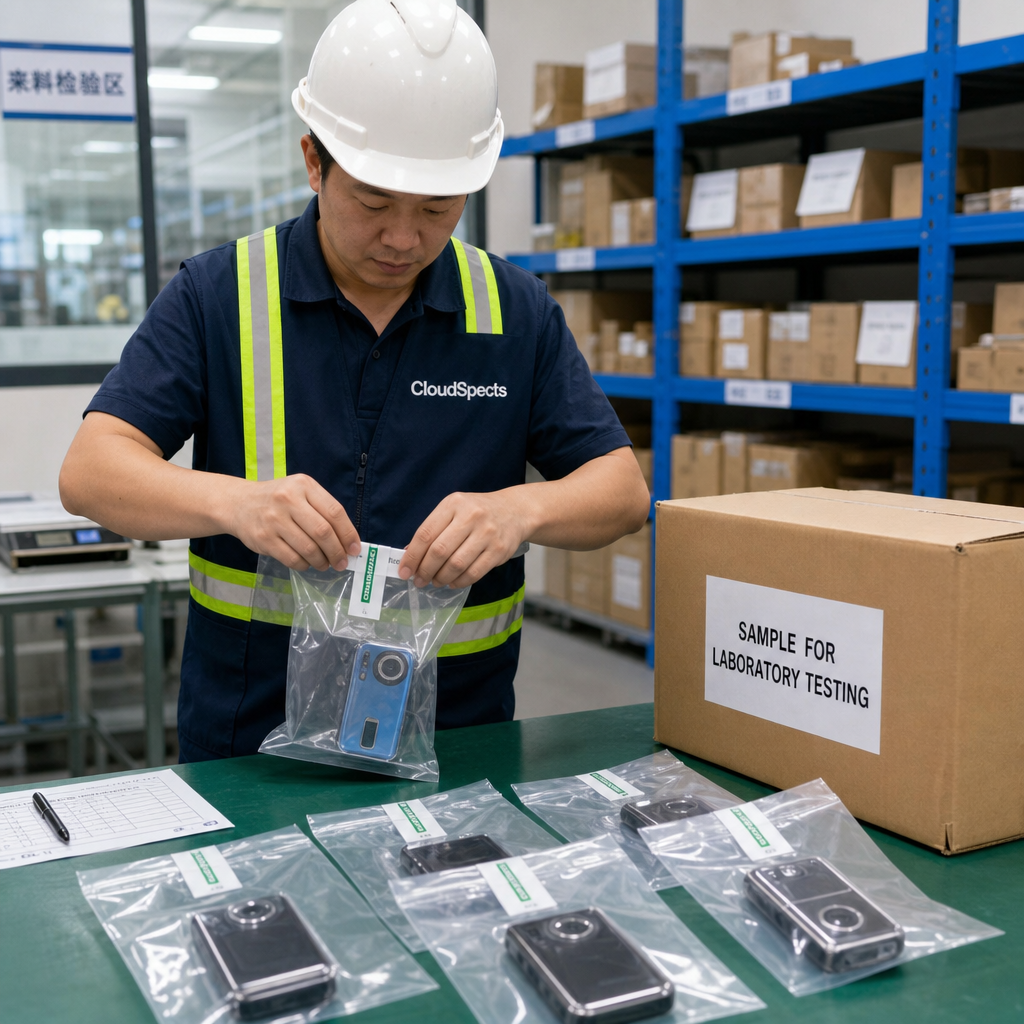
You do not need a separate 'lab project' from scratch. When we are already on site for a pre-shipment inspection, our inspectors can draw the lab sample the same day: representative units from across the production run, sealed with tamper-evident labels, photographed, and logged against the lot and batch codes. The units travel under chain of custody to an ISO 17025-accredited laboratory, and the lab report comes back with the test methods, the limits and the measured values. 📦
Sampling discipline matters here too — the same AQL logic that protects your carton-level checks applies to picking units for testing. Use our free AQL calculator to size a fair sample, and ask the lab to test blind so the result is the result.
The Case That Made a Believer: 6,000 Plush Toys
A US seller ordered 6,000 plush toys — $26,400 — from a Guangdong supplier for a Q4 launch. The visual pre-shipment inspection passed: stitching, fill, eyes, polybag and FNSKU all clean, defect rate under 2% majors. The seller was about to give final payment when he asked us to also run a CPSIA test on five sealed samples.
The lab found the surface paint on the embroidered logo area at 210 ppm lead — more than double the 90 ppm CPSIA limit. The fabric itself was clean; the decorative thread paint was not. Total cost of the discovery: one $169 man-day plus a lab test that cost less than $400. The alternative — 6,000 toys received at FBA, gated, returned or destroyed — was a $26,000 write-off plus removal fees. He re-sourced the thread, re-ran the test, and the corrected batch passed at 40 ppm. 📊
That is the pattern we see across 2,000+ inspections: the visual pass protects you from bad workmanship; the lab test protects you from bad chemistry. If your category is gated, regulated or sold to children, book the inspection and the lab sample on the same visit — see our inspection services or talk to us about your product.
FAQs
Why did my 'passed' shipment still get flagged by Amazon?
A pre-shipment inspection checks workmanship, dimensions, function and packaging against your spec and AQL limits. It is not a substitute for compliance testing. If your product needs a CPSC lead test, a flammability rating or an FCC report, Amazon and customs want to see laboratory evidence — a visual QC pass does not prove a chemical or electrical standard was met.
Which products most often need lab tests, not just visual QC?
Toys and children's products (CPSIA lead, phthalates, ASTM F963), textiles and sleepwear (16 CFR 1610 flammability), electronics and anything with a battery (FCC, UL 62368-1, UN38.3), food-contact kitchenware (FDA or LFGB migration tests), and candles or décor with fragrance (CLP labeling and flash-point data). If a listing category is gated, that is usually the clue.
Can't the factory just send me its own test report?
A supplier's PDF is a starting point, not proof for your shipment. We see certificates that name a different legal entity, an older model, a lab that cannot be found, or a scope that does not include the standard your product needs. Independent testing on samples drawn from your actual production run closes that gap.
How does sample-based lab testing work alongside an inspection?
During a normal pre-shipment visit our inspectors seal representative samples with tamper-evident labels, document the lot and batch codes, and dispatch them to an ISO 17025-accredited lab under chain of custody. You get the on-site QC report in about 24 hours and the lab report when the test cycle finishes — usually 5 to 10 working days depending on the standard.
Do I need lab testing on every order?
No. For repeat orders of an unchanged product you typically need a full test once per model per year plus a lighter verification (material review, certificate match) on each batch. For a new product, a new factory, a material substitution or a gated category, test before you commit to the full production run.
The Bottom Line
Your inspection report and your compliance certificates answer two different questions. Ship on a visual pass alone and you are betting the chemistry, the electronics and the flammability of your product on a supplier's word. Add the right lab test — drawn from your real batch, run at an accredited lab — and the bet disappears. From $169 per man-day, with reports typically delivered within ~24h, it is the cheapest insurance in the building. 🧪
Frequently asked questions
Why did my 'passed' shipment still get flagged by Amazon?
A pre-shipment inspection checks workmanship, dimensions, function and packaging against your spec and AQL limits. It is not a substitute for compliance testing. If your product needs a CPSC lead test, a flammability rating or an FCC report, Amazon and customs want to see laboratory evidence — a visual QC pass does not prove a chemical or electrical standard was met.
Which products most often need lab tests, not just visual QC?
Toys and children's products (CPSIA lead, phthalates, ASTM F963), textiles and sleepwear (16 CFR 1610 flammability), electronics and anything with a battery (FCC, UL 62368-1, UN38.3), food-contact kitchenware (FDA or LFGB migration tests), and candles or décor with fragrance (CLP labeling and flash-point data). If a listing category is gated, that is usually the clue.
Can't the factory just send me its own test report?
A supplier's PDF is a starting point, not proof for your shipment. We see certificates that name a different legal entity, an older model, a lab that cannot be found, or a scope that does not include the standard your product needs. Independent testing on samples drawn from your actual production run closes that gap.
How does sample-based lab testing work alongside an inspection?
During a normal pre-shipment visit our inspectors seal representative samples with tamper-evident labels, document the lot and batch codes, and dispatch them to an ISO 17025-accredited lab under chain of custody. You get the on-site QC report in about 24 hours and the lab report when the test cycle finishes — usually 5 to 10 working days depending on the standard.
Do I need lab testing on every order?
No. For repeat orders of an unchanged product you typically need a full test once per model per year plus a lighter verification (material review, certificate match) on each batch. For a new product, a new factory, a material substitution or a gated category, test before you commit to the full production run.