Watching Your Factory on Video Is Not an Inspection: 6 Blind Spots a Live Stream Cannot Show
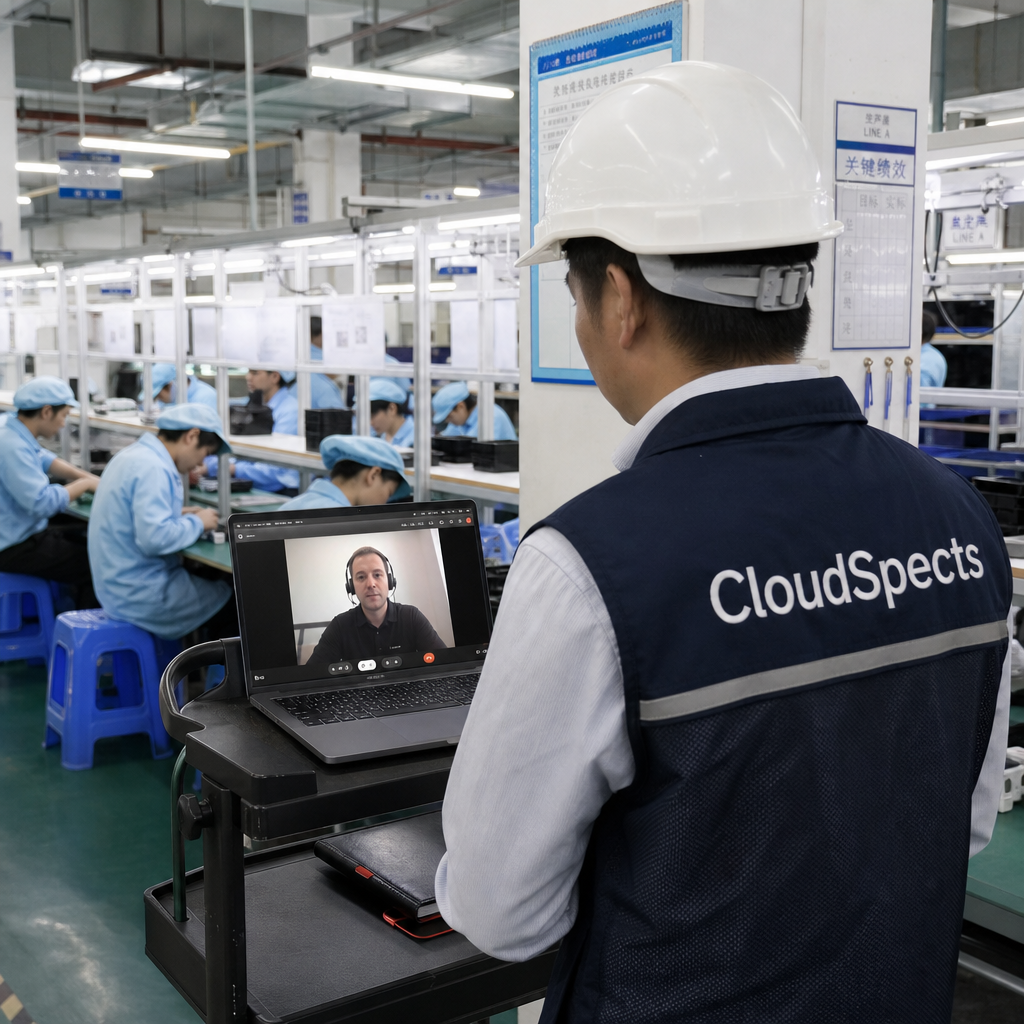
📹 Why a Video Tour Feels Exactly Like Quality Control It is 9 p. m. in Austin and your phone lights up: your supplier in Guangdong is live from the line.
📹 Why a Video Tour Feels Exactly Like Quality Control
It is 9 p.m. in Austin and your phone lights up: your supplier in Guangdong is live from the line. Clean floor, new jigs, a stack of finished cartons, a supervisor waving at the camera. Twenty minutes later you send a thumbs-up and wire the 70% balance. Nothing about that call was a lie — and still nothing about it was evidence. We have run 2,000+ inspections in China, and the number one pattern behind a bad lot is a buyer who felt informed because they had watched, not because anyone had sampled. A camera is a witness; it is not a sampler, not a caliper and not a counter. If you are making a release decision, the documented route is an on-site check tied to a written spec — see what a real pre-shipment inspection in China actually produces before you treat a WhatsApp call as one.
To be fair: watching production is not useless. It changes what you should ask for. The trick is knowing which questions a lens can answer and which ones only a person standing at the pallet can.
🔍 The Six Blind Spots a Lens Cannot Cover
| Blind spot | What a video call gives you | What only an on-site visit gives you |
|---|---|---|
| Random sampling | A supervisor opening one beautiful carton, on cue | Units pulled by carton number from sealed finished-goods stock, photographed in place |
| Metrology | A close-up of a caliper screen held at an angle | Metal rule and micrometer readings on a zero-checked tool, at fixed points, with the reading in the same frame as the part |
| Touch and smell | Words: "same material as sample" | Fabric hand, sharp die-cut edges, solvent and adhesive odor, corrugation that springs back — or does not |
| Packed and stacked goods | The one row facing the camera | Pallet compression, wrap tension, corner protectors, dust, moisture in the back of the warehouse, carton drop test |
| Count and label reconciliation | A sweep across cartons | Carton-by-carton marks, FNSKU scans, packing-list count against the PO, export labels checked at unit level |
| Staging and the "line" itself | The line the supplier chose, on a day the supplier chose | An unannounced arrival, walking to a second building, opening the pallet nobody prepared |
Notice the shape of the problem. Five of the six blind spots are not about honesty at all — they are about sampling. A video can show you a defect; it cannot show you a defect rate. And rate is the only number that tells you whether to ship. We set the sample size before a visit ever happens — a lot size goes into the AQL calculator and comes out as a defensible n, not a guess.
🧮 The Arithmetic of a "Free" Video Call
A real case from this year. A buyer ordered 5,400 USB desk fans at $9.60 FOB — $51,840 landed. Over three weeks the factory sent eleven videos and two photos of a test bench. Everything looked right. On site, with AQL 2.5 Level II on n=200 units (Ac 10), we found 27 fans with blade imbalance (vibration 1.8 mm/s against a 1.0 spec), 19 with the guard 1.5 mm out of position — a finger and stall risk — 14 with 0.3 mm² copper in the USB cord instead of the 0.5 mm² in the signed spec, and 9 missing a base nut because the supplier had subbed a slightly different weld jig. Rework: 240 units, $2,150 and three days, re-inspection 1.2% majors. The whole intervention cost two man-days, about $169 per man-day, and the report reached the buyer in ~24 hours.
Run the other branch. A 9% return rate on 5,400 units is roughly 486 fans coming back from FBA: refunds near $4,700, removal and disposal fees, relabeling, and a listing whose star rating sags right when traffic is cheapest. The video call was free. The missing sample cost more than the inspection by an order of magnitude.
🤝 When Video Genuinely Helps: Build a Hybrid Plan
Video is good at progress: is the tooling in place, has molding started, how many units are boxed today, did the factory implement the corrective action from last time. On-site inspection is good at release: is this lot, as sampled, fit to ship. Write the split into the PO so nobody argues later: video updates every 3-4 days for visibility, a named third-party visit before the balance, and the balance released against the report.
If you do want a remote session, make it worth something: fixed camera positions, units drawn by carton number and read out loud, caliper readings on a tool whose calibration sticker is legible in frame, and the test list agreed in advance. That turns a tour into a small piece of evidence — good enough for a mid-production check, never enough for a release signature.
⏰ Three Moments a Physical Visit Is Not Optional
First order from a new supplier — you have no history to lean on. Anything with a liability edge — mains power, lithium cells, anything a child can reach. Peak season — in Q4 a bad lot does not just cost money, it costs the season, because there is no time left to rework and re-ship. In those three moments, the video call is a warm-up and the visit is the decision. Prefer a written, sampled, photographed report you can send to your factory without translation — the pattern we use on every visit is on our third-party inspection services page, and pricing is published rather than quoted: $169 per man-day, no mystery.
Have a supplier sending you beautiful videos right now and a balance due next week? Send us the PO and the ship date — we will tell you honestly whether a visit is worth it for this order.
❓ FAQs
Can a remote video inspection replace an on-site QC visit?
For progress visibility, close. For a release decision, no. A remote session cannot randomly sample sealed finished goods, verify a measuring tool, count cartons against a packing list or run a carton drop test. Use video to watch progress and an on-site visit to approve a lot.
What should I ask for so a video call is still useful?
Agree the test list in advance, fix camera positions, require units to be drawn by carton number and read out loud, and insist that caliper or micrometer readings appear in the same frame as the part, on an in-date calibrated tool. Record the session and keep it with the PO.
How much does a single on-site inspection cost?
Our published rate is $169 per man-day inside major manufacturing regions, with the report back in about 24 hours. Most small and mid-size lots fit inside one man-day; furniture, multi-SKU and full-function tests may need two.
What decides whether a video-only check is risky for my order?
Three things: order value relative to inspection cost, whether the supplier is new to you, and liability exposure in the category. Electrical, battery and child-reachable products, plus first orders and peak-season lots, are where the escape cost dwarfs the visit.
Do you report what you could not check?
Yes. Every report lists what was covered, what was sampled, and what was excluded — for example if a carton drop test was skipped because production was still running. A report that quietly implies full coverage is worse than no report, because you would ship on it.
Frequently asked questions
Can a remote video inspection replace an on-site QC visit?
For progress visibility, close. For a release decision, no. A remote session cannot randomly sample sealed finished goods, verify a measuring tool, count cartons against a packing list or run a carton drop test. Use video to watch progress and an on-site visit to approve a lot.
What should I ask for so a video call is still useful?
Agree the test list in advance, fix camera positions, require units to be drawn by carton number and read out loud, and insist that caliper or micrometer readings appear in the same frame as the part, on an in-date calibrated tool. Record the session and keep it with the PO.
How much does a single on-site inspection cost?
Our published rate is $169 per man-day inside major manufacturing regions, with the report back in about 24 hours. Most small and mid-size lots fit inside one man-day; furniture, multi-SKU and full-function tests may need two.
What decides whether a video-only check is risky for my order?
Three things: order value relative to inspection cost, whether the supplier is new to you, and liability exposure in the category. Electrical, battery and child-reachable products, plus first orders and peak-season lots, are where the escape cost dwarfs the visit.
Do you report what you could not check?
Yes. Every report lists what was covered, what was sampled, and what was excluded — for example if a carton drop test was skipped because production was still running. A report that quietly implies full coverage is worse than no report, because you would ship on it.