When Your China Order Has to Fly: 6 Air-Freight QC Checks for FBA Restocks That Can't Miss October
Air Freight Has No Buffer: The QC Math Changes the Moment Your Stock Flies Every September the same two calendars collide.
Air Freight Has No Buffer: The QC Math Changes the Moment Your Stock Flies
Every September the same two calendars collide. Amazon's fall Prime event has landed in the first half of October for the past several years, holiday inbound starts stacking up at fulfillment centers right behind it, and sellers who watched the sea-freight window close look at a plane and think "problem solved." It is solved, until it is not. ✈️
Sea freight gives you a slow boat and a month of cushion. Air freight gives you speed and zero forgiveness: 7 to 12 days from factory floor to FC, no rework window, no "we will fix it in transit," and a bill 6 to 12 times higher per kilo. When a defect survives to the far side of an air leg, you do not fix it, you miss the event. A carton of returned goods is not a recovery plan when the sale starts in three weeks.
Across 2,000+ inspections a year, we see the same pattern every fall: sellers who fly restocks but run them like sea freight make the most expensive little mistakes. Six checks genuinely change when the freight flies. 💸
Case Study: $7,500 of Air Freight, Evaporated by Carton Air
An FBA seller restocking 3,600 insulated lunch bags for an October event had a $41,500 order ready at the factory in Guangdong. The air quote came back at $8.10 per kilo for 300 cartons. The factory, trying to help, had "improved" the packaging: bigger cartons and extra air pillows for protection. Generous, and expensive.
Air carriers bill the higher of real weight or volumetric weight, typically length x width x height in centimeters divided by 6000. Those 300 cartons each measured 48 x 40 x 36 cm, which is 11.5 kg of chargeable weight, against an actual weight of 8.4 kg. The seller was paying for roughly 3.1 kg of air per carton, about $7,500 across the whole shipment. Air freight is already the premium option; paying a 37 percent surcharge on nothing is how restocks stop being profitable. 📏
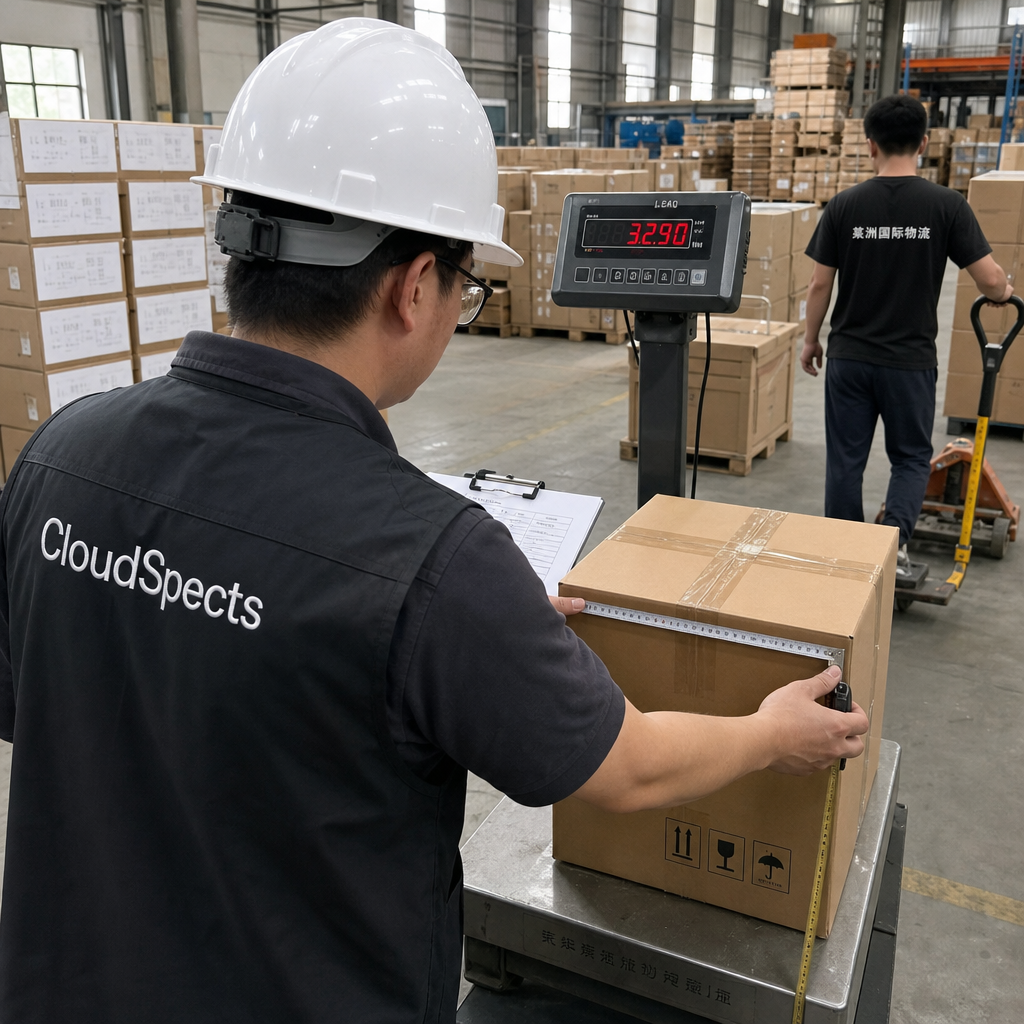
Our inspector caught it during the pre-shipment inspection with the carton weigh-and-measure check, one of the first steps on every air-bound order. The factory repacked into 43 x 36 x 33 cm cartons at a chargeable 8.5 kg, saving about $6,800 on the waybill, plus $1,050 in repack labor and three days. The same inspection also flagged 4 percent of polybags carrying a wrong FNSKU and 3 percent of cartons missing inner dividers, defects that would have stalled FC receiving in the middle of event week. The freight left three days later and landed with six days to spare, versus the alternative: stock stuck in processing, a missed event, and an $18,000-plus hole where the promotion should have been. ⚠️
The 6 Checks That Matter More When Freight Flies
Everything on a standard PSI still applies. These six get extra attention on air shipments because the price of each mistake multiplies:
| # | Check | Why it matters by air | How we verify |
|---|---|---|---|
| 1 | Chargeable weight and carton dimensions | Oversized cartons inflate the volumetric bill 20-40 percent | Tape-measure every carton face and weigh each one; compare against the forwarder's quote |
| 2 | Carton integrity for air handling | Air cargo is tossed into bins, not stacked on forklifts | 60-80 cm drop test, edge protection and stretch-wrap check on packed cartons |
| 3 | FNSKU and label accuracy | No time for a repack cycle before the event window | Scan every unit label in the sample and verify barcode readability |
| 4 | Lithium and DG rules | Battery goods fly as restricted cargo with SoC and paperwork limits | UN38.3 report model-match, cell markings, Class 9 packing review |
| 5 | Count and mixed-SKU accuracy | Weight disputes and shorts strand freight on the ramp | Full count on sample cartons plus scale reconciliation against the packing list |
| 6 | Documentation set | A missing HAWB or certificate means a delayed flight and storage fees | Document audit before handover: airway bill, commercial invoice, certs, DG paperwork |
Because the buffer is gone, we do not soften the sampling plan on air shipments. Stick with AQL 2.5 at General Inspection Level II for major defects, and treat anything critical as zero tolerance. If you need to know exactly how many units to pull, the AQL calculator gives you the sample size and accept/reject numbers in seconds, and it is the same math we use on site. 🎯
The Golden Rule: Inspect Before Handover, Not After Arrival
On sea freight you can sometimes survive a bad PSI by catching it at the port. On air freight there is no port, there is a handover, and after that the next stop is a customs broker and an FC dock in another country. That is why we push a pre-shipment inspection at the factory, before the cartons go to the forwarder, with photos of every check in the report. If the flight is booked for Thursday, the inspection happens Monday or Tuesday, the report lands within about 24 hours, and you still have a full day to stop the booking if the batch fails. 🛡️
Air freight is not a gamble if you treat it like the tight-rope walk it is: fewer moving days, no spare time, and every check done while the goods are still on Chinese soil, where they can still be fixed.
Frequently Asked Questions
How much more expensive is air freight than sea from China?
For FBA-sized shipments, air typically runs 6 to 12 times the per-kilo cost of sea freight, and every chargeable kilo is billed, including the air inside an oversized carton. It makes sense when a deadline matters more than money, but it also means there is no spare budget or spare time for defects.
What is chargeable weight and why do carton dimensions matter by air?
Air carriers bill the higher of actual weight or volumetric weight, usually length x width x height divided by 6000. An overpacked or oversized carton can add 20 to 40 percent to your air waybill for zero product. That is why we tape-measure and weigh every carton face during a pre-shipment inspection on air-bound orders.
Can lithium battery products fly out of China?
Yes, but only as restricted cargo: the battery needs a valid UN38.3 test report matching the exact cell model, the State of Charge is capped (commonly 30 percent for cargo), and the shipment needs Class 9 DG paperwork and carrier approval. A pre-shipment inspection verifies the report, the cell markings and the packing before the forwarder books the flight.
Should I use a stricter AQL when shipping by air?
We keep AQL 2.5 for majors on air shipments and tighten critical attributes to AQL 1.0 or zero tolerance, because there is no rework-and-reship buffer. Use the same General Inspection Level II sampling as sea freight, just do not soften it because the flight is urgent.
How late can I book a pre-shipment inspection before an air shipment?
Book 48 hours ahead for a standard PSI and the report typically lands within about 24 hours of the inspection. Same-week bookings are usually possible, but the inspection must happen at the factory before handover to the forwarder, never after the freight is booked on a plane.
The Bottom Line
Flying FBA stock to an October event is a perfectly sane strategy, as long as the inspection happens before the handover, not after the arrival. A pre-shipment inspection from CloudSpects starts at $169 per man-day, reports typically come within about 24 hours, and the carton weigh-check alone has paid for itself on air shipments more times than we can count. See what a full PSI covers on our inspection services page, or contact us and we will match the inspection date to your flight date.
Frequently asked questions
How much more expensive is air freight than sea from China?
For FBA-sized shipments, air typically runs 6 to 12 times the per-kilo cost of sea freight, and every chargeable kilo is billed, including the air inside an oversized carton. It makes sense when a deadline matters more than money, but it also means there is no spare budget or spare time for defects.
What is chargeable weight and why do carton dimensions matter by air?
Air carriers bill the higher of actual weight or volumetric weight, usually length x width x height divided by 6000. An overpacked or oversized carton can add 20 to 40 percent to your air waybill for zero product. That is why we tape-measure and weigh every carton face during a pre-shipment inspection on air-bound orders.
Can lithium battery products fly out of China?
Yes, but only as restricted cargo: the battery needs a valid UN38.3 test report matching the exact cell model, the State of Charge is capped (commonly 30 percent for cargo), and the shipment needs Class 9 DG paperwork and carrier approval. A pre-shipment inspection verifies the report, the cell markings and the packing before the forwarder books the flight.
Should I use a stricter AQL when shipping by air?
We keep AQL 2.5 for majors on air shipments and tighten critical attributes to AQL 1.0 or zero tolerance, because there is no rework-and-reship buffer. Use the same General Inspection Level II sampling as sea freight, just do not soften it because the flight is urgent.
How late can I book a pre-shipment inspection before an air shipment?
Book 48 hours ahead for a standard PSI and the report typically lands within about 24 hours of the inspection. Same-week bookings are usually possible, but the inspection must happen at the factory before handover to the forwarder, never after the freight is booked on a plane.