Who Owns the Tooling: Marks, Custody and the Transfer Nobody Documents
The parts were clean, on dimension and on time — and one of them carried a small stamped number nobody had seen before. It sat in the shadow of an internal rib, where a customer would never look.
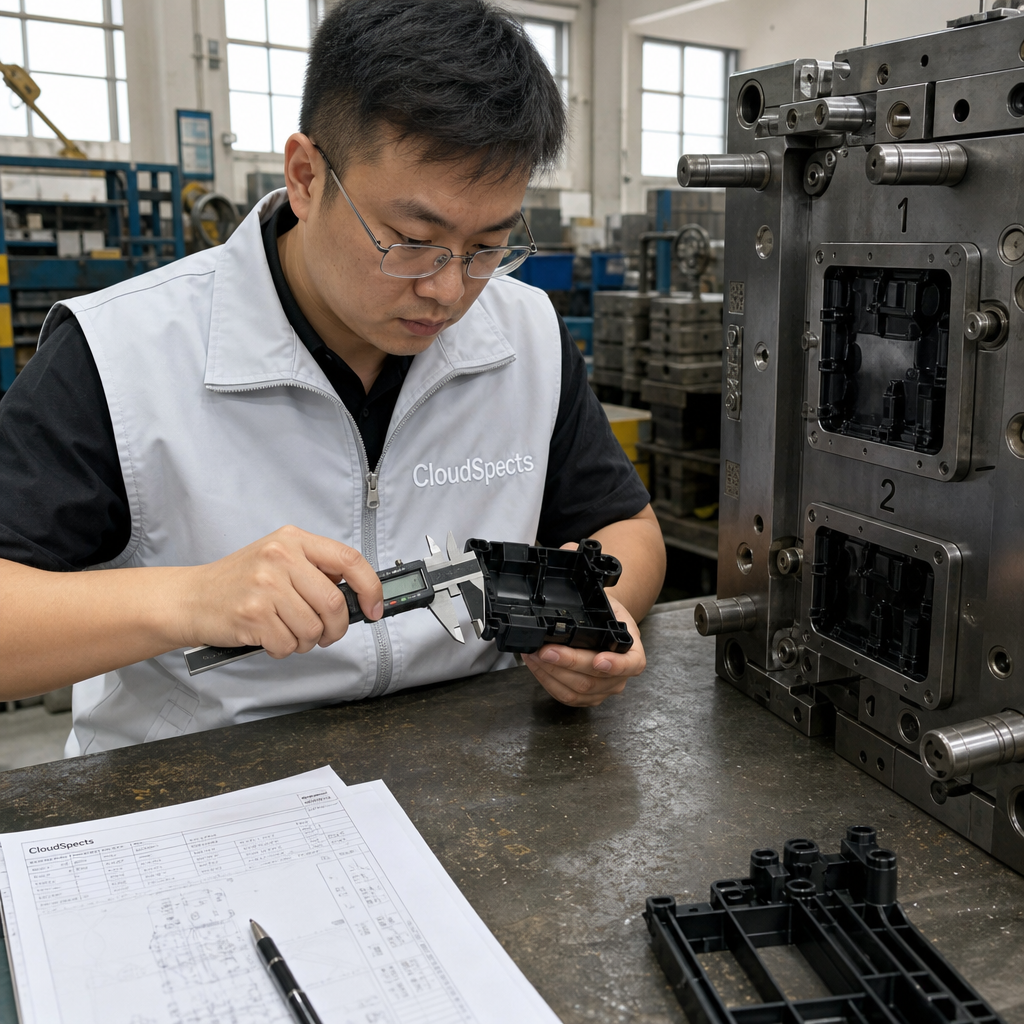
The parts were clean, on dimension and on time — and one of them carried a small stamped number nobody had seen before. It sat in the shadow of an internal rib, where a customer would never look. The number was a cavity code, and the cavity code led back to a tool: a mold the buyer believed they had paid for three years earlier and which the factory was now running for a second customer's order. Nothing in that shipment was defective. What was missing was any way to prove who owned the metal that made it. Tooling sits underneath almost every imported product — molds, dies, welding jigs, paint fixtures and test gauges — and it is the one part of an order that usually rests on paperwork nobody wrote. The pages behind china pre-shipment inspection explain how a batch is sampled and judged; this article is about the tool beneath it, the marks it leaves, and the five lines to add to the purchase order before the first shot is moulded.
CloudSpects runs 2,000+ inspections a year from $169 per man-day, with a report typically in the buyer's inbox within 24 hours of the visit. A tool is invisible in that report unless somebody thinks to look for it.
🧰 Tooling Is the Real Product
Every repeatable part comes out of something: a steel cavity, a die, a jig that holds the work while it is cut or welded. The buyer pays for that tooling — directly on a tooling invoice, or quietly inside the piece price as an amortised charge. Whoever holds the tool controls every future run, the life left in it, and whether your product can be made anywhere else at all. Two phrases cause most of the trouble. "The factory owns the tool" means you are renting your own product back. And "tool transfer at the end of the relationship" sounds generous until nobody has said who pays to move a two-tonne mold, or what happens if it arrives as scrap.
📜 The Paper Trail That Is Usually Missing
Look at the gap between what a buyer paid for and what they can actually prove.
| Item | Common reality | What proves it |
|---|---|---|
| Tooling invoice | Buried in the piece price, never itemised | A separate line showing tool cost and ownership |
| Ownership clause | Absent from the PO and the contract | One sentence naming the buyer as owner |
| Tool identity | No number on the tool and none on the part | A tool ID marked on both tool and part |
| Custody | Which plant, which press, unknown | A register listing location and custodian |
| Transfer terms | Mentioned once, never costed | Who packs, who pays, who inspects, by when |
🔍 The Marks a Tool Leaves Behind
Tools are usually identified by a small engraved or stamped mark: a tool number, a date, a cavity number. On a multi-cavity tool each cavity can carry its own number — and cavities do not wear at the same rate. One cavity drifts, flashes or starves while its neighbours stay perfect. If you can read the cavity mark on a part, you can sample by cavity, which is far more useful than sampling a pile. A new mark appearing mid-order is a signal in itself: a tool was replaced, re-cut or borrowed. A part with no mark at all, where a mark was agreed, is a tool you cannot trace.
✅ Six Checks on the Factory Floor
One: find the tool or cavity mark and photograph it. Two: draw the sample so it includes parts from every cavity in use, not just the easy stack. Three: measure the critical dimensions separately per cavity and compare the spread — a difference between cavities is a tooling problem, a uniform shift is a setup problem. Four: look for tool-wear signatures: flash lines, short shots, sink marks, weld lines and ejector marks. Five: compare the mark you found against the tooling register in your own documents. Six: ask plainly where the tool is today, who holds it, and whether it has run anything else since the last order.
📐 Cavity Spread, and What It Costs
Where a sampling plan is agreed, the AQL calculator gives the sample size and the accept number for the lot — but on a multi-cavity tool the sample should be split across cavities rather than drawn at random, because a random draw hides one bad cavity inside a pile of good parts. If one cavity in eight is out of tolerance, a flat sample of 125 units may contain only a handful of its parts; a cavity-split sample finds the problem in the first hour.
A case we see often: an order of 4,800 moulded wall brackets at $6.40 FOB — about $30,720 — came off an eight-cavity tool. Sampling found flash on eleven units and a dimensional drift on nine, all tracing to cavity three. Worse, the cartons mixed cavity numbers with no pattern, so a partial sort was impossible: 620 units had to be pulled and reworked, and a cavity-three insert replaced. Two man-days on site came to $338. The alternative — shipping the mix — is a customer discovering that one bracket in eight does not fit.
⚠️ What a Visit Can and Cannot Prove
An inspection can read the mark, measure per cavity, see the wear signatures and record where the tool is being used. It cannot establish legal ownership — that lives in the invoice and the clause, and no photograph replaces them. It also cannot see a tool moved off site, or prove what the tool will produce after another thousand cycles. Treat the visit as the physical half of the story and the paperwork as the other.
✍️ Five Lines for the Purchase Order
One: the buyer owns the tool, identified by number, on payment of the tooling charge. Two: the tool is used only for the buyer's parts and is not moved, copied or re-cut without written consent. Three: a tool and cavity mark appears on every part, and parts are packed by cavity where the tool has more than one. Four: a tooling register is maintained and shared, listing location, custodian and any maintenance. Five: on request the tool is returned or transferred, with costs, packing and pre-transfer inspection named. Five sentences, signed once, and the mark in the rib stops being a mystery.
If you are booking a first visit for a tooled product, the man-day rates are published and a date starts on the contact page. Ask for the tool number before the inspector travels — it costs nothing and it changes what the day can achieve.
❓ FAQs
Who owns a mold or die after the buyer pays for it?
In most cases the buyer, but only if the documents say so. Paying a tooling charge does not by itself transfer ownership; the purchase order or contract has to name the buyer as owner and identify the tool. Where the tool cost is hidden inside the piece price the question gets murkier still, which is why a separate tooling line is worth the argument.
What is a cavity number and why does it matter?
It identifies which cavity of a multi-cavity tool made a particular part. Because cavities wear at different rates, one can drift out of tolerance while the rest stay perfect. Reading the cavity mark lets you sample across cavities and catch a single failing cavity that a random draw would hide.
Can an inspector prove who owns the tooling?
No, ownership is a paper question. An inspector can record the marks, measure parts per cavity and describe where the tool is being run. The invoice, the ownership clause and the tooling register are what establish the legal position, and they have to be in place before there is ever a dispute.
How much does it cost to move tooling to another supplier?
It depends on size, weight, customs treatment and the state of the tool. What matters is agreeing in advance who packs it, who pays the freight, who inspects it before it moves and who carries the risk if it arrives damaged. A one-line transfer clause is cheaper than a two-tonne argument.
Should parts always be marked with the tool number?
Where the tool has more than one cavity, yes — a mark on the part is the only way to trace a defect back to the cavity that made it. For single-cavity tools a date or batch mark is usually enough. Either way, agree the mark in the purchase order so it is not quietly dropped from the second run.
Frequently asked questions
Who owns a mold or die after the buyer pays for it?
In most cases the buyer, but only if the documents say so. Paying a tooling charge does not by itself transfer ownership; the purchase order or contract has to name the buyer as owner and identify the tool. Where the tool cost is hidden inside the piece price the question gets murkier still, which is why a separate tooling line is worth the argument.
What is a cavity number and why does it matter?
It identifies which cavity of a multi-cavity tool made a particular part. Because cavities wear at different rates, one can drift out of tolerance while the rest stay perfect. Reading the cavity mark lets you sample across cavities and catch a single failing cavity that a random draw would hide.
Can an inspector prove who owns the tooling?
No, ownership is a paper question. An inspector can record the marks, measure parts per cavity and describe where the tool is being run. The invoice, the ownership clause and the tooling register are what establish the legal position, and they have to be in place before there is ever a dispute.
How much does it cost to move tooling to another supplier?
It depends on size, weight, customs treatment and the state of the tool. What matters is agreeing in advance who packs it, who pays the freight, who inspects it before it moves and who carries the risk if it arrives damaged. A one-line transfer clause is cheaper than a two-tonne argument.
Should parts always be marked with the tool number?
Where the tool has more than one cavity, yes — a mark on the part is the only way to trace a defect back to the cavity that made it. For single-cavity tools a date or batch mark is usually enough. Either way, agree the mark in the purchase order so it is not quietly dropped from the second run.