Your WeChat Message Isn't a Spec Sheet: 8 Things to Lock Down Before Your China Factory Starts
"Lid color: black, ok? " — "Ok boss 👍". Three weeks later the factory's WhatsApp photo shows 7,200 lids in a blue you would call navy and they would call black.
"Lid color: black, ok?" — "Ok boss 👍". Three weeks later the factory's WhatsApp photo shows 7,200 lids in a blue you would call navy and they would call black. Nobody lied. Everybody lost. 💬
In 2,000+ inspections a year across Chinese factories, we sit on both sides of this conversation constantly. And the pattern is so consistent we can predict it: when a quality dispute has no clear villain, it almost always turns out the spec was never actually written down.
The "WeChat OK" Trap: When a Nod Becomes a Nightmare
Here is the uncomfortable truth about China sourcing: most spec disputes are not fraud, and they are not even sloppy work. They are ambiguity. A buyer writes "black", the factory hears "any dark color". A buyer approves a photo on a phone screen, and the factory matches a screen that was never calibrated. A buyer says "good quality stainless steel", and the factory reasonably picks the cheapest grade that still technically counts.
We have walked into factories where the "spec" for a six-figure order was seven WeChat voice messages and one screenshot of a competitor's Amazon listing. The factory is not trying to cheat — it is trying to guess. And guessing is where every expensive mistake starts. ✍️
| WeChat promise | Written spec line |
|---|---|
| "Black lid, ok?" | Lid color: Pantone Black 6C, gloss level 80-90%, matched against approved sample CS-2210 |
| "Good stainless steel" | Body: 304 stainless (18/8), verify with PMI or magnet-plus-acid test, thickness 0.5 mm ± 0.05 mm |
| "Standard size" | Height 185 mm ± 2 mm, diameter 82 mm ± 1 mm at rim, capacity 473 ml to the brim |
| "6 per carton" | 6 pcs/carton, carton 38 x 30 x 22 cm, max gross weight 14 kg, FNSKU on each poly bag |
| "Should pass QC" | AQL 2.5, General Inspection Level II, 200 pcs sampled, Ac 10 Re 11, defect definitions attached |
Look at the two columns and ask yourself which one a factory manager can build to, which one an inspector can measure, and which one survives a month of production. The answer is the same every time. 📏
Case Study: A $43,000 Tumbler Order and the 26 kg Carton
A Proven-member seller ordered 7,200 stainless steel tumblers for $43,000. The product spec was good: grade, dimensions, logo position, even the laser-etch depth. One line was missing — packaging. Nobody wrote down units per carton, carton dimensions, or a maximum carton weight.
The factory, doing what factories do, optimized the carton to save freight: eight tumblers per carton instead of six. Each carton came out at 26.4 kg. Sounds efficient — until you remember Amazon's FBA receiving limit sits around 22.7 kg (50 lb). Cartons above it trigger extra-handling fees, team-lift requirements, and receiving refusals. A container of 58 lb cartons was a logistics time bomb. 💣
Our inspector caught it during the pre-shipment inspection with a simple carton weigh-check — one of the last checks in the report. The factory repacked 1,200 cartons to six pieces each: $1,440 in labor and five days of delay. Painful. But compare it with the alternative: FBA refusal, re-prep fees, removal orders, and a listing that misses its Q4 window — easily $8,000 to $9,000 and a pile of 1-star reviews. The whole incident was one missing line in a spec sheet that would have taken two minutes to write.
We tell every seller the same thing now: if your spec sheet has no packaging section, the factory will write your packaging spec for you. And they will optimize it for their freight bill, not for your FBA receiving dock. ⚠️
The 8 Lines Every China Order Spec Needs
You do not need a 40-page engineering document. You need eight lines, written down, agreed, and attached to the purchase order. Here is the checklist we hand to every seller who asks:
| # | Line | What to write | Example |
|---|---|---|---|
| 1 | Material & grade | The exact material plus how to verify it | 304 stainless steel body; 18/8; PMI or magnet + acid spot test |
| 2 | Dimensions & tolerances | Every critical measurement with ± tolerance | Height 185 mm ± 2 mm; rim Ø 82 mm ± 1 mm |
| 3 | Color reference | Pantone code or approved sample number | Pantone Black 6C; match approved sample CS-2210 |
| 4 | Function & performance | What it must do, with a test where possible | Keeps liquid ≥ 65°C for 6 hours; lid seal: no leak inverted 30 s |
| 5 | Packaging | Units per carton, carton size, max weight, inserts | 6 pcs/ctn; carton 38 x 30 x 22 cm; max 14 kg; poly bag + FNSKU |
| 6 | Shipping marks & labels | What goes on the carton and the unit | Carton: SKU, qty, Made in China; unit: FNSKU + batch code on base |
| 7 | Certifications & documents | Reports and certificates that must accompany the batch | Food-contact test report matching this batch; UN38.3 if battery |
| 8 | AQL & defect definitions | Sampling plan and what counts as critical/major/minor | AQL 2.5 level II; 200 pcs; Ac 10 Re 11; defect photos attached |
Print it, PDF it, and put the PDF in the same chat where you say "ok boss". The factory will respect it more than you expect — good factories prefer a clear target over a guessing game, because guessing is what causes THEIR rework costs too. 🎯
How a Written Spec Turns Inspection into a Pass/Fail Test
Here is the part sellers usually do not realize: an inspection is only as objective as the document it checks against. Give an inspector a vague brief and you get a vague report full of "minor observations". Give him your eight-line spec and you get measurements, deviations, and a clear verdict — because every check now has a number attached to it.
That is exactly how our pre-shipment inspections work: we open your spec, we open the AQL sampling plan, and we test the goods against both. Where sampling is involved, most sellers use our free AQL calculator to lock the sample size before the inspector ever leaves the office. The visit itself starts at $169 per man-day, and the report lands typically within ~24 hours — with photos of every deviation, so your factory can see exactly what to fix.
And if the factory still drifts after all that? The golden sample becomes your referee: the approved unit sits in a sealed box, and both sides agree that bulk must match it within the written tolerances. First article of each production lot gets compared to it. That one box of samples has settled more disputes than any contract we have ever seen. 📦
Frequently Asked Questions
Why isn't a WeChat agreement enough when ordering from a China factory?
Because color names, materials and tolerances do not survive translation. "Black lid, ok?" can mean matte black, glossy black, or charcoal depending on who reads it Tuesday morning. We referee quality disputes almost every week, and the most common root cause is a spec that existed only in a chat thread or in someone's memory. No numbers, no reference sample, no agreed tolerance — just a thumbs-up emoji.
What should a China order spec sheet include?
Eight things: material and grade plus the test method that proves it, dimensions with tolerances, color reference (Pantone code or approved sample number), function and performance requirements, packaging (units per carton, carton size and maximum weight, FNSKU label placement), shipping marks, certifications and documents, and the AQL level with defect definitions. Write all eight and the factory knows exactly what it is being measured against.
How does a pre-shipment inspection use my spec sheet?
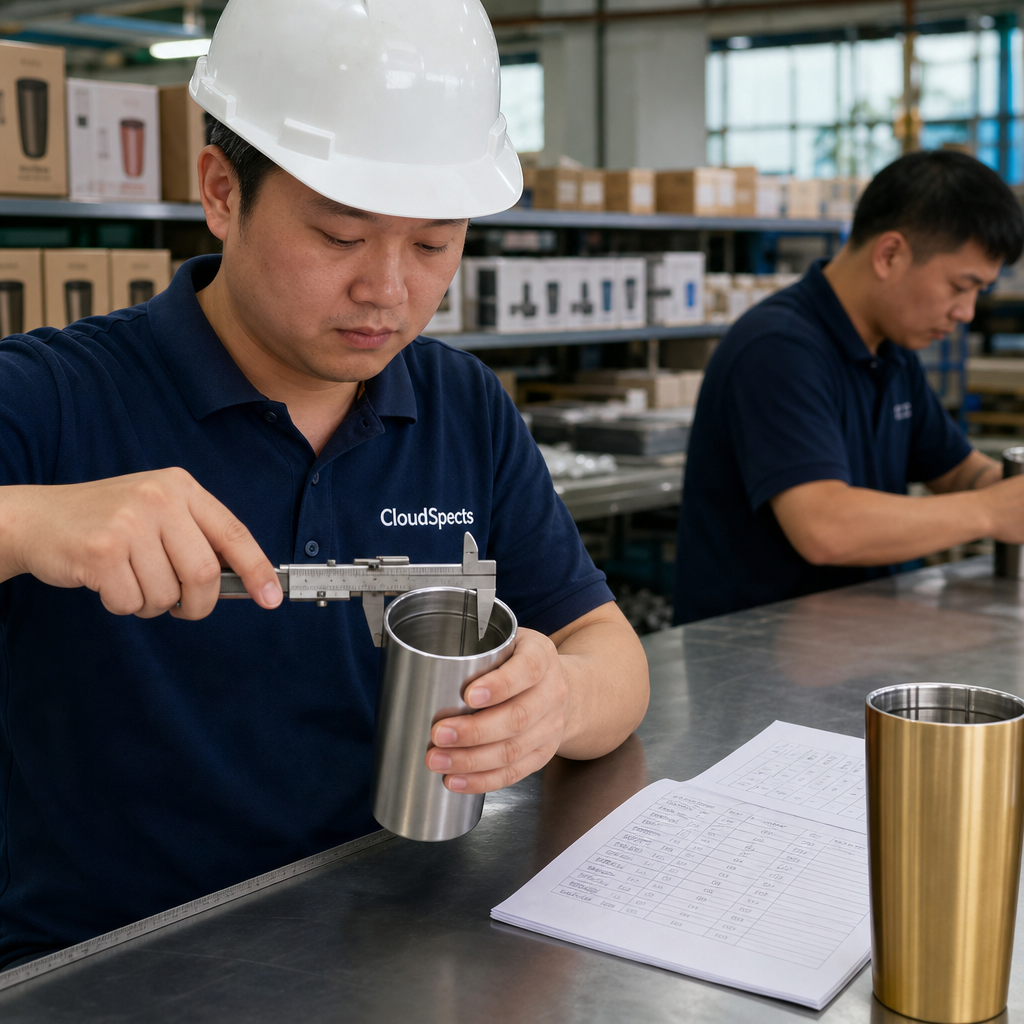
Line by line. The inspector turns every spec item into a measurement or a check: caliper the dimensions, weigh the unit, compare the color under D65 daylight, count the carton contents, scan the labels. Anything outside the written tolerance is flagged as a defect, and AQL sampling decides pass or fail. The report lands typically within ~24 hours of the visit. A written spec is what makes that pass or fail objective instead of an argument.
What happens if the factory ships something different from the spec anyway?
You have evidence instead of opinions: photos, measurements, and a report that names each deviation. That evidence is what gets you a rework, a credit, or a discount before you pay the balance. A pre-shipment inspection catches the deviation before the container is sealed — and a written spec is what tells the inspector, and the factory, exactly where the line was crossed.
Is a spec sheet worth it on a small or first order?
Yes — especially on a first order, because that is when you set the baseline every future order will copy. An inspection starts at $169 per man-day, and one caught mismatch pays for hundreds of spec sheets. Sellers who skip the spec on the small trial order usually end up writing it under pressure on the big one.
The Bottom Line
A thumbs-up emoji is not a quality spec. The factories that ship exactly what you wanted are almost never the ones with the best salespeople — they are the ones with the clearest targets. Write the eight lines, attach them to the PO, and let the inspection do its job against something measurable. 💪
See what a pre-shipment inspection checks against your spec on our inspection services page, or send us your spec sheet and we will tell you straight whether it is tight enough to protect your order — quotes from $169 per man-day.
Frequently asked questions
Why isn't a WeChat agreement enough when ordering from a China factory?
Because color names, materials and tolerances do not survive translation. "Black lid, ok?" can mean matte black, glossy black, or charcoal depending on who reads it Tuesday morning. We referee quality disputes almost every week, and the most common root cause is a spec that existed only in a chat thread or in someone's memory. No numbers, no reference sample, no agreed tolerance — just a thumbs-up emoji.
What should a China order spec sheet include?
Eight things: material and grade plus the test method that proves it, dimensions with tolerances, color reference (Pantone code or approved sample number), function and performance requirements, packaging (units per carton, carton size and maximum weight, FNSKU label placement), shipping marks, certifications and documents, and the AQL level with defect definitions. Write all eight and the factory knows exactly what it is being measured against.
How does a pre-shipment inspection use my spec sheet?
Line by line. The inspector turns every spec item into a measurement or a check: caliper the dimensions, weigh the unit, compare the color under D65 daylight, count the carton contents, scan the labels. Anything outside the written tolerance is flagged as a defect, and AQL sampling decides pass or fail. The report lands typically within ~24 hours of the visit. A written spec is what makes that pass or fail objective instead of an argument.
What happens if the factory ships something different from the spec anyway?
You have evidence instead of opinions: photos, measurements, and a report that names each deviation. That evidence is what gets you a rework, a credit, or a discount before you pay the balance. A pre-shipment inspection catches the deviation before the container is sealed — and a written spec is what tells the inspector, and the factory, exactly where the line was crossed.
Is a spec sheet worth it on a small or first order?
Yes — especially on a first order, because that is when you set the baseline every future order will copy. An inspection starts at $169 per man-day, and one caught mismatch pays for hundreds of spec sheets. Sellers who skip the spec on the small trial order usually end up writing it under pressure on the big one.