Amazon FBA Product Inspection Checklist: $169/Man-Day QC Guide
Sending products to Amazon FBA without a quality check is one of the costliest mistakes private label sellers make. A single shipment of defective units can trigger customer returns, negative reviews, ASIN suspension, and $15+ per-unit return fees .
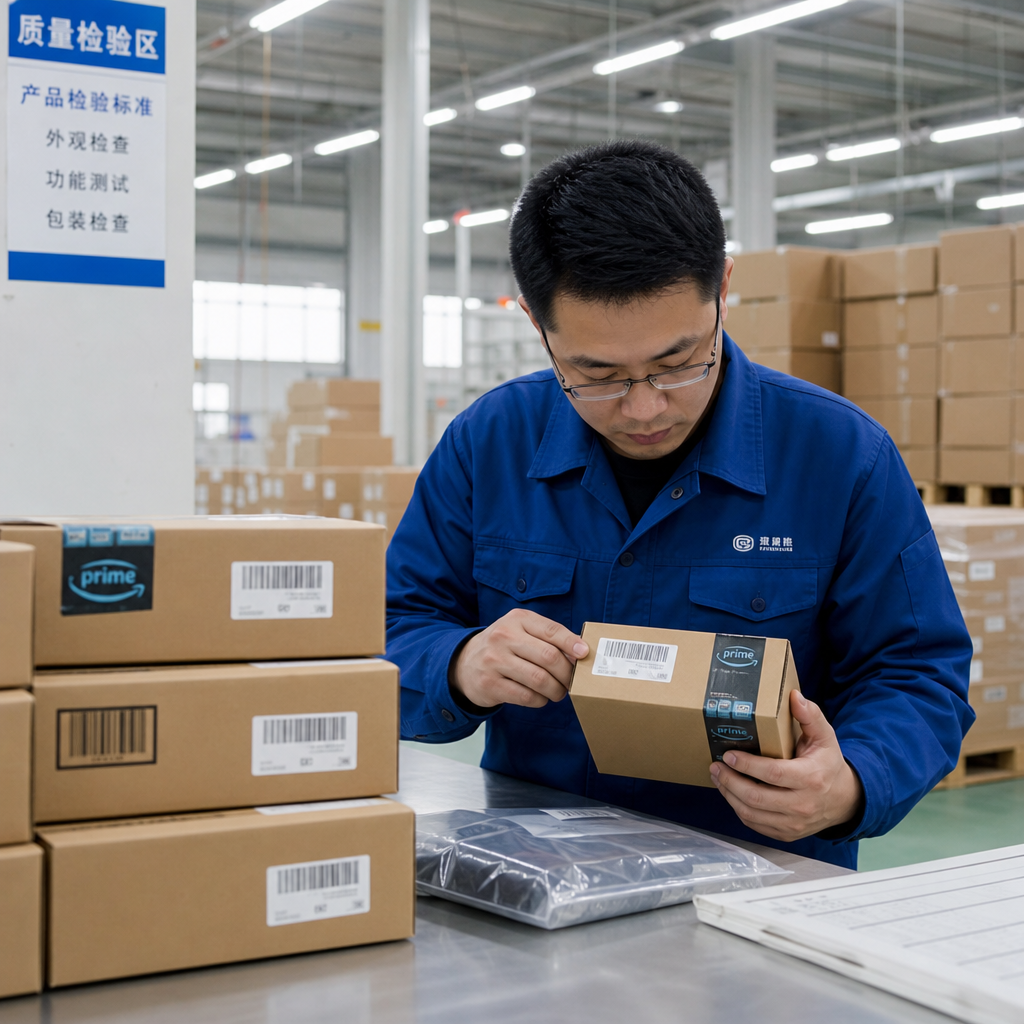
Sending products to Amazon FBA without a quality check is one of the costliest mistakes private label sellers make. A single shipment of defective units can trigger customer returns, negative reviews, ASIN suspension, and $15+ per-unit return fees. Amazon FBA product inspection is your pre-shipment safety net — it verifies what the factory actually built matches what you ordered, before it leaves China. Book the visit as an Amazon FBA inspection while the lot is still at the factory.
This guide covers everything an Amazon seller needs to know about FBA product inspection: what gets checked, how the AQL sampling works, category-specific risks, packaging and label compliance, costs, and a step-by-step process to book and run your inspection.
Why Product Inspection Matters for FBA Sellers
Amazon's FBA program is built on speed and scale. When a customer orders your product, Amazon ships from the nearest fulfillment center within 24 hours. But that same speed works against you if the product arriving at those centers is defective.
The real cost of skipping inspection:
| Cost category | Per-unit impact | Per-1000-units impact |
|---|---|---|
| FBA return processing fee | $3.50 - $5.50 | $3,500 - $5,500 |
| Customer refund + shipping | $8 - $15 | $8,000 - $15,000 |
| Removal/disposal fee | $0.50 - $2.00 | $500 - $2,000 |
| Restocking loss (22% typical) | $4 - $22 | $4,000 - $22,000 |
| ASIN health score damage | ODR increase | Account suspension risk |
An FBA product inspection from $169/man-day costs a fraction of a single return wave. For private label sellers managing 3-5 SKUs from new suppliers, inspection is not optional — it's the difference between a profitable launch and a costly recall.
Amazon FBA Product Inspection Scope
A standard FBA product inspection covers five core areas. Every inspector from CloudSpects checks all five, then documents findings with photos and a detailed report.
1. Quantity and Packing Count
The inspector physically counts cartons and units, matching against the packing list and purchase order. Any shortage or overage is recorded with photos. For large orders (5000+ units), we use stratified sampling — counting all cartons, then verifying a statistically valid sample of units per carton.
2. Workmanship and Appearance (AQL 2.5)
Inspectors check products against the agreed Critical / Major / Minor defect criteria using AQL 2.5 normal (standard consumer goods) or AQL 4.0 major (less critical household items). Each inspected sample is checked for:
- Surface finish, color, texture match to approved sample
- Assembly quality — gaps, alignment, loose parts
- Labeling and branding accuracy
- Packaging quality — carton strength, inserts, foam fit
3. Function Testing
Inspectors test a subset of samples for basic operation. For electronics: power on, button response, display function. For kitchenware: lid fit, handle strength, weight capacity. For toys: assembly test, battery compartment, safety label presence. Any functional failure is logged as a Major defect.
4. Dimensions and Weight
Amazon charges FBA fees based on product dimensions and weight tier. Inspectors measure at least 10% of samples — average, max, and min — and record deviations. If your product measures 0.5 inches larger than spec, it might bump to the next FBA fee tier, eating 10-15% of your margin.
5. FBA Packaging Compliance
This is where most Chinese factories trip up. The inspector verifies:
✅ FNSKU barcode on each unit — scannable, correct format
✅ Poly bag suffocation warning (if applicable) — standard 30 x 80mm white label with skull/crossbones symbol
✅ Case pack labels with FBA barcode + country of origin
✅ Expiration dates (if applicable) — DD-MM-YYYY followed by "Shelf life" text per Amazon policy
✅ Shipping box weight ≤ 50 lbs (23 kg) — Amazon max per carton
Product Inspection by Category
Different product categories have different failure patterns. CloudSpects inspectors tailor their AQL criteria and checkpoints to your category:
| Category | Top defects found | AQL recommendation |
|---|---|---|
| Electronics | Dead on arrival (5-8%), cosmetic scratches, wrong cable type | 2.5 normal |
| Toys | Sharp edges (7-12%), choking hazards, missing safety labels | 2.5 normal |
| Clothing | Stitching defects, color variation, size deviation | 4.0 major |
| Kitchenware | Coating peeling (10-15%), lid misalignment, handle weak point | 2.5 normal |
| Baby products | Material off-spec, missing CPSIA tracking label | 1.0 tight |
| Hardware/Tools | Measurement tolerance off, rust, missing parts | 2.5 normal |
FBA Product Inspection vs FBA Label Inspection
Sellers often confuse these two services. Here is the distinction:
| Checkpoint | Product inspection | Label inspection |
|---|---|---|
| Product quality | ✅ Yes | ❌ No |
| FNSKU barcode scan | ✅ Yes | ✅ Yes (primary focus) |
| Poly bag labels | ✅ Included | ✅ Yes |
| Case pack labels | ✅ Included | ✅ Yes |
| Function testing | ✅ Yes | ❌ No |
| Amazon SST-required checks | ⚠️ Only if specified | ✅ Yes |
| Typical cost | $169/man-day | $169/man-day |
Pro tip: Combine both in a single visit. CloudSpects inspectors handle product quality and FBA label compliance in one inspection — you get one report, one visit fee, and complete coverage.
How Much Does FBA Product Inspection Cost?
CloudSpects FBA product inspection starts from $169 per man-day. The total cost depends on:
- Order quantity — larger orders need bigger sample sizes per AQL tables, which may require 2 inspector-days
- Number of SKUs — each product variant is inspected separately with its own AQL sample
- Factory location — inspections in Guangzhou/Shenzhen are same-day; remote factories in Fujian or Zhejiang may need half-day travel
- Special testing equipment — if your product requires calibrated tools (e.g., salt spray test for metal, spectrometer for color) there is a small equipment surcharge
Cost comparison vs competitors:
| Provider | Starting price | Report turnaround | Hidden fees? |
|---|---|---|---|
| CloudSpects | $169/man-day | 24 hours | ❌ None |
| QIMA | $350 - $525/day | 48 hours | Report fee, reschedule fee |
| Inspect-China | $280/day | 1-2 days | Photo fee per image |
| Bureau Veritas | $600 - $900/day | 3-5 days | Travel fee, admin fee |
Step by Step Guide to FBA Product Inspection
Step 1: Define your inspection criteria
Before your inspector visits the factory, submit a product specification sheet: approved sample reference photo, critical-to-quality features, acceptable color tolerance (ΔE), function test protocol, and packaging requirements. The clearer your criteria, the fewer disputes with the factory.
Step 2: Book inspection at 80% production
Instruct the factory to hold finished goods and notify you when 80% is ready. Then book your inspection with CloudSpects — we schedule within 1-3 working days. Booking early in the week (Monday-Wednesday) helps avoid weekend delays at factories.
Step 3: Inspector on-site sampling and checks
The CloudSpects inspector arrives at the factory, confirms the finished goods area, randomly samples units per the AQL table (e.g., 315 units for a 50,000-piece order at AQL 2.5), and runs through the full checklist: count, workmanship, function, dimensions, packaging, and labels. Every step is documented with date-stamped photos.
Step 4: Review the inspection report
Within 24 hours, you receive a PDF report with: pass/fail verdict per AQL level, defect photo gallery, measurement data, packaging compliance checklist, and inspector notes. If your criteria specify rework thresholds, the report flags them.
Step 5: Decide — ship, rework, or reject
Based on the report, you have three options:
Ship — defects within AQL limit, packaging compliant, proceed to FBA inbound
Rework — Major defects found but fixable (wrong labels, loose screws). Factory fixes, CloudSpects re-inspects at half-day rate
Reject — Critical defects, wrong product, systematic quality failure. Reject the batch, negotiate with the factory
FAQ
What does an Amazon FBA product inspection check?
An Amazon FBA product inspection checks product quantity, workmanship quality per AQL standards (2.5 normal / 4.0 major), FBA packaging requirements (FNSKU labels, poly bag safety warnings, case pack labels), product dimensions and weight, function testing across samples, and overall compliance with Amazon's fulfillment requirements.
How much does FBA product inspection cost in China?
FBA product inspection in China starts from $169 per man-day with CloudSpects. A typical inspection for one product SKU at a single factory takes 1-2 man-days depending on order quantity and AQL sample size. There are no hidden fees for reports or photos.
What is the difference between product inspection and FBA label inspection?
FBA product inspection covers the product itself — workmanship, functionality, dimensions, materials, and packaging quality. FBA label inspection specifically checks FNSKU barcodes (can they be scanned?), poly bag suffocation warnings, expiration date formatting, case pack labels, and shipment pallet labels. CloudSpects combines both in a single inspection visit to save time.
When should I book FBA product inspection?
Book FBA product inspection when 80% or more of your production is complete. This timing lets inspectors check finished product quality while leaving room for the factory to rework any defects found. Inspections during early production (10-20%) can catch systemic issues but miss final packaging and labeling compliance.
Do I need FBA product inspection for every shipment?
Not necessarily every shipment, but certainly the first batch from a new supplier and spot checks on subsequent batches. New suppliers have a 40-60% defect rate on first orders according to industry data. After you've built trust with a factory, rotating inspections every 2-3 shipments maintains quality without inflating costs.
Get Your FBA Product Inspection Quote
CloudSpects provides Amazon FBA inspection China services with same-week scheduling across all major manufacturing cities: Guangzhou, Shenzhen, Yiwu, Shanghai, Wenzhou, Qingdao, Xiamen, and Ningbo. Our inspectors combine FNSKU inspection and FBA packaging verification in a single visit, so you get complete FBA compliance coverage from one service.
Orders placed before 12:00 PM Beijing time can schedule same-week inspection. Contact us with your product details and quantity for a fixed-price quote — no obligation, no hidden fees.
Frequently asked questions
Why Product Inspection Matters for FBA Sellers Amazon's FBA program is built on speed and scale. When a customer orders your product, Amazon ships from the nearest fulfillment center within 24 hours. But that same speed works against you if the product arriving at those centers is defective. The real cost of skipping inspection: Cost category Per-unit impact Per-1000-units impact FBA return processing fee $3.50 - $5.50 $3,500 - $5,500 Customer refund + shipping $8 - $15 $8,000 - $15,000 Removal/disposal fee $0.50 - $2.00 $500 - $2,000 Restocking loss (22% typical) $4 - $22 $4,000 - $22,000 ASIN health score damage ODR increase Account suspension risk An FBA product inspection from $169/man-day costs a fraction of a single return wave. For private label sellers managing 3-5 SKUs from new suppliers, inspection is not optional — it's the difference between a profitable launch and a costly recall. Amazon FBA Product Inspection Scope A standard FBA product inspection covers five core areas. Every inspector from CloudSpects checks all five, then documents findings with photos and a detailed report. 1. Quantity and Packing Count The inspector physically counts cartons and units, matching against the packing list and purchase order. Any shortage or overage is recorded with photos. For large orders (5000+ units), we use stratified sampling — counting all cartons, then verifying a statistically valid sample of units per carton. 2. Workmanship and Appearance (AQL 2.5) Inspectors check products against the agreed Critical / Major / Minor defect criteria using AQL 2.5 normal (standard consumer goods) or AQL 4.0 major (less critical household items). Each inspected sample is checked for: Surface finish, color, texture match to approved sample Assembly quality — gaps, alignment, loose parts Labeling and branding accuracy Packaging quality — carton strength, inserts, foam fit 3. Function Testing Inspectors test a subset of samples for basic operation. For electronics: power on, button response, display function. For kitchenware: lid fit, handle strength, weight capacity. For toys: assembly test, battery compartment, safety label presence. Any functional failure is logged as a Major defect. 4. Dimensions and Weight Amazon charges FBA fees based on product dimensions and weight tier. Inspectors measure at least 10% of samples — average, max, and min — and record deviations. If your product measures 0.5 inches larger than spec, it might bump to the next FBA fee tier, eating 10-15% of your margin. 5. FBA Packaging Compliance This is where most Chinese factories trip up. The inspector verifies: ✅ FNSKU barcode on each unit — scannable, correct format ✅ Poly bag suffocation warning (if applicable) — standard 30 x 80mm white label with skull/crossbones symbol ✅ Case pack labels with FBA barcode + country of origin ✅ Expiration dates (if applicable) — DD-MM-YYYY followed by "Shelf life" text per Amazon policy ✅ Shipping box weight ≤ 50 lbs (23 kg) — Amazon max per carton Product Inspection by Category Different product categories have different failure patterns. CloudSpects inspectors tailor their AQL criteria and checkpoints to your category: Category Top defects found AQL recommendation Electronics Dead on arrival (5-8%), cosmetic scratches, wrong cable type 2.5 normal Toys Sharp edges (7-12%), choking hazards, missing safety labels 2.5 normal Clothing Stitching defects, color variation, size deviation 4.0 major Kitchenware Coating peeling (10-15%), lid misalignment, handle weak point 2.5 normal Baby products Material off-spec, missing CPSIA tracking label 1.0 tight Hardware/Tools Measurement tolerance off, rust, missing parts 2.5 normal FBA Product Inspection vs FBA Label Inspection Sellers often confuse these two services. Here is the distinction: Checkpoint Product inspection Label inspection Product quality ✅ Yes ❌ No FNSKU barcode scan ✅ Yes ✅ Yes (primary focus) Poly bag labels ✅ Included ✅ Yes Case pack labels ✅ Included ✅ Yes Function testing ✅ Yes ❌ No Amazon SST-required checks ⚠️ Only if specified ✅ Yes Typical cost $169/man-day $169/man-day Pro tip: Combine both in a single visit. CloudSpects inspectors handle product quality and FBA label compliance in one inspection — you get one report, one visit fee, and complete coverage. How Much Does FBA Product Inspection Cost?
CloudSpects FBA product inspection starts from $169 per man-day . The total cost depends on:
Step 1: Define your inspection criteria Before your inspector visits the factory, submit a product specification sheet: approved sample reference photo, critical-to-quality features, acceptable color tolerance (ΔE), function test protocol, and packaging requirements. The clearer your criteria, the fewer disputes with the factory. Step 2: Book inspection at 80% production Instruct the factory to hold finished goods and notify you when 80% is ready. Then book your inspection with CloudSpects — we schedule within 1-3 working days. Booking early in the week (Monday-Wednesday) helps avoid weekend delays at factories. Step 3: Inspector on-site sampling and checks The CloudSpects inspector arrives at the factory, confirms the finished goods area, randomly samples units per the AQL table (e.g., 315 units for a 50,000-piece order at AQL 2.5), and runs through the full checklist: count, workmanship, function, dimensions, packaging, and labels. Every step is documented with date-stamped photos. Step 4: Review the inspection report Within 24 hours, you receive a PDF report with: pass/fail verdict per AQL level, defect photo gallery, measurement data, packaging compliance checklist, and inspector notes. If your criteria specify rework thresholds, the report flags them. Step 5: Decide — ship, rework, or reject Based on the report, you have three options: Ship — defects within AQL limit, packaging compliant, proceed to FBA inbound Rework — Major defects found but fixable (wrong labels, loose screws). Factory fixes, CloudSpects re-inspects at half-day rate Reject — Critical defects, wrong product, systematic quality failure. Reject the batch, negotiate with the factory FAQ What does an Amazon FBA product inspection check?
An Amazon FBA product inspection checks product quantity, workmanship quality per AQL standards (2.5 normal / 4.0 major), FBA packaging requirements (FNSKU labels, poly bag safety warnings, case pack labels), product dimensions and weight, function testing across samples, and overall compliance with Amazon's fulfillment requirements.
How much does FBA product inspection cost in China?
FBA product inspection in China starts from $169 per man-day with CloudSpects. A typical inspection for one product SKU at a single factory takes 1-2 man-days depending on order quantity and AQL sample size. There are no hidden fees for reports or photos.
What is the difference between product inspection and FBA label inspection?
FBA product inspection covers the product itself — workmanship, functionality, dimensions, materials, and packaging quality. FBA label inspection specifically checks FNSKU barcodes (can they be scanned?), poly bag suffocation warnings, expiration date formatting, case pack labels, and shipment pallet labels. CloudSpects combines both in a single inspection visit to save time.
When should I book FBA product inspection?
Book FBA product inspection when 80% or more of your production is complete. This timing lets inspectors check finished product quality while leaving room for the factory to rework any defects found. Inspections during early production (10-20%) can catch systemic issues but miss final packaging and labeling compliance.
Do I need FBA product inspection for every shipment?
Not necessarily every shipment, but certainly the first batch from a new supplier and spot checks on subsequent batches. New suppliers have a 40-60% defect rate on first orders according to industry data. After you've built trust with a factory, rotating inspections every 2-3 shipments maintains quality without inflating costs.