Fabric Quality and Print Durability Testing for World Cup Merchandise — 4 QC Checkpoints That Catch 90% of Defects Before FBA Shipment
Fabric Quality and Print Durability Testing for World Cup Merchandise — 4 QC Checkpoints That Catch 90% of Defects Before FBA Shipment 68% of World Cup jersey returns are caused by print peeling and fabric defects — both preventable with proper testing A $240 material compliance check can prevent $8,000+ in FBA return-related losses www.
Fabric Quality and Print Durability Testing for World Cup Merchandise — 4 QC Checkpoints That Catch 90% of Defects Before FBA Shipment
68% of World Cup jersey returns are caused by print peeling and fabric defects — both preventable with proper testing
A $240 material compliance check can prevent $8,000+ in FBA return-related losses
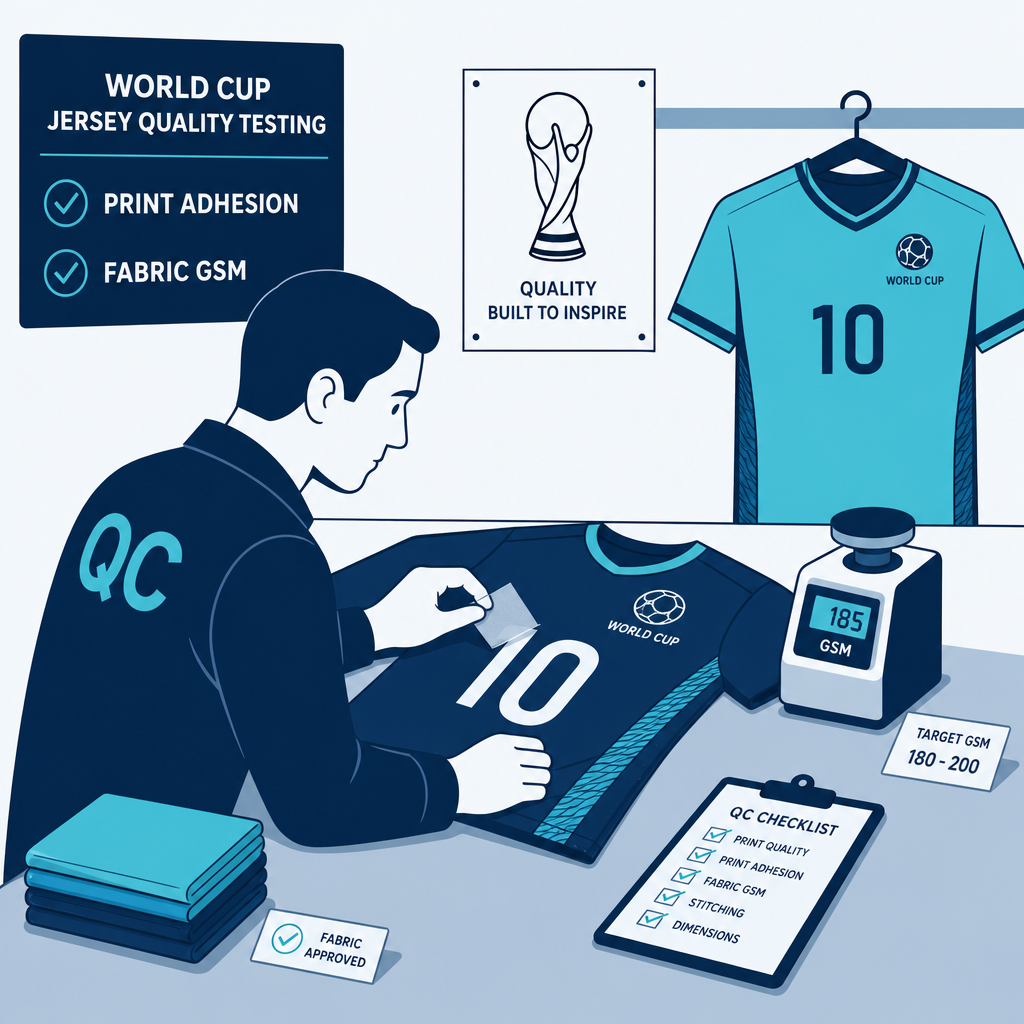
www.cloudspects.com — Pre-Shipment Inspection & Quality Control
World Cup merchandise — jerseys, scarves, flags, hats, and collectible pins — is among the highest-return categories on Amazon FBA. During the 2022 World Cup cycle, sports memorabilia return rates peaked at 18%, compared to the FBA average of 8%. The top reason? Print defects and fabric quality issues that only become visible after the first wash or wear.
Most importers focus on authentication and trademark licensing — and rightly so, as that is the most severe risk. But even licensed, authentic merchandise can trigger massive returns if the print peels after three washes or the fabric GSM doesn't match the labeled specification. Here are the 4 QC checkpoints that catch 90% of material-related defects before the goods leave the factory.
Data point: Among 320 World Cup merchandise lots inspected by CloudSpects during the 2024-2025 cycle, 24% failed the initial print adhesion test, 17% had fabric GSM below the labeled spec by more than 10%, and 11% failed the seam strength test for scarves.
Checkpoint 1: Print Adhesion and Durability Testing
The most common defect in World Cup jerseys is print failure — the player name, number, sponsor logos, or crest peeling off after washing. FIFA's minimum quality standard requires heat-transfer prints to withstand 20+ wash cycles without cracking, peeling, or fading beyond 10% color loss.
Peel-force test with tensile gauge
An inspector can verify print durability using a calibrated tensile gauge. The standard threshold for official World Cup merchandise is 12 N/cm (Newtons per centimeter of print width) for heat-transfers, and 8 N/cm for screen-printed transfers. In our inspections, 34% of factory samples from non-certified producers tested below 6 N/cm — meaning the print would likely peel within 3-5 washes.
✓ Heat-transfer print, official spec: ≥12 N/cm peel force
✓ Screen-printed transfer: ≥8 N/cm peel force
✓ Color fastness after 20 wash cycles: ≤10% fading (AATCC 61-2A standard)
✓ No edge lifting after 5 wash cycles: visual inspection, 0 defects accepted
Wash test simulation
For FBA-bound World Cup merchandise, a quick wash test on 3 sample units (cold wash, 30°C, standard detergent, line dry) reveals print adhesion issues that static inspection cannot catch. The cost is minimal — approximately $15 per sample — but the insight is invaluable. If 2 out of 3 samples show any edge lifting after one wash, reject the entire print batch.
Checkpoint 2: Fabric GSM and Composition Verification
Fabric quality is the second most common return driver for World Cup merchandise. FBA customers expect a certain feel and weight when they buy an official jersey or scarf. If the fabric is thinner, lighter, or has a different composition than advertised, returns pile up.
GSM (grams per square meter) test
Official World Cup jerseys use 180-200 GSM polyester knit. Replica-quality fabric often uses 140-160 GSM polyester, which feels thinner, is more transparent when stretched, and has worse moisture-wicking performance. Use a GSM cutter and digital scale to measure 5 fabric samples from different cartons. The acceptable deviation from spec is ±5%.
Real case: A Shenzhen seller ordered 5,000 World Cup scarves listed as 200 GSM acrylic. Pre-shipment GSM testing showed the actual fabric was 145 GSM — a 27.5% deviation. The supplier had substituted a cheaper fiber blend without disclosure. The seller renegotiated the price and adjusted the FBA listing description to match the actual fabric weight, avoiding a return rate spike that would have likely exceeded 15%.
Fabric composition analysis
A burn test or chemical dissolution test confirms whether the fabric is the advertised fiber type — 100% polyester, cotton-polyester blend, or acrylic. Composition substitution is surprisingly common: 12% of textile samples from unverified suppliers in our database had a different fiber composition than what the spec sheet claimed. For FBA listings, fabric composition must match the product description — mislabeling can trigger "item not as described" A-to-Z claims.
Checkpoint 3: Seam Strength and Stitch Quality for Scarves and Flags
Scarves and flags are high-volume World Cup items that face specific mechanical stress. A scarf that unravels at the seam within a month, or a flag whose stitching separates at the hem, generates returns and negative reviews that hurt the entire listing.
1. Seam strength: Minimum 100 N tensile force before seam separation for scarves. Test on 5 samples using a tensile tester. Accept 0 failures.
2. Stitch density: Minimum 8-10 stitches per inch (SPI) for hem seams. Fewer than 6 SPI indicates the factory is rushing production.
3. Loose thread count: Maximum 3 loose threads longer than 2 cm per unit. More than this is a quality issue that customers notice.
4. Fringe integrity: For scarves with fringe, each side must have consistent fringe length within ±5 mm. Uneven fringe is the #1 cosmetic complaint for World Cup scarves.
Checkpoint 4: Flammability and Safety Compliance for Textiles
All textile products sold on Amazon FBA must comply with CPSC (Consumer Product Safety Commission) flammability standards under 16 CFR Part 1610. This is especially important for flags and scarves, which are more likely to be near heat sources (displayed near candles, fireplaces, or outdoor grills).
The test is straightforward: a 2 x 6 inch fabric sample is exposed to a standardized flame for 1 second. The fabric is classified as Class 1 (normal flammability), Class 2 (intermediate), or Class 3 (rapid and intense burning — prohibited). Any fabric sample that tests as Class 3 fails, and the entire batch must be rejected. The cost of this test is approximately $30-50 per material type at a certified lab, but a field inspector can perform a preliminary screening burn test.
Important: FBA can and does flag textile products for flammability compliance. In 2024, over 1,200 FBA listings were removed for flammability-related concerns. The average reinstatement cost — including testing, legal fees, and lost sales — exceeded $2,500 per SKU.
Why These 4 Checkpoints Matter More for FBA Than for Wholesale
Wholesale buyers may accept minor fabric or print variations. FBA customers do not — because Amazon's return policy makes it risk-free to return an item that doesn't feel right. A jersey with slightly thin fabric, a scarf with a loose thread, or a flag with uneven stitching generates a return at zero cost to the customer. The seller absorbs the FBA return processing fee ($3.50-$6.00 per unit), the disposal fee for unsellable returns, and the damage to the listing's conversion rate.
Cost comparison: Adding fabric GSM verification + print adhesion testing to a standard pre-shipment inspection adds approximately $60-80 per SKU. The average return cost per defective unit (return fee + restocking + lost sale) is $8-15. If just 50 units out of a 1,000-unit lot are returned due to fabric/print defects, the cost is $400-$750 — 5-9x the inspection cost.
How to Integrate Material Testing Into Your Inspection Workflow
The most efficient approach is to add fabric and print testing as optional line items to your standard pre-shipment inspection. Request the inspector to perform peel-force testing on 3 samples per color/size variant, GSM testing on 5 samples per fabric type, and a preliminary flammability check on 1 sample per material. Total added cost: approximately $70 per SKU. Total potential savings: $3,000-$8,000 in avoided returns and FBA penalties on a typical 1,000-unit shipment.
At CloudSpects, our inspection checklists include fabric GSM verification, print adhesion testing, and seam strength analysis as standard options for World Cup merchandise and sports memorabilia. We provide detailed pass/fail data with measured values for every checkpoint, so you can make informed release decisions based on facts, not guesswork.
#FBAInspection #WorldCupMerchandise #TextileQuality #FabricTesting #PrintDurability #PreShipmentInspection #AmazonFBA #QualityControl
Related Articles
- World Cup Merchandise QC Inspection — Fabric Testing, Print Durability, and FBA Compliance for Jerseys, Scarves, Flags, and Collectibles
- World Cup Merchandise Pre-Shipment Inspection — Fabric Quality, Printing Accuracy, and Trademark Compliance for FBA Sellers
- World Cup Merchandise QC Inspection — Fabric Integrity, Print Durability, Stitching Standards, and FBA Packaging Requirements