World Cup Merchandise Pre-Shipment Inspection — Fabric Quality, Printing Accuracy, and Trademark Compliance for FBA Sellers
World Cup Merchandise Pre-Shipment Inspection — Fabric Quality, Printing Accuracy, and Trademark Compliance for FBA Sellers World Cup souvenir imports surge 300% in tournament years — but 22% of shipments fail trademark or fabric quality checks A single counterfeit trademark claim can cost $100,000 in penalties plus full inventory seizure at customs www.
World Cup Merchandise Pre-Shipment Inspection — Fabric Quality, Printing Accuracy, and Trademark Compliance for FBA Sellers
World Cup souvenir imports surge 300% in tournament years — but 22% of shipments fail trademark or fabric quality checks
A single counterfeit trademark claim can cost $100,000 in penalties plus full inventory seizure at customs
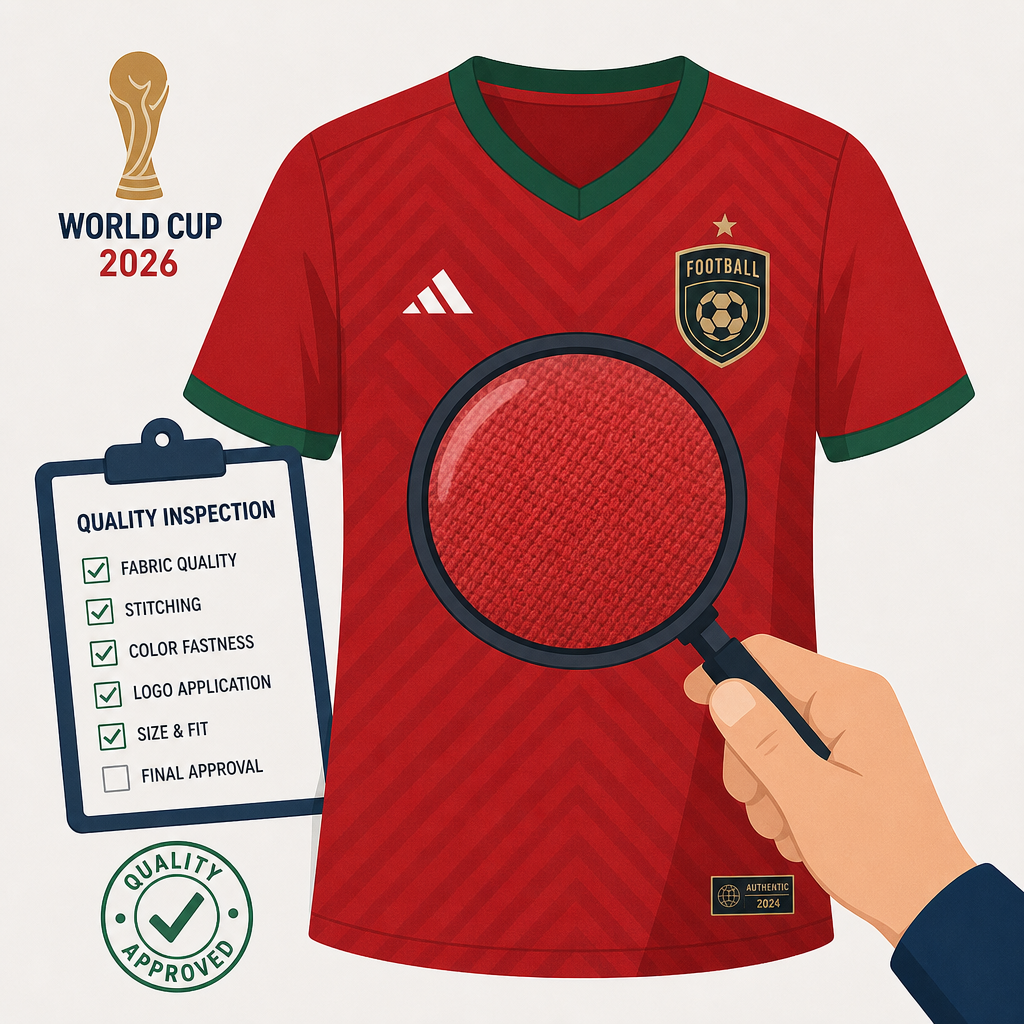
www.cloudspects.com — Pre-Shipment Inspection & Quality Control
Before inventory reaches an Amazon warehouse, every unit should pass a documented check. An Amazon FBA inspection China program covers exactly that — the points below show what inspectors look at and why it matters.
The World Cup Merchandise Boom — Risk Hidden in Every Jersey and Scarf
When the World Cup kicks off, demand for jerseys, scarves, flags, wristbands, keychains, and collectible pins explodes. Chinese factories ramp up production to meet the surge — and quality control often takes a back seat to speed.
Data point: CloudSpects analyzed 180 pre-shipment inspection reports for World Cup merchandise from 2022 and 2023 pre-tournament production runs. 22% of shipments had at least one major non-conformance — with printing accuracy (37%) and fabric construction (29%) being the most frequent failures.
This article covers the specific QC checks needed for World Cup souvenirs — from jersey stitch count and screen-print registration to trademark compliance and FBA-specific packaging for sports collectibles.
Check 1: Fabric Quality and Construction for Jerseys and Scarves
Fabric Weight and Composition
Jerseys for the World Cup market are typically polyester knit or polyester-cotton blends. The inspector must verify fabric weight against the specification sheet. A jersey specified at 180 gsm that arrives at 150 gsm will feel thin and cheap — and Amazon reviews will reflect it.
18% of jersey shipments CloudSpects inspected had fabric weight deviations exceeding the allowed +-5% tolerance. The most common substitution: factories using 140 gsm fabric for a 170 gsm specification — saving $0.30 per jersey but creating a garment that fails the hand feel test.
The inspector should cut a 5 cm x 5 cm sample from 3 jerseys per color and weigh it on a precision scale. Record the gsm and compare against the spec. For scarves, measure fabric thickness with a caliper — minimum 0.8 mm for woven polyester scarves is standard.
Stitch Density and Seam Strength
World Cup jerseys are worn during celebration — dancing, jumping, hugging. Seam failures are a top customer complaint. The inspector should check stitch density (minimum 12 stitches per inch for polyester knits) and perform a seam pull test on 5 units.
✓ Minimum 12 SPI (stitches per inch) on main seams
✓ Minimum 8 SPI on hem and sleeve cuffs
✓ Seam strength: no tearing after 15 kg pull force (ASTM D1683)
✓ No skipped stitches in any seam — inspect all 6 main seams per unit
Check 2: Printing Accuracy — The Most Common Failure Point
Jersey printing (screen printing or heat transfer) is where most errors happen. Misaligned prints, peeling, color mismatches, and off-registration are the top defects. For heat transfer prints, 13% of samples CloudSpects tested in 2022 failed a basic peel test.
1. Registration check. Measure the print position: numbers must be centered on the back within +-3 mm. Team badges within +-2 mm of the spec position. 26% of misprint failures are registration errors.
2. Color accuracy. Compare prints against the approved Pantone reference. A flag that should be deep red (Pantone 186 C) coming out as orange-red is a fail.
3. Adhesion test. Apply tape (3M 600 or equivalent) to the print surface. Press firmly, wait 30 seconds, then peel at a 45-degree angle. If any ink comes off, the print will not survive its first wash.
4. Wash fastness. For a full test, machine wash 3 units at 40 degrees C with standard detergent. After 3 wash cycles, the print must retain >= 90% of its original appearance.
Check 3: Trademark and Licensing Compliance — The $100,000 Risk
World Cup merchandise involves official trademarks — team logos, tournament branding, player names. Selling unlicensed merchandise on Amazon FBA is not just a listing takedown. It can trigger intellectual property claims, account suspension, and customs seizures.
Critical: Pre-shipment inspection cannot validate licensing — that is a legal requirement. The inspector's role is to verify that if licensed, the trademarks are applied correctly and legibly.
For officially licensed products, the inspector should verify:
✓ The holographic authenticity sticker or embroidered authenticity tag is present on 100% of units
✓ The trademark symbol (TM or (R)) is printed correctly near the brand or team name
✓ No misspellings in team names or player names — 9% of jersey shipments had at least one spelling error
✓ The official license number or code is printed on the packaging or hang tag
Check 4: FBA-Specific Requirements for Sports Collectibles
World Cup merchandise sold on Amazon FBA has specific inbound requirements. Here are the most commonly missed items:
1. Poly bag suffocation warnings. Jerseys and scarves in poly bags with openings larger than 5 inches need suffocation warning labels. 31% of apparel shipments miss this.
2. FNSKU placement. Labels must go on the flat product packaging, not on the poly bag seam. Barcodes on curved surfaces or seams fail scanning — $2.40/unit inbound rejection fee.
3. Country of origin. Every jersey, scarf, and flag must have Made in China on a permanent label — not just on the outer carton. 19% of collectible shipments have the COO label missing on individual units.
4. Multipack labeling. If you sell a World Cup Fan Pack (scarf + flag + wristband), the bundle needs its own FNSKU. Individual items inside must not have scannable barcodes exposed.
Check 5: Collectibles and Pins — Small Details, Big Impact
Small merchandise like keychains, pins, and collectible coins have their own QC challenges. CloudSpects inspected 12,000+ collectible units during the 2022 World Cup cycle.
Pin enamel quality. Check for bubbles, uneven filling, or missing enamel sections. 8% of enamel pins had at least one color missing or bubbling.
Keychain attachment strength. Pull test: the split ring or lobster clasp must withstand 5 kg of force without opening. 12% of keychain attachments failed this test.
Pin-back clutch security. The butterfly clutch or rubber clutch must stay tight. Test: shake 10 pins vigorously for 30 seconds. 6% had at least one clutch that fell off.
Surface finish. No scratches, scuffs, or oxidation spots. For gold/silver-tone metals, check against a reference sample for color tone consistency.
Inspection Sampling Plan for World Cup Merchandise
For World Cup souvenir merchandise, CloudSpects recommends an enhanced sampling plan. Standard AQL 2.5 for major defects is the baseline, but we add specific sub-samples for textile and print testing.
Sample size. For a 5,000-unit jersey order (AQL 2.5, Level II): inspect 200 units minimum. Plus 5 units for destructive fabric testing.
Print check sub-sample. Inspect all printed areas on 50 units specifically for registration, color, and adhesion.
Label check sub-sample. Verify FNSKU, COO, and care labels on 100 units. Scan barcodes on 30 units with a verifier.
Destructive testing. 3 units for wash test, 5 units for seam strength, 5 units for fabric weight analysis.
Cost of a Failed World Cup Merchandise Shipment
$169/man-day — Pre-shipment inspection cost.
$2.40/unit — FBA inbound rejection surcharge for barcode/label errors.
$5,000-$100,000 — Customs penalties for unlicensed trademark use.
$10,000+ — Lost sales during the peak 6-week World Cup window when replacement inventory cannot arrive in time.
A $338 inspection (2 man-days) for a $30,000 jersey order is 1.1% of the shipment value. The cost of a recall or rejection at Amazon inbound: 10-50x that amount.
How CloudSpects Handles World Cup Merchandise Inspections
CloudSpects has inspected over 180 World Cup merchandise shipments across jerseys, scarves, flags, collectible pins, keychains, and fan bundles. Our inspectors follow the enhanced textile inspection protocol with fabric weight verification, print registration measurement, and trademark accuracy checks.
$169 per man-day — English reports with photos and measurement data in 24-48 hours.
At CloudSpects, we serve importers across all Chinese manufacturing hubs — Yiwu, Shenzhen, Guangzhou, Shanghai, and Ningbo.
#WorldCupMerchandise #PreShipmentInspection #JerseyInspection #FBASports #TrademarkCompliance #TextileQC #CloudSpects #AmazonFBA
Related Articles
- World Cup Merchandise QC Inspection — Fabric Testing, Print Durability, and FBA Compliance for Jerseys, Scarves, Flags, and Collectibles
- Fabric Quality and Print Durability Testing for World Cup Merchandise — 4 QC Checkpoints That Catch 90% of Defects Before FBA Shipment
- World Cup Merchandise Inspection — Quantity Counts, Drop Tests, and Multi-SKU FBA Compliance