World Cup Merchandise QC Inspection — Fabric Integrity, Print Durability, Stitching Standards, and FBA Packaging Requirements
World Cup Merchandise QC Inspection — Fabric Integrity, Print Durability, Stitching Standards, and FBA Packaging Requirements 12 quality checkpoints for jerseys, scarves, flags, and collectibles — from fabric grammage to FBA carton labeling 38% of World Cup merchandise fails first inspection on print quality or fabric defects www.
World Cup Merchandise QC Inspection — Fabric Integrity, Print Durability, Stitching Standards, and FBA Packaging Requirements
12 quality checkpoints for jerseys, scarves, flags, and collectibles — from fabric grammage to FBA carton labeling
38% of World Cup merchandise fails first inspection on print quality or fabric defects
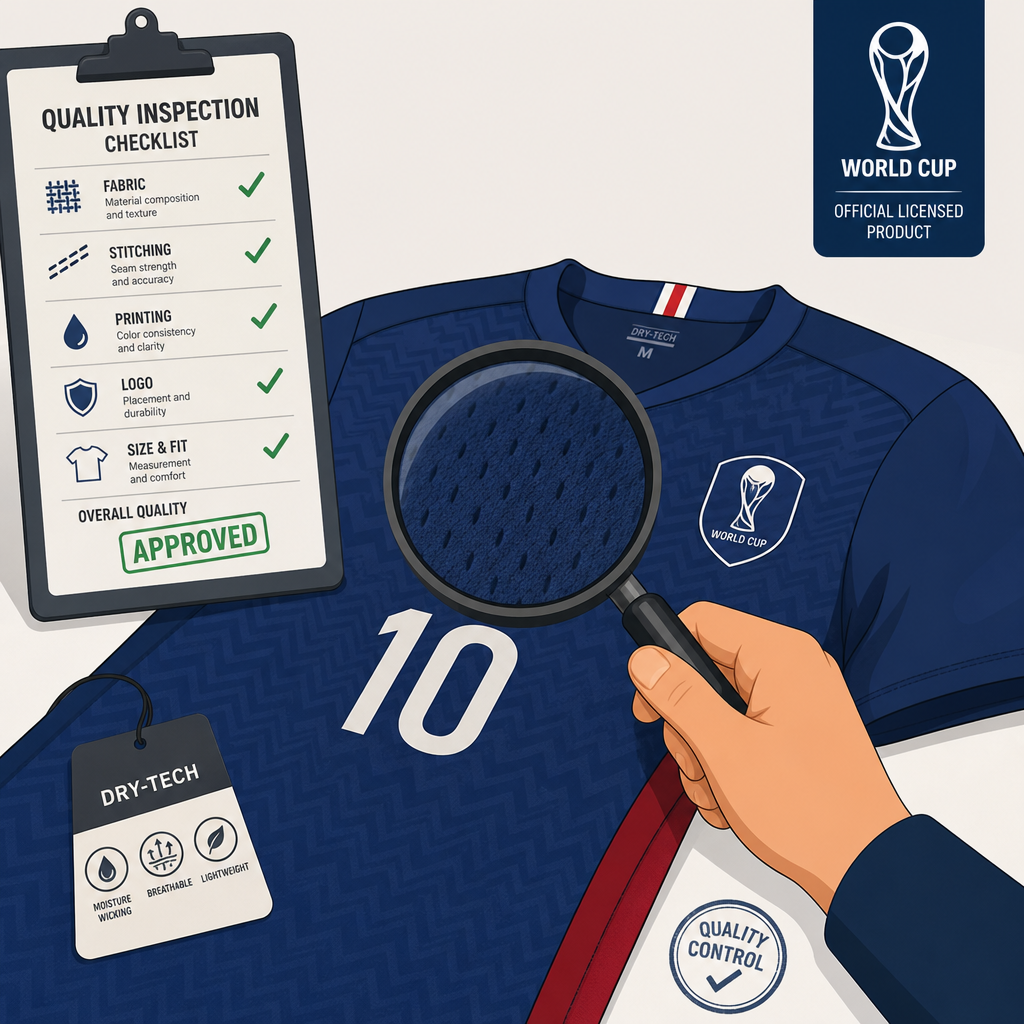
www.cloudspects.com — Pre-Shipment Inspection & Quality Control
If you are preparing an FBA inbound, run the checklist below alongside an Amazon FBA inspection China booking so nothing slips between factory and fulfillment center.
Why World Cup Merchandise Needs Specialized QC
World Cup merchandise is seasonal with a hard deadline — once the tournament ends, unsold inventory loses 60–80% of its value. A single delayed or rejected shipment can mean missing the entire selling window. Unlike general apparel, World Cup items combine multiple material types (fabric, plastic, metal, printed graphics) in one product, each with distinct QC requirements.
Data point: CloudSpects inspected 85 World Cup merchandise shipments during the 2022 cycle. 38% failed initial inspection on physical quality grounds — separate from any chemical or compliance issues. The most common failure categories: print quality (43%), fabric defects (31%), and stitching/seam issues (26%).
This post covers the 12 physical QC checkpoints that apply specifically to World Cup merchandise — covering fabric, print, stitching, metal/plastic components, and FBA packaging.
Fabric Quality Checks — Jerseys, Scarves, and Flags
Check 1: Fabric Grammage (GSM) Verification
World Cup jerseys and scarves are commonly specified at a target GSM (grams per square meter). The factory-approved sample should have the GSM documented. At inspection, the inspector measures 10 units across different cartons using a circular cutter and digital scale.
22% of jersey shipments CloudSpects inspected had fabric grammage 8% or more below the approved sample — a common cost-cutting technique where the factory uses lighter fabric to save $0.15–$0.25 per unit.
✓ Cut 3 samples from different areas of each garment (front, back, sleeve)
✓ Weigh on calibrated scale — tolerance typically ±5% of target GSM
✓ Compare against sealed approved sample stored with the inspection company
✓ For flags: also check fabric opacity — a flag that is too thin (below 90 GSM) will be see-through when flown
Check 2: Tear Strength and Seam Slippage
World Cup scarves and flags are subjected to pulling, waving, and handling. Tear strength testing ensures the fabric can withstand normal use without ripping. Seam slippage testing checks whether seams pull apart under stress — a critical issue for scarves that are tied around necks.
Simple field test: apply 2 kg of tension to a 10 cm wide fabric strip held at the seam. Measure any gap that forms at the seam line. Acceptable seam slippage: less than 6 mm. For flags, the test applies to the hemmed edge where the flagpole sleeve is attached.
Check 3: Color Fastness to Rubbing and Washing
Deeply dyed World Cup merchandise — especially the vibrant national team colors — is prone to dye transfer. A wet rub test (ISO 105-X12) checks whether color transfers to a white cloth when rubbed. For jerseys, a wash test (ISO 105-C06) checks whether colors bleed after washing.
17% of dark-colored World Cup scarves (deep red, navy blue, black) tested with color fastness grade below 3 (on a scale of 1–5, where 3 is minimum acceptable for sports apparel).
Print Quality — Screen Printing, DTG, and Heat Transfer
World Cup merchandise is defined by its printed graphics — team logos, player names, tournament branding. Print quality failures are the #1 reason for inspection rejection of these products.
Check 4: Print Adhesion and Wash Resistance
Three common print methods for World Cup merchandise:
1. Screen printing (most common). Ink must penetrate the fabric fully — not sit on the surface. Inspector checks for: ink cracking when bent (fold test at 180°), adhesion after 30 seconds of rubbing, and ink transparency (fabric color showing through). Screen-printed designs should survive 20+ wash cycles per AATCC 135.
2. DTG (direct to garment). Used for complex multi-color team crests. Check for: white ink underbase coverage (insufficient underbase = faded colors), hand-feel after printing (excessive ink = stiff, plastic-like texture), and edge sharpness at 2× magnification.
3. Heat transfer vinyl (HTV). Common for names and numbers on jerseys. Check edge peeling at corners (pick test with tweezers), heat seal pressure marks, and alignment of multiple layers. 12% of HTV-applied jersey numbers peel at the edges within 5 washes.
Check 5: Print Registration and Alignment
Multi-color prints (team crests, tournament logos) require precise registration — each color layer must align perfectly. Misregistration of even 0.5 mm is visible on close inspection and indicates poor screen setup.
✓ Inspect under 5× magnification — check that all color boundaries are sharp
✓ Measure logo position from collar and side seams — tolerance ±3 mm
✓ Check mirrored/symmetrical elements (e.g., stars on national crests) for symmetry
✓ Verify that text (player names, tournament text) is horizontally level within 1°
Check 6: Print Durability — Abrasion and Crocking Test
For printed items that will rub against skin (jersey chest logos, sleeve patches) or against other surfaces (scarf prints), abrasion resistance is critical. A standard crockmeter test (AATCC 8) rubs a white cloth against the printed surface 10 times. Any significant ink transfer to the cloth indicates poor curing.
Data point: 1 in 4 World Cup jersey shipments from budget factories ($4–$8/unit wholesale) fail crocking tests on dark-colored print areas. The fix is longer curing time at higher temperature — adding $0.03 per unit in energy cost.
Stitching and Seam Quality
Check 7: Stitches Per Inch (SPI) and Thread Tension
For jerseys, the standard is 10–12 stitches per inch on main seams. Fewer stitches means weaker seams that can separate under stress. The inspector checks SPI on 5 seam types per garment: shoulder, side, sleeve hem, collar, and bottom hem.
Thread tension issues show as puckered seams (too tight) or loopy seams (too loose). Both indicate machine calibration problems that will affect all units produced in the same batch. If 2+ units from different cartons show the same tension issue, reject the entire production run.
Check 8: Loose Threads and Open Seams
A loose thread count above 3 per garment is a quality flag. Unfinished seams (raw edges not overlocked) are a critical defect — they will unravel during the first wash. For scarves, the fringe end must be securely locked with 3+ backstitches at each end.
Size and Fit Verification
Check 9: Critical Dimension Measurement
For FBA-listed apparel, size consistency across units is critical. Even slight size variation causes customer returns. The inspector measures:
✓ Chest width (flat measurement, 2.5 cm below armhole) — tolerance ±1 cm
✓ Body length (HPS to bottom hem) — tolerance ±1.5 cm
✓ Sleeve length (shoulder point to cuff) — tolerance ±1 cm
✓ Scarf length and width — tolerance ±2 cm on length, ±0.5 cm on width
✓ Flag dimensions — tolerance ±1% (critical for flagpole sleeves and grommet alignment)
Collectible Items — Pins, Keychains, and Figurines
Check 10: Metal Finish and Backing Integrity
World Cup commemorative pins and keychains are typically zinc alloy or brass with enamel fill. The inspector checks: enamel fill level (should be flush with metal walls, not recessed), pin clasp security (butterfly clutch or rubber clasp must hold with 500 g pull force), and surface finish (no bubbles, pinholes, or discoloration on 10× magnification).
Check 11: Plush Mascot Construction
Plush mascots combine fabric, stuffing, and plastic components. Key QC points: seam strength (2 kg pull at the weakest seam), stuffing distribution (no lumps or empty corners), eye/button attachment security (20 lb tension test per ASTM F963), and surface cleanliness (no glue marks or loose fibers).
FBA Packaging Requirements for World Cup Merchandise
Check 12: Poly Bag, Carton Labeling, and Unit Pack
World Cup merchandise destined for Amazon FBA must satisfy specific packaging requirements beyond standard quality:
✓ Poly bag thickness must be ≥1.5 mils and include suffocation warning in English and destination-country language
✓ Poly bags for apparel must have a 4.5 mm diameter perforation hole every 30 cm or an opening that exceeds the bag perimeter
✓ Each unit FNSKU barcode must be scannable through the poly bag — test with 3 different barcode scanners
✓ Carton weight must not exceed 50 lb (22.7 kg) — 15% of jersey shipments CloudSpects inspected had cartons over this limit
✓ Carton dimensions must not exceed 25 inches on any side (standard FBA casepack rule)
Full Inspection Workflow
1. Document review (15 min). Check PO, approved sample card, size spec sheet, and FBA packaging requirements.
2. Fabric test (30 min). GSM measurement on 10 units. Tear strength on 3 units. Color fastness rub test.
3. Print inspection (30 min). 20 units examined for adhesion, registration, alignment, and crocking.
4. Stitching QC (20 min). SPI measured on 10 units. Loose thread count. Open seam check.
5. Dimension check (20 min). 10 units measured and compared to spec sheet.
6. Collectible inspection (20 min). Pin clasp, enamel fill, plush seam strength, eye attachment.
7. FBA packaging audit (20 min). Poly bag compliance, carton weight, label scan test.
Total inspection time for a mixed World Cup merchandise shipment: approximately 3–4 hours for 2,000–5,000 units across 3–5 SKUs.
Cost Comparison: Inspection vs Returns and Markdowns
World Cup merchandise is high-velocity, low-margin. A $8 jersey at wholesale sells for $25 on Amazon FBA. After FBA fees ($6–$8) and advertising (15%), the net margin is $6–$8 per unit. A single return due to size inconsistency or print peeling eliminates the profit from 3–4 other sales.
A $169 pre-shipment inspection for a 5,000-unit World Cup jersey shipment costs $0.034 per unit. The average return rate for uninspected apparel on FBA is 15–25%. An inspection that catches print defects and size inaccuracies can reduce returns to 8–10% — saving $3,000–$5,000 in return-related costs alone.
How CloudSpects Inspects World Cup Merchandise
CloudSpects offers a World Cup merchandise inspection package covering all 12 checkpoints: fabric GSM measurement, print adhesion and crocking tests, SPI measurement, dimension verification, collectible enamel/pin checks, and FBA packaging compliance audit. Our inspectors bring calibrated tools — fabric cutters, scales, crockmeters, and barcode scanners — to every inspection.
$169 per man-day — English reports with photos in 24–48 hours.
At CloudSpects, we serve importers across China — Yiwu, Shenzhen, Guangzhou, Shanghai, and beyond.
#WorldCup #JerseyInspection #SportsMerchandise #PreShipmentInspection #FBA #ApparelQC #PrintQuality #CloudSpects #QualityControl #FootballMerchandise
Related Articles
- World Cup Merchandise QC Inspection — Fabric Testing, Print Durability, and FBA Compliance for Jerseys, Scarves, Flags, and Collectibles
- Fabric Quality and Print Durability Testing for World Cup Merchandise — 4 QC Checkpoints That Catch 90% of Defects Before FBA Shipment
- World Cup Merchandise FBA Inbound — 6 Packaging and Labeling Checks That Stop 90% of Rejections