Lithium Batteries on the Water: 6 Dangerous-Goods Checks Before Your Holiday Electronics Container Sails
One Missing Label Held 7,200 Units at the Dock It was a textbook September story: a seller orders 7,200 rechargeable hand warmers for the cold-weather season, the factory produces them in twelve days, the quality on the units is genuinely good — and then the container does not sail.
One Missing Label Held 7,200 Units at the Dock
It was a textbook September story: a seller orders 7,200 rechargeable hand warmers for the cold-weather season, the factory produces them in twelve days, the quality on the units is genuinely good — and then the container does not sail. Not because of a defect. Because of a lithium battery label that was never printed, and a UN38.3 test summary that named a different cell than the one inside the product. 🚢
The unit quality was never the problem. The dangerous-goods paperwork was. And that paperwork is a pre-shipment problem, not a port problem.
If you sell battery-powered holiday electronics to Amazon FBA — hand warmers, LED mirrors, portable speakers, anything rechargeable — the six checks below are the difference between a container that loads on schedule and a container that sits at the dock for nine days while you pay someone else to fix the labels. The full check sequence is part of our pre-shipment inspection services, and sellers booking through Amazon FBA inspection China get the dangerous-goods module folded into the same visit, from $169 per man-day.
Why a Battery Product Is Not a Normal Product
Most Amazon sellers think of "quality" as workmanship: does the seam line up, does the app pair, does the color match the sample. With lithium products there is a second gate that has nothing to do with how the product looks — how it is allowed to travel. 🌡️
Under international transport rules, rechargeable lithium products ship as dangerous goods. Every export carton should carry a lithium battery mark with the right UN number — UN3481 when the battery is inside the equipment (your hand warmer), UN3480 when loose cells travel on their own. The shipper needs a UN38.3 test summary covering the actual cell model, a safety data sheet (SDS) that matches the real chemistry, and — for ocean freight since 2024 — a state-of-charge ceiling around 30% under the IMDG Code. Amazon adds its own layer: battery ASINs must pass its hazmat review before FBA will accept them.
None of that shows up in a visual quality check. All of it shows up the moment your forwarder tries to book the container. 🔋
Six Checks Before the Container Door Closes
Here is the checklist our inspectors run on battery-powered orders, and what each check actually protects:
| # | Check | What we verify on site | The failure it prevents |
|---|---|---|---|
| 1 | Lithium battery mark | Every sampled export carton carries a visible UN3480/UN3481 lithium battery mark — printed or stickered, not hidden under tape | Carrier refuses unmarked cartons; emergency re-labeling at the port costs $0.50–$1.00 per unit plus days of delay |
| 2 | UN number matches the product | The mark and the shipping docs say UN3481 (battery contained in equipment), not UN3480 | A wrong UN number is a false declaration — the fastest way to get a container pulled for inspection |
| 3 | UN38.3 summary vs the real cell | The cell model and chemistry on the test summary match the marking printed on the cell inside the unit | A mismatched summary is invalid documentation — re-testing takes 4–8 weeks and can blow the whole season |
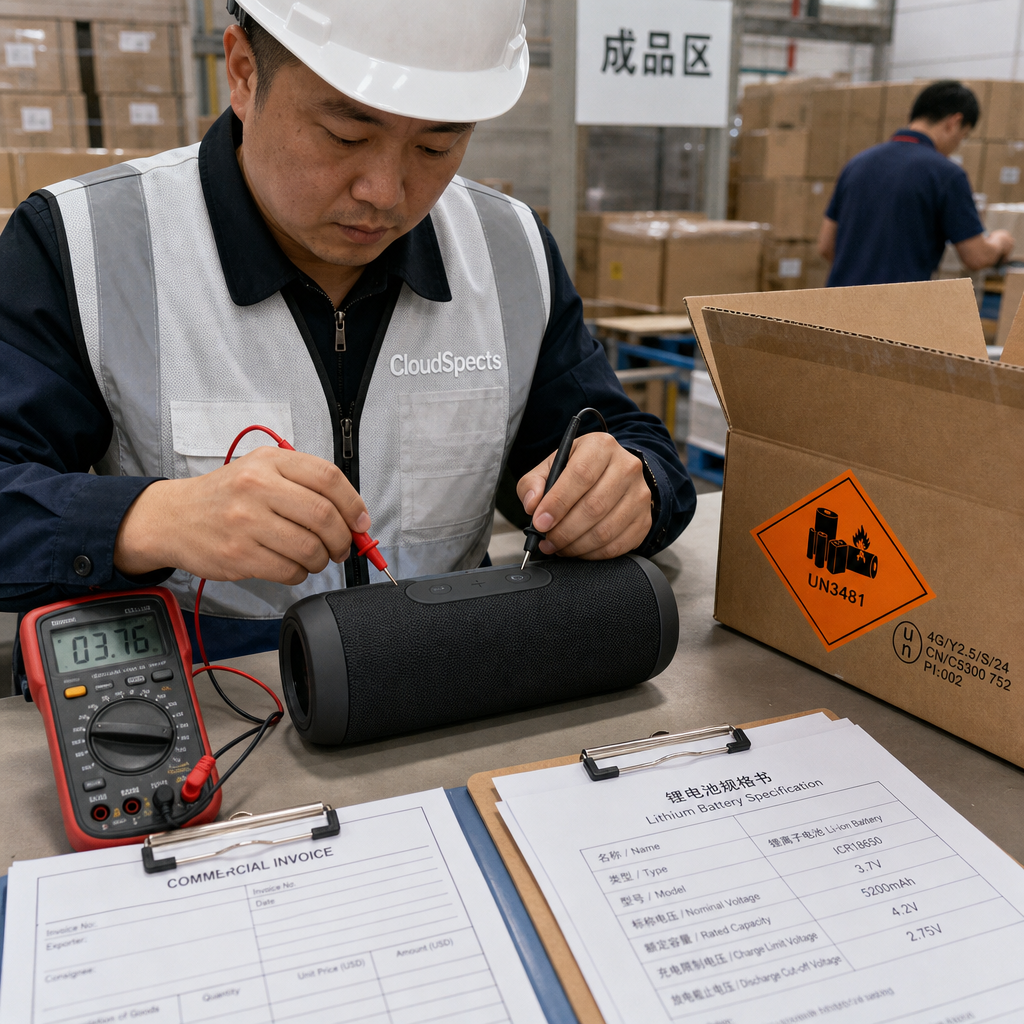
| 4 | State of charge | Resting voltage spot-check on sample units — roughly 3.7–3.8 V or below for a standard 3.7 V cell (about 30% charge) | Over-charged cells are rejected by carriers and are a genuine fire risk in a sealed container |
| 5 | SDS matches the chemistry | English safety data sheet covers the actual battery chemistry, product name and shipper, with a 24-hour emergency contact | Generic or wrong-chemistry SDS fails the forwarder's document check at booking time |
| 6 | FBA hazmat + DG declaration | Seller-side: ASIN passed Amazon hazmat review; forwarder has a signed DG declaration before booking | Undeclared battery stock can be rejected at the Amazon receiving dock — after you already paid the freight |
Checks 1 through 5 happen at the factory, on the same visit as the quality inspection, using an AQL 2.5 sample of cartons and units — you can run the sample math in our AQL calculator before you book.
The Case: 7,200 Hand Warmers and a Five-Page Template
A seller we work with ordered 7,200 rechargeable hand warmers, $54,000, planned to arrive the first week of October — right when the "cold hands" searches start. The factory assured him it was "the same as last year." It was not. ⏰
When the forwarder asked for the DG pack, three things fell apart: the cartons had no UN3481 mark (just the product name printed on the side), the UN38.3 summary referenced an ICR18650-26V cell while the unit actually contained an INR18650-29E, and the SDS was a generic template for a nickel-metal-hydride battery — a completely different chemistry. The booking was refused eight days before the intended sail date.
The fix cost real money: re-labeling and re-packing at the port ran $0.60 per unit × 7,200 = $4,320, rush booking added $1,600, and the container arrived in late October instead of October 5 — the seller missed the first three weeks of the cold-weather buying window entirely. Total damage was north of $5,900 plus lost sales velocity.
On his next order we ran the DG module as part of the pre-shipment inspection: an 80-carton sample confirmed marks on every carton, the cell model on the test summary matched the cell inside the product, a 20-unit voltage spot-check read between 3.62 and 3.78 V (inside the 30% ceiling), and the SDS matched the chemistry. The container sailed the same week. The extra inspection cost: about $507 for two man-days — roughly one-tenth of what the paperwork failure cost. 💸
Who Closes Each Check: Inspector, Seller or Forwarder
A quick note on ownership, because this trips everyone up. The inspector verifies what is physically true at the factory: marks on cartons, model numbers on cells, state of charge, SDS content. But two checks live at your desk: the Amazon hazmat review for the ASIN, and the DG declaration your forwarder files. Ask your forwarder for the exact DG requirements before production starts — not after the container is stuffed. When the factory documents and the on-site reality match, the whole thing takes hours instead of weeks.
The Bottom Line
Holiday electronics are a lithium story now — hand warmers, LED mirrors, speakers, chargers, everything rechargeable. The units can be flawless and the shipment can still fail on paperwork that nobody checked at the factory. That is exactly the kind of expensive surprise a pre-shipment inspection exists to catch. ✅
We run dangerous-goods verification as part of standard inspections for Amazon sellers — 2,000+ inspections a year, reports back within ~24 hours, pricing from $169 per man-day. If your Q4 order has a battery in it, contact us with your PO and we will confirm the DG module is on the checklist before your container door closes.
FAQs
Do all battery-powered products need dangerous-goods paperwork for ocean freight?
If the product contains lithium-ion cells that require UN38.3 testing, yes. Most rechargeable consumer electronics ship as UN3481 (batteries contained in equipment), and both the cartons and the shipping documents must carry the correct marks.
Can't my freight forwarder just handle the DG paperwork?
Your forwarder files the declaration, but they can only declare what the factory's documents and carton marks support. If the UN38.3 summary names a different cell, or cartons show no battery mark, the booking is refused at origin — and you pay for the re-labeling, re-packing and demurrage.
Is the 30% state-of-charge limit actually enforced on ocean shipments?
Under special provision 376 of the IMDG Code, major carriers have enforced a 30% state-of-charge ceiling for lithium-ion batteries since 2024, more strictly every peak season. We spot-check resting voltage on sample units so you are not surprised at the port.
What is the difference between UN3480 and UN3481?
UN3480 is loose lithium-ion batteries shipped on their own. UN3481 is batteries contained in equipment or packed with it. The wrong UN number on a carton or declaration is a common reason containers get pulled for inspection.
I sell only to Amazon FBA. Do I still need a hazmat review?
Yes. Battery ASINs go through Amazon's hazmat review before FBA will accept them, and undeclared battery stock can be rejected at the receiving dock. The hazmat classification is your desk-side check; the carton marks, cell match and state of charge are what we verify at the factory.
Frequently asked questions
Do all battery-powered products need dangerous-goods paperwork for ocean freight?
If the product contains lithium-ion cells that require UN38.3 testing, yes. Most rechargeable consumer electronics ship as UN3481 (batteries contained in equipment), and both the cartons and the shipping documents must carry the correct marks.
Can't my freight forwarder just handle the DG paperwork?
Your forwarder files the declaration, but they can only declare what the factory's documents and carton marks support. If the UN38.3 summary names a different cell, or cartons show no battery mark, the booking is refused at origin — and you pay for the re-labeling, re-packing and demurrage.
Is the 30% state-of-charge limit actually enforced on ocean shipments?
Under special provision 376 of the IMDG Code, major carriers have enforced a 30% state-of-charge ceiling for lithium-ion batteries since 2024, more strictly every peak season. We spot-check resting voltage on sample units so you are not surprised at the port.
What is the difference between UN3480 and UN3481?
UN3480 is loose lithium-ion batteries shipped on their own. UN3481 is batteries contained in equipment or packed with it. The wrong UN number on a carton or declaration is a common reason containers get pulled for inspection.
I sell only to Amazon FBA. Do I still need a hazmat review?
Yes. Battery ASINs go through Amazon's hazmat review before FBA will accept them, and undeclared battery stock can be rejected at the receiving dock. The hazmat classification is your desk-side check; the carton marks, cell match and state of charge are what we verify at the factory.