Passed Inspection, Failed in Week Three: 6 Tests That Catch Intermittent Defects Before Your Q4 Order Ships
Your inspection report says 1. 4% major defects. The factory fixes them, you pay the balance, and the container sails. Three weeks after launch the returns start.
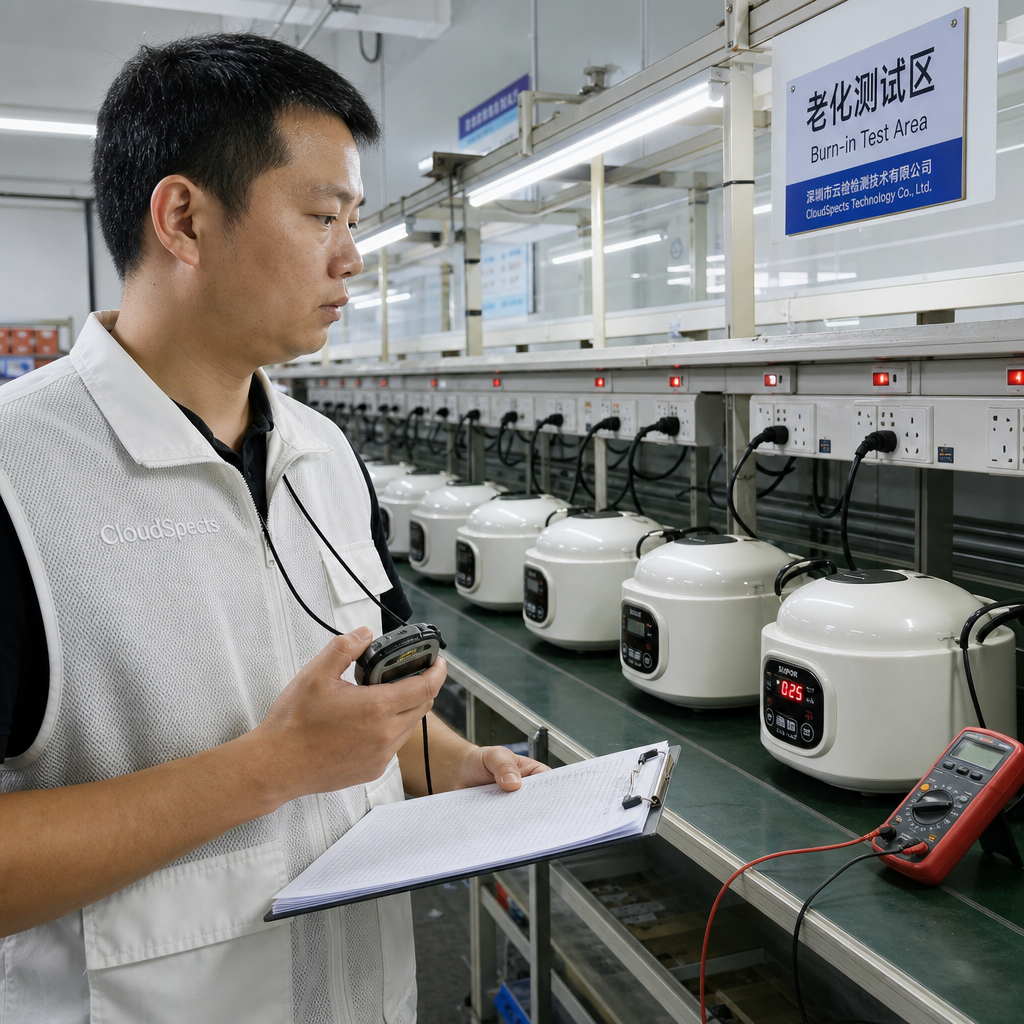
Your inspection report says 1.4% major defects. The factory fixes them, you pay the balance, and the container sails. Three weeks after launch the returns start. 😤 Not the same defects either. These are new ones — the unit that looked perfect on the bench dies on day 19.
That is not a failed inspection. It is the wrong test. A one-day visual check finds defects that exist right now: cracks, missing screws, wrong labels, bad stitching. It cannot see a solder joint that opens after 30 minutes of heat, or a spring that sags after 400 presses. Those live in their own family of checks.
CloudSpects runs Amazon FBA inspection China programs across 2,000+ inspections a year, and the pattern repeats every Q4: an intermittent fault costs five to ten times more in January than it does inside the factory.
⏰ Why a unit can pass inspection and still fail in week three
Three things are true at the same time on inspection day.
The bench is comfortable. Room temperature, clean power, a unit that was assembled this morning. Stress is what makes intermittent defects appear, and an inspection bench removes most stress.
The check is a snapshot. Continuity, voltage and fit are measured once. A joint that is marginal passes that one measurement.
Time is not tested. Plastic creep, spring fatigue, coating cure and cell balance all need days or cycles to become visible. Nobody waits three weeks on a factory floor.
So the report is honest, and the batch still fails in the field. Two different jobs were never done.
🎯 The four defect families that hide on inspection day
| Defect family | Looks fine on the bench | What triggers it later | Typical products |
|---|---|---|---|
| Cold or marginal solder joint | Reads perfect when cold | Heat cycling opens the joint | Chargers, motors, LED drivers, controllers |
| Spring, crimp and contact fatigue | Switch clicks, terminal holds | 300-500 cycles loosen contact | Switches, release buttons, latches, plugs |
| Creep and under-cured coating | Dimensions pass today | 2-6 weeks of sag, warp or rust | Housings, powder coating, foam, gaskets |
| Cell and motor imbalance | Full charge reads fine | 20-40 cycles later, runtime drops | Any lithium or motor-driven product |
Notice what these have in common: nothing is broken yet. There is no defect to count, which is exactly why a defect-counting system walks straight past them.
🧪 The 6 checks that expose intermittent faults
These are the line items we add when a product has electronics, moving parts, or both. Each is priced in man-days, not magic.
| Check | What it catches | How we run it | Pass gate |
|---|---|---|---|
| Burn-in / power soak | Cold solder, thermal shutdown, driver faults | 45-60 minutes at rated load, units from sealed cartons | Zero dropouts; any failure is a major defect |
| Function cycle test | Switch, latch and hinge fatigue | 500 on/off cycles or 10,000 hinge cycles on 20-30 units | No contact loss, no cracked pivot, no drift |
| Thermal soak | Heat-related shutdown and cell imbalance | 40°C for 4 hours, then a cold start and recharge | Starts and charges on the first attempt |
| Vibration and packed drop | Loose joints, cracked housings, cracked boards | Vibration table, then one corner and three edges per ISTA 1A for the weight class (typically 60-80 cm) | No functional failure, no internal rattle |
| Pull and torque on terminations | Crimp and screw-terminal faults | 30 N pull for 10 seconds on every termination family | No movement, no resistance change |
| Light overload | Marginal design and weak protection | 1.2x rated load for 10 minutes, then repeat the function check | No cut-out, no deformation, no smell |
One rule matters more than the list: units must come from sealed finished cartons across different carton ranges. If the factory knows which units go on the bench, you are testing their samples, not your order.
📊 Why sampling alone cannot see this
Run the numbers on a real order. 4,800 units, AQL 2.5, Level II, gives a sample of 200 with an acceptance number of 10 and rejection at 11. Now suppose the batch carries a 2% intermittent defect rate. You expect about 4 bad units in the sample, and 10 are still allowed. The batch passes — and so would most batches like it.
Sampling protects you against visible defects in proportion to how often they appear. Intermittent faults do not behave that way. So the fix is different: test 100% of a defined run for burn-in, and test a smaller group for longer with cycles and soak. Run it yourself on the AQL calculator and you will get the same answer we did.
The practical version most of our clients use: standard AQL for visual and functional checks, plus one burn-in line, plus one cycle line. Usually one extra man-day. At from $169/man-day, that is $169-338 on an order worth six figures.
💸 Two bills for the same batch
Case: 4,800 portable tire inflators, $31 each, a $148,800 order from a Guangdong factory. The standard inspection came back at 1.5% majors, which is a normal and decent result. Then the burn-in line ran 100 units for 60 minutes at rated load.
At minute 25, unit 7 stopped. At minute 40, four more followed. The cause was a cold solder fillet on the motor driver board, roughly 0.3 mm, invisible to the eye, and perfect on a cold continuity test. 🔍 The cycle test then found 4 more faults between 180 and 400 presses.
The factory reworked 210 units, re-soldered the driver joints, and re-ran a 60-minute burn-in on every reworked unit. Cost: $2,300 and three days before the vessel cut-off. Re-inspection came back at 1.1% majors.
The January version of the same batch: a 6% return rate on 4,800 units is 288 units back. At $31 that is $8,930 refunded, plus return shipping at roughly $4 per unit, plus removal if they cannot be resold, plus the conversion drag on a listing that now carries reviews about a product that "stopped working." Same factory, same batch. Only one of those bills was optional.
🏷️ The 3 lines to add to your QC brief
You do not need a technical spec to ask for this. Copy three lines:
1. Burn-in: 45-60 minutes at rated load on 100 units drawn across carton ranges. Any dropout is a major defect.
2. Cycles: 500 on/off cycles, or 10,000 hinge cycles, on 30 units across at least two pallets.
3. Disposition: if either test fails, rework and re-test the affected batch before shipment, with a raw test log that carries timestamps and unit IDs.
The third line is the one people forget. Without it, a fail is an argument. With it, it is a rework instruction the factory can follow and you can verify. Our inspection services quote these as separate line items, so you see the cost before you approve.
Frequently asked questions
What is a burn-in test in a pre-shipment inspection?
A burn-in runs a sample of finished units under power at rated load for 45-60 minutes or more, drawn from sealed cartons. It catches faults that only appear after warm-up, such as cold solder joints, marginal drivers and thermal shutdowns.
Can AQL sampling find intermittent defects?
Rarely. Sampling counts visible defects. A fault that appears in 2% of units can still pass an AQL 2.5 plan, because a few failures inside the sample are allowed. Intermittent risk needs time-based tests or full testing of a defined run.
How much does burn-in and cycle testing cost?
Usually one extra man-day per test line. CloudSpects charges from $169/man-day, so burn-in plus a cycle test typically adds $169-338 to an inspection. Reports come back typically within 24 hours.
Which products need cycle testing instead of visual checks?
Anything with a moving interface: switches, latches, hinges, folding frames, release buttons and plug connections. If a customer will operate it hundreds of times, test it hundreds of times.
Will a factory agree to burn-in testing?
Most do once it is written into the QC brief and the purchase order. Factories dislike rework after shipment even more than you do. If a supplier refuses time-based testing outright, treat that as information about the order.
Pricing and how to book
A standard pre-shipment inspection or a full FBA program — visual checks, function tests, burn-in and cycle lines, photos of every defect, and a report typically within 24 hours. CloudSpects has completed 2,000+ inspections a year for Amazon sellers and importers. Send us your order details and you will have a same-day quote from $169/man-day.
Frequently asked questions
What is a burn-in test in a pre-shipment inspection?
A burn-in runs a sample of finished units under power at rated load for 45-60 minutes or more, drawn from sealed cartons. It catches faults that only appear after warm-up, such as cold solder joints, marginal drivers and thermal shutdowns.
Can AQL sampling find intermittent defects?
Rarely. Sampling counts visible defects. A fault that appears in 2% of units can still pass an AQL 2.5 plan, because a few failures inside the sample are allowed. Intermittent risk needs time-based tests or full testing of a defined run.
How much does burn-in and cycle testing cost?
Usually one extra man-day per test line. CloudSpects charges from $169/man-day , so burn-in plus a cycle test typically adds $169-338 to an inspection. Reports come back typically within 24 hours.
Which products need cycle testing instead of visual checks?
Anything with a moving interface: switches, latches, hinges, folding frames, release buttons and plug connections. If a customer will operate it hundreds of times, test it hundreds of times.
Will a factory agree to burn-in testing?
Most do once it is written into the QC brief and the purchase order. Factories dislike rework after shipment even more than you do. If a supplier refuses time-based testing outright, treat that as information about the order.