Who Pays When a Bad Batch Hurts Someone: Product Liability for Amazon Sellers
🧾 The chain nobody reads until something breaks A defect that injures a buyer stops being a customer-service problem and becomes a legal one, and the paperwork trail decides who writes the cheque.
🧾 The chain nobody reads until something breaks
A defect that injures a buyer stops being a customer-service problem and becomes a legal one, and the paperwork trail decides who writes the cheque. Most importers start with one comfortable assumption: the factory made it, so the factory owns it. That assumption survives until the first claim lands. Long before any lawyer arrives, the only thing that matters is what you can prove about the batch you shipped - which is exactly what an Amazon FBA inspection China programme is for.
We run 2,000+ inspections a year for Amazon sellers, and the pattern is boringly consistent. The seller holding a dated, signed, photo-backed third-party report from before the container left China argues from a completely different seat than the seller whose only evidence is a WeChat thread promising good quality.
⚖️ Where the risk actually sits
Liability is a relay, not a single point. Each party controls something and, in practice, carries something else.
| Party | What they control | What usually lands on them |
|---|---|---|
| Chinese factory | Materials, tooling, process, assembly | Contractual rework and replacement - if the contract says so and you can prove the batch |
| Trading company | Which factory actually runs the order | Everything the factory denies, because they sourced it |
| Importer of record | Specification, testing, labelling, QC scope | Product-safety and regulatory exposure at the border |
| Amazon seller / FBA | Listing claims, warnings, packaging | Consumer claims, refunds, removal fees and account health |
The relay matters because the party with the least control often carries the most exposure. A trading company that quietly moved your order to a cheaper line keeps the margin and hands you the risk; a factory that ran a substitute material mid-run keeps the paperwork tidy and hands you the batch. The importer of record sits at the end of that relay in law, which is why the only practical defence is the one you built before shipping.
🔍 The document that changes the conversation
A third-party report is not a certificate and it is not a warranty. It is time-stamped evidence that on a given day, at a given factory, a named sampling plan was applied and specific defects were counted. That is enough to move a real argument from your word against theirs to here is what the goods were when they left. Size that sampling plan with the AQL calculator on our site, and the numbers stop being negotiable.
🧪 Case: the heater that failed after 40 days
An importer shipped 1,400 portable space heaters, FOB $19.80 each, roughly $27,700 of goods. Five weeks into the season, eleven units had scorched their own housing and two customers filed claims. The factory opened with a familiar line: the units left in perfect condition.
What saved the seller was a pre-shipment report showing that the moulded housing on that batch measured 1.9 mm against a 2.5 mm specification, and that the same thin wall had been flagged on fifteen units out of a sample of 125. The defect had been photographed and counted before the container was sealed. The factory funded the rework, the seller replaced the units from a corrected second run, and the total exposure stayed in the low four figures instead of the high five.
🛡️ Insurance without evidence is just an argument
Product-liability cover is quoted on the risk you describe, and most policies ask the same question in different words: what checks do you apply before you ship? A written QC scope, an agreed sampling plan and archived reports are the difference between a policy that responds and a claim that turns into a negotiation. Ask your broker which evidence they want retained and for how long, then make sure your inspection partner stores it that way from day one.
📸 What to capture while the goods still exist
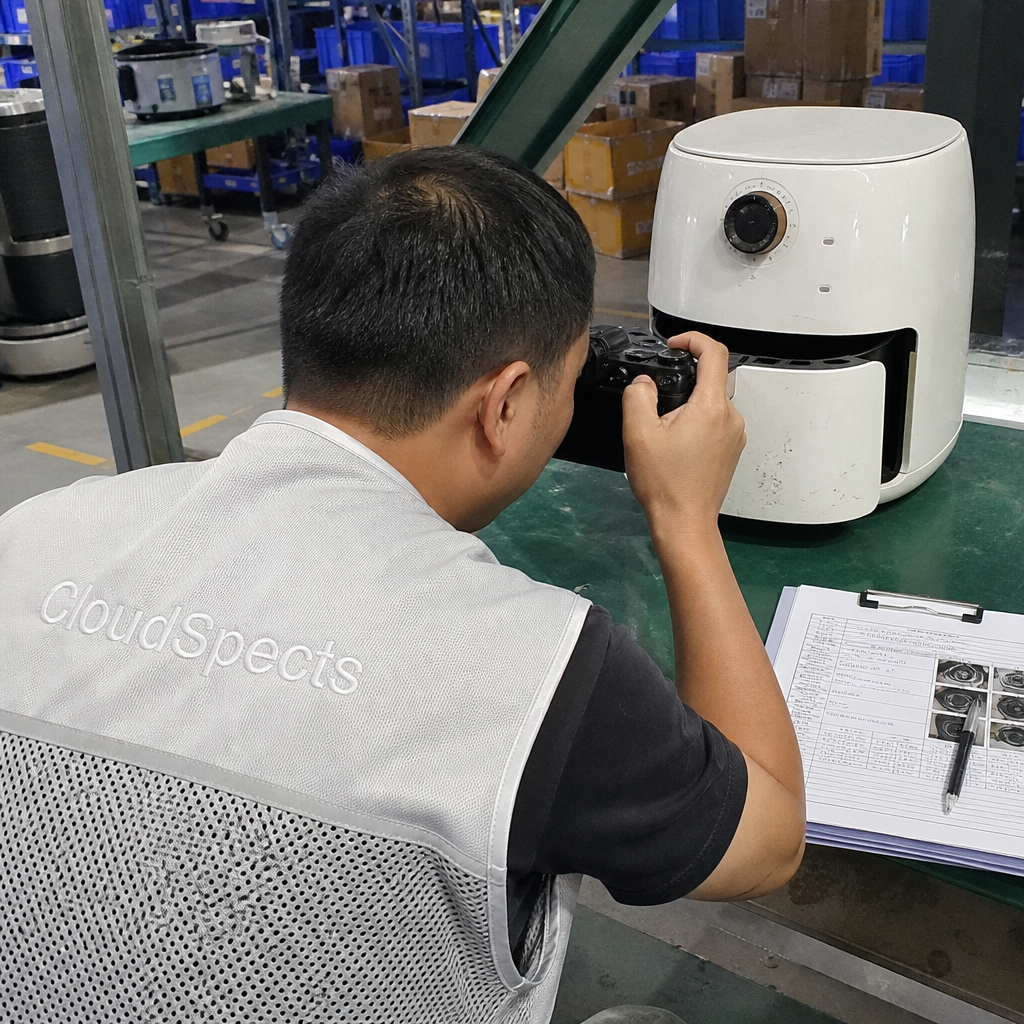
Evidence decays quickly. Once the container is sealed and the goods are on a vessel you cannot re-measure anything, and a defect nobody photographed becomes a story two parties remember differently. Six things we capture on every visit, in a fixed order, so the archive is still usable months later: the unit and the measuring tool in the same frame; the defect at working distance and at close range; the carton label with lot and date code; the packing list with the counted quantity; the sample size and the accept number written down; and the report signed on site with a timestamp.
Reports are typically returned within 24 hours of the visit, which matters most when the factory is still mid-run: a line that is still running can fix a process, while a line that has packed and palletised can only rework.
🧭 The two questions a claim always asks
Strip away the legal language and every product-safety claim asks the same two things. Were the goods what they were supposed to be? And did you do what a reasonable importer does to check? You answer the first with a specification and a measured report, and the second with a habit - a scope, a schedule, and records you can actually find. Sellers who lose these arguments tend to lose them quietly, by having nothing to hand over, rather than because they did anything dishonest.
That is also why we recommend a fixed inspection rhythm rather than visits only when something feels wrong. A supplier that expects a check on every run keeps its process steady; a supplier that has never been checked drifts slowly toward whatever the cheapest material allows.
📋 Five lines to put in the next PO
One: the agreed specification with measured limits, attached rather than described. Two: the sampling plan and AQL for each defect class. Three: third-party inspection rights with short-notice access. Four: defect liability - who funds rework, who funds freight, and what happens to the balance. Five: records retention, so reports, photos and lot codes survive the claim window. Rates start at $169 per man-day on the pricing page, and one visit before shipping costs less than one settled claim.
If a batch is already on the water, keep the contact page close: the sooner we are told, the faster we can plan a re-inspection or a receiving check at your 3PL.
❓ FAQs
Does a third-party inspection transfer liability away from me?
No. It does not move legal responsibility off the importer, and any provider claiming otherwise is overselling. What it does is create dated evidence of the batch condition, which is what insurers, suppliers and eventually lawyers actually argue over.
How long should I keep inspection reports?
At least as long as your product can plausibly trigger a claim in your market, and longer than your insurer requires. Store each report with the lot codes and the shipping documents so a single batch can always be pulled out of the archive.
Can a report prove the factory was at fault?
It can prove what the goods measured and how many units failed on that day. Fault is a contractual question settled by your PO terms, which is why the liability lines matter as much as the report itself.
What if the factory refuses inspection access?
That refusal is information in itself. Document it, escalate through your contract, or arrange verification at the freight forwarder's warehouse before loading. A supplier that blocks access is showing you where your risk sits.
Do I need laboratory testing as well as inspection?
They answer different questions. Inspection counts and measures the units in front of it; laboratory testing proves compliance with a standard on a sample. Safety-critical products usually need both, and a clear report should say plainly which one you are holding.
Frequently asked questions
Does a third-party inspection transfer liability away from me?
No. It does not move legal responsibility off the importer, and any provider claiming otherwise is overselling. What it does is create dated evidence of the batch condition, which is what insurers, suppliers and eventually lawyers actually argue over.
How long should I keep inspection reports?
At least as long as your product can plausibly trigger a claim in your market, and longer than your insurer requires. Store each report with the lot codes and the shipping documents so a single batch can always be pulled out of the archive.
Can a report prove the factory was at fault?
It can prove what the goods measured and how many units failed on that day. Fault is a contractual question settled by your PO terms, which is why the liability lines matter as much as the report itself.
What if the factory refuses inspection access?
That refusal is information in itself. Document it, escalate through your contract, or arrange verification at the freight forwarder's warehouse before loading. A supplier that blocks access is showing you where your risk sits.
Do I need laboratory testing as well as inspection?
They answer different questions. Inspection counts and measures the units in front of it; laboratory testing proves compliance with a standard on a sample. Safety-critical products usually need both, and a clear report should say plainly which one you are holding.