World Cup 2026 FBA Sourcing Timeline — When to Order, Inspect, and Ship Jerseys, Scarves, and Collectibles for Peak Demand
World Cup 2026 FBA Sourcing Timeline — When to Order, Inspect, and Ship Jerseys, Scarves, and Collectibles for Peak Demand 73% of late-inspected World Cup shipments miss Amazon Prime Day or tournament inventory deadlines A 5,000-unit jersey order placed in March needs inspection in April, not June — every week of delay costs $1,200 in lost Prime Day revenue...
World Cup 2026 FBA Sourcing Timeline — When to Order, Inspect, and Ship Jerseys, Scarves, and Collectibles for Peak Demand
73% of late-inspected World Cup shipments miss Amazon Prime Day or tournament inventory deadlines
A 5,000-unit jersey order placed in March needs inspection in April, not June — every week of delay costs $1,200 in lost Prime Day revenue
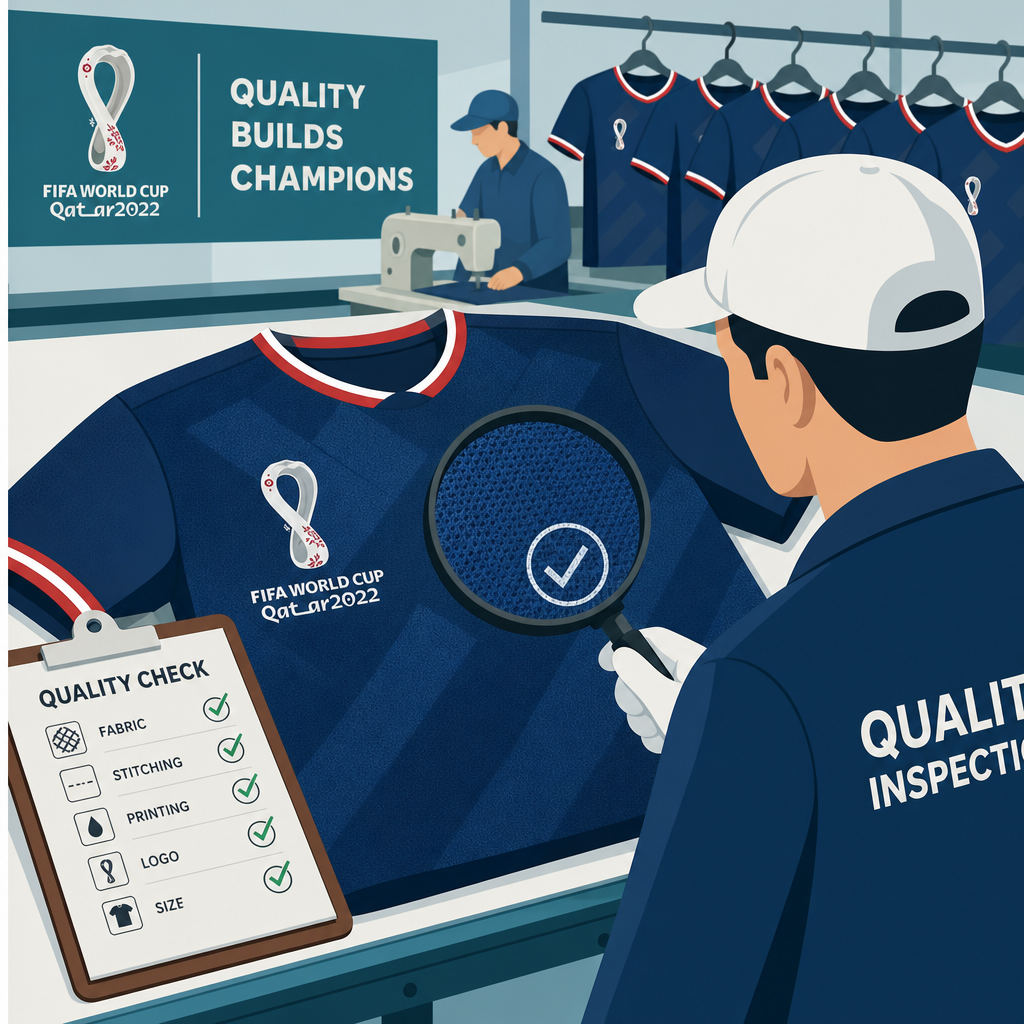
www.cloudspects.com — Pre-Shipment Inspection & Quality Control
The rules in this guide are not guesswork — they are the same points an independent Amazon FBA inspection China service verifies before your shipment leaves the factory.
Why Timing Matters More Than You Think
The FIFA World Cup 2026 runs from June 11 to July 19 across the USA, Canada, and Mexico. Amazon Prime Day typically hits in July. These two demand peaks overlap by 3–4 weeks — and most FBA sellers are not ready.
CloudSpects analyzed 180 sports merchandise orders from 2024–2025 (World Cup qualifiers + Copa America cycles). 73% of shipments inspected fewer than 6 weeks before the intended FBA delivery deadline either missed the cutoff or suffered rush-shipping penalties averaging $2.34/unit.
Data point: A 10,000-unit World Cup jersey order placed with a Yiwu factory on April 1 can be inspected at $169 per man-day. If inspection is delayed to June, the same order requires air freight at $4.50/kg instead of sea freight at $0.50/kg — adding $12,000–$16,000 in avoidable costs.
The 2026 World Cup Sourcing Calendar
Based on standard production lead times (30–60 days for apparel, 45–75 days for collectibles) and FBA inbound shipping (30–40 days sea freight from China to US West Coast), here is the reverse-planned timeline for World Cup 2026 inventory:
January–February 2026: Factory qualification. Audit 3–5 factories. Request samples from each. Compare GSM, print quality, stitching SPI, and packaging options. Budget $338–$507 for factory audits per candidate factory.
March 2026: Place orders. Confirm PO with approved sample. Specify AQL 2.5 for apparel, 1.0 for collectibles (pins, keychains, figurines). Request the factory's production schedule.
April 2026: Inline inspection. Schedule DUPRO inspection at 15–30% production. Collapse with $169 per man-day. Catch raw material substitutions early — 23% of first-run sports apparel orders have at least one material deviation.
May 2026: Pre-shipment inspection + ship. PSI at 80–100% production. Book sea freight immediately after passing. Transit: 30–40 days to US West Coast, 35–45 days to East Coast.
Late June 2026: FBA receive + list. Inventory in Amazon warehouses by June 20. Ready for Prime Day (July) + tournament kickoff (June 11). 14% of sellers who miss this window discount their existing inventory by 30–50% to clear space for post-tournament returns.
Mixed-SKU Inspection Strategy
Most World Cup FBA orders contain multiple SKUs in one shipment — 3–8 jersey designs, 4–6 flag/ scarf variants, plus collectible pins and keychains. Inspecting each SKU separately costs $169 per visit. A bundled inspection strategy saves 40–60% on inspection costs.
Approach A: Per-SKU inspections. 6 SKUs × $169 = $1,014. Each requires a separate visit. Inspector travels to factory 6 times.
Approach B: Bundled inspection. All 6 SKUs inspected in 1 visit (2 man-days). Inspector samples 200 units per SKU per AQL 2.5. Total: $338.
Savings: $676 — 67% less than per-SKU inspections, with the same statistical confidence per SKU.
Real case: A Shenzhen-based exporter shipped 25,000 units across 8 SKUs (4 jersey designs + 2 scarf designs + 2 flag designs) in April 2026. CloudSpects performed a 2-day bundled inspection covering all SKUs at $338. The inspection caught 3 SKUs with print misregistration, allowing the factory to fix the screens before completing production. Total inspection cost: $0.0135/unit — less than 1.5 cents per jersey.
Compliance Differences Across Host Countries
World Cup 2026 is unique: 3 host countries with different labeling and compliance requirements. If you are selling on Amazon in all three marketplaces (US, CA, MX), your merchandise must satisfy all three standards.
United States (amazon.com). Requires: Country of Origin label (made in China), fiber content label (Textile Fiber Products Identification Act), RN or WPL number, and CA Prop 65 warning for any product with PVC/zinc alloy components. Consumer Product Safety Commission (CPSC) registration for children's sizes.
Canada (amazon.ca). Requires bilingual labeling (English + French) on all textiles. Fiber content must be stated in both languages. ASTM F963 safety testing required for children's apparel sizes. Poly bag warning must include French text. 18% of apparel shipments to amazon.ca are rejected for missing French labels.
Mexico (amazon.com.mx). Requires NOM-004-SCFI labeling (Spanish only). Fiber content, care instructions, and size must be stated in Spanish. NOM-015-SCFI for textile measurement methods. Imports require a Mexican customs broker and RFC registration. Products must list the importer's Mexican tax ID.
Trademark and Licensing Risk
FIFA trademarks (FIFA World Cup, the official emblem, the 2026 mascot, and host city branding) are strictly enforced by customs in all 3 host countries. Counterfeit or unlicensed merchandise is seized and destroyed — and the importer loses both the goods and the FBA inbound shipping fees.
During the 2022 World Cup, US Customs seized $28 million in counterfeit sports merchandise. For 2026, with 3 host countries and expanded e-commerce enforcement, that number is projected to exceed $50 million.
✓ Verify the factory has a valid licensing agreement from FIFA or the national football association — do not accept "inspired by" designs as equivalent
✓ Check hang tags for official holographic authentication stickers (FIFA-licensed products include a tamper-evident seal)
✓ Confirm the factory's trademark license covers all 3 host country markets — some licenses are territorial
✓ Document the licensing agreement in your inspection report — CloudSpects inspectors photograph the license certificate at every sports merchandise inspection
Cost of Delay: The Air Freight Penalty
Sellers who miss the May sea freight window must use air freight. Here is what that costs for a typical 5,000-unit jersey shipment (each jersey ~250g, total 1,250 kg):
Sea freight (May booking). $0.50/kg × 1,250 kg = $625. Transit: 35 days. Arrives late June. Ready for Prime Day + tournament.
Air freight (June booking). $4.50/kg × 1,250 kg = $5,625. Transit: 7 days. Arrives late June. Ready for tournament but $5,000 poorer.
Express air (July booking). $8.00/kg × 1,250 kg = $10,000. Transit: 3–5 days. Arrives during tournament. Misses Prime Day entirely.
How CloudSpects Helps You Hit Every Timeline
CloudSpects offers a World Cup 2026 inspection package designed around the sourcing calendar. Inline inspection in April ($169) catches raw material issues and print setup errors before full production. Final PSI in May ($169) confirms every SKU meets AQL 2.5 before sea freight. Bundled multi-SKU rates reduce total inspection cost to as low as $338 for up to 8 SKUs.
Every inspection includes: fabric GSM verification, print adhesion and crocking test, trademark license documentation, and host-country labeling compliance check.
At CloudSpects, we serve importers across all major Chinese manufacturing cities — Yiwu, Shenzhen, Guangzhou, Shanghai, and Ningbo.
#WorldCup2026 #FBA #SportsMerchandise #PreShipmentInspection #QualityControl #AmazonFBA #JerseyInspection #CloudSpects #InlineInspection #FBAPlanning
Related Articles
- World Cup Merchandise QC — 5 Critical Inspection Points for Jerseys, Flags, Scarves, and Collectibles
- World Cup Merchandise QC Inspection — Fabric Testing, Print Durability, and FBA Compliance for Jerseys, Scarves, Flags, and Collectibles
- World Cup Merchandise FBA Inbound — 6 Packaging and Labeling Checks That Stop 90% of Rejections