You Asked for Eight Percent Off: Six Things That Quietly Change After a Price Cut
🎯 The cheapest word in sourcing is yes Ask a supplier for eight percent off and the answer arrives within a day, and the answer is almost always yes.
🎯 The cheapest word in sourcing is yes
Ask a supplier for eight percent off and the answer arrives within a day, and the answer is almost always yes. It is not because the factory found eight percent of waste in the last month. It is because the specification is the easiest thing on the whole order to move: a gauge, a coating thickness, a foam density, two screws out of a hardware bag. Nothing on the invoice changes — only the unit does. For an Amazon seller that difference surfaces as a return three months later, which is exactly what a one-day Amazon FBA inspection China is built to catch: a physical reading of the unit against the numbers on your purchase order, not against the photo in your listing.
Most buyers meet the change in a customer review, or in a carton that arrives 900 grams lighter than the last one. The good news is that a cost-down leaves measurable fingerprints.
💸 Six things that move when the price moves
Factories trim the same six items, in roughly the same order of preference, because they are the ones a buyer cannot see in a photo.
| What the buyer asked | What quietly changes | The reading that proves it |
|---|---|---|
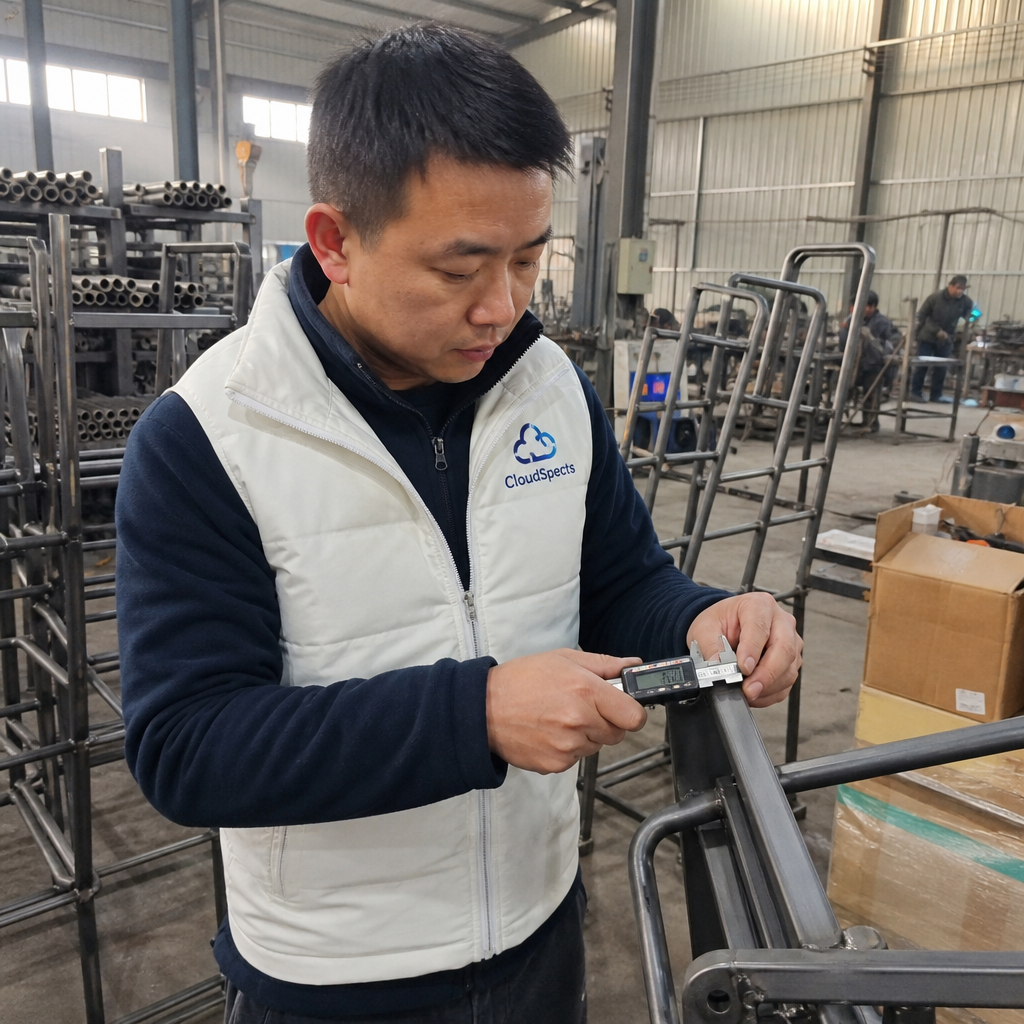
| Can you do eight percent less? | Material gauge drops on the main frame, tube or housing | Caliper at three points away from the welds: 1.10 mm becomes 0.86 mm |
| Same as the last order | A cheaper material family under an identical part number | Single-unit weight against the approved weight, plus a magnet test and a salt-spray sample |
| Keep the packaging the same | Carton board downgraded, inner protection deleted | Board caliper and carton weight, then a corner drop on the first and last pallet |
| Hardware unchanged | Screw and anchor counts trimmed, grade marks gone | Open the hardware bag against the bill of materials and weigh the whole bag |
| Same foam, same fill | Lower density fill, thinner core, no recovery time | Cut one unit open, weigh a known volume, read recovery after 24 hours |
| Same motor, same cell | A tier-down component inside a housing that looks identical | Nameplate against component ID, load test at rated duty, cell code against the test summary |
🔍 One day on site turns "same as last order" into numbers
This is not a hunt for fraud. It is the same four or five readings on every unit in the sample, each one photographed with the instrument in frame.
We measure the frame or tube at three points with a caliper and photograph the reading beside the part number. We weigh a stripped unit against the specification weight, because a six percent shortfall on a stamped frame is not a tolerance — it is a different coil of steel. We open the hardware bag, count it against the bill of materials and weigh the bag. We cut one cushion or one carton open to read the fill. We drop a coated sample into the salt-spray log and note the hour it comes out. Sampling follows AQL 2.5 Level II — 80 units up to 1,200 pieces, 125 units from 1,201 to 3,200, 200 units above that — and the AQL calculator on our site gives the accept and reject line for the lot in front of you. The report is back within 24 hours of the visit with the same five numbers every time, so two orders can be compared side by side.
📋 Four numbers that make a discount harmless
A supplier can agree to a cut because most orders never state a single measurable number. Fix that and the discount stays commercial. Four lines on the purchase order and the next shipment carries its own proof:
- Net weight per unit — 1.85 kg ± 3%. Weighable in seconds, and the fastest alarm on a material swap.
- Material and gauge — cold-rolled steel tube, wall 1.10 mm, measured at three points away from welds. One caliper, one photograph.
- Coating and fill — powder coat 60–90 µm on flats, bends and cut ends; foam at 28 kg/m³ with a 25 mm core and 24-hour recovery of 95% or better.
- Hardware and carton — per unit 4 × M6 × 40 screws, 4 anchors, 1 hex key, bag weight 84 g ± 5%; 5-layer board with corner protection on all four corners.
None of those lines tell a factory how to build the product. They tell it what will be measured, which is usually enough to move the saving back into the process.
⚖️ The honest cut and the quiet one
Not every lower price is a downgrade. A genuine cut is fewer parts through better design, a larger lot spreading tooling cost, freight weight trimmed with the buyer's agreement, a cosmetic grade accepted in writing. The saving comes out of the process.
The quiet version changes something the customer can measure, with no change note and no re-submitted sample. The test takes one email: ask for the modified drawing, the part number of any substituted component and a new sample submitted for approval. A supplier with real engineering behind the number sends all three the same day. A supplier who was already planning to change the material sends one sentence about industry standard.
This is the mirror image of the cheap-quote problem, and it is worth keeping the two apart: there the low price came first and the specification followed. Here you picked a fair supplier and then pushed the price down. Same physics, opposite direction — the first thing to move is still the specification.
📦 What the readings cost on a recent order
A buyer took seven percent off a metal-and-wood side table, $18.90 down to $17.58 FOB, 4,600 units in one container. A CloudSpects inspector ran a during-production check in week six — one man-day at the standard rate, and the pricing page shows what a second one adds. The readings: frame tube at 0.86 mm, measured at three points, against a PO specification of 1.10 mm; five of twelve assembled units rocking 2.5–3.0 mm because the cross-bar count had dropped from four to three; powder coat at 41 µm on the flats against a 60 µm minimum; inner corner protection gone, with two of the first four cartons already crushed.
The correction stayed inside the production window: 340 frames re-welded, 60 cartons re-packed, two man-days at $169 each, and a signed change note before the balance payment was released. The other number is the one that matters. At the rate that would have shipped, roughly eight percent of the container — about 368 units — reaches the retail channel as a wobbly table at $39.99, before removal fees and before the reviews. Catching it on the factory floor cost $338. Catching it after delivery is a refund line, not a negotiation. If you would like these four numbers written into your next purchase order, send us the spec sheet and we will return a one-page inspection plan.
❓ FAQs
Can a supplier really change the material without telling me?
Routinely, because the order never described the material in measurable terms. "Same as last order" is not a specification. Once weight, gauge, coating thickness and hardware counts are on the purchase order, the same substitution becomes a visible nonconformity in a report instead of a matter of opinion.
How do I know a price cut came out of the process and not the product?
Ask for three things in writing before production: the modified drawing, the part number of any substituted component, and a re-submitted sample. If the reply is a sentence rather than a document, the saving is coming out of the unit.
Is a lighter unit always a defect?
No. A redesigned bracket, or a thinner but stronger section, can legitimately weigh less. What matters is whether the new weight matches a documented, approved change; we record the measured number and the specification it was checked against, and the buyer decides whether the change is acceptable.
What does a check like this cost?
A focused one-day visit is $169 per man-day, drawn from 2,000+ inspections a year, and the report is back typically within 24 hours. On the order above that was under half a percent of the container value, and it caught the change while the goods were still standing in the factory.
Do you inspect against my purchase order or your own checklist?
Your purchase order, drawing and approved sample come first, and the report states which number is the contract and which is our reference. Where a drawing is silent we measure against the approved sample and the last accepted order.
Frequently asked questions
Can a supplier really change the material without telling me?
Routinely, because the order never described the material in measurable terms. "Same as last order" is not a specification. Once weight, gauge, coating thickness and hardware counts are on the purchase order, the same substitution becomes a visible nonconformity in a report instead of a matter of opinion.
How do I know a price cut came out of the process and not the product?
Ask for three things in writing before production: the modified drawing, the part number of any substituted component, and a re-submitted sample. If the reply is a sentence rather than a document, the saving is coming out of the unit.
Is a lighter unit always a defect?
No. A redesigned bracket, or a thinner but stronger section, can legitimately weigh less. What matters is whether the new weight matches a documented, approved change; we record the measured number and the specification it was checked against, and the buyer decides whether the change is acceptable.
What does a check like this cost?
A focused one-day visit is $169 per man-day, drawn from 2,000+ inspections a year, and the report is back typically within 24 hours. On the order above that was under half a percent of the container value, and it caught the change while the goods were still standing in the factory.
Do you inspect against my purchase order or your own checklist?
Your purchase order, drawing and approved sample come first, and the report states which number is the contract and which is our reference. Where a drawing is silent we measure against the approved sample and the last accepted order.