Chemical and Safety Compliance for World Cup Merchandise — REACH, CPSIA, and Flammability Tests That Prevent Customs Seizures
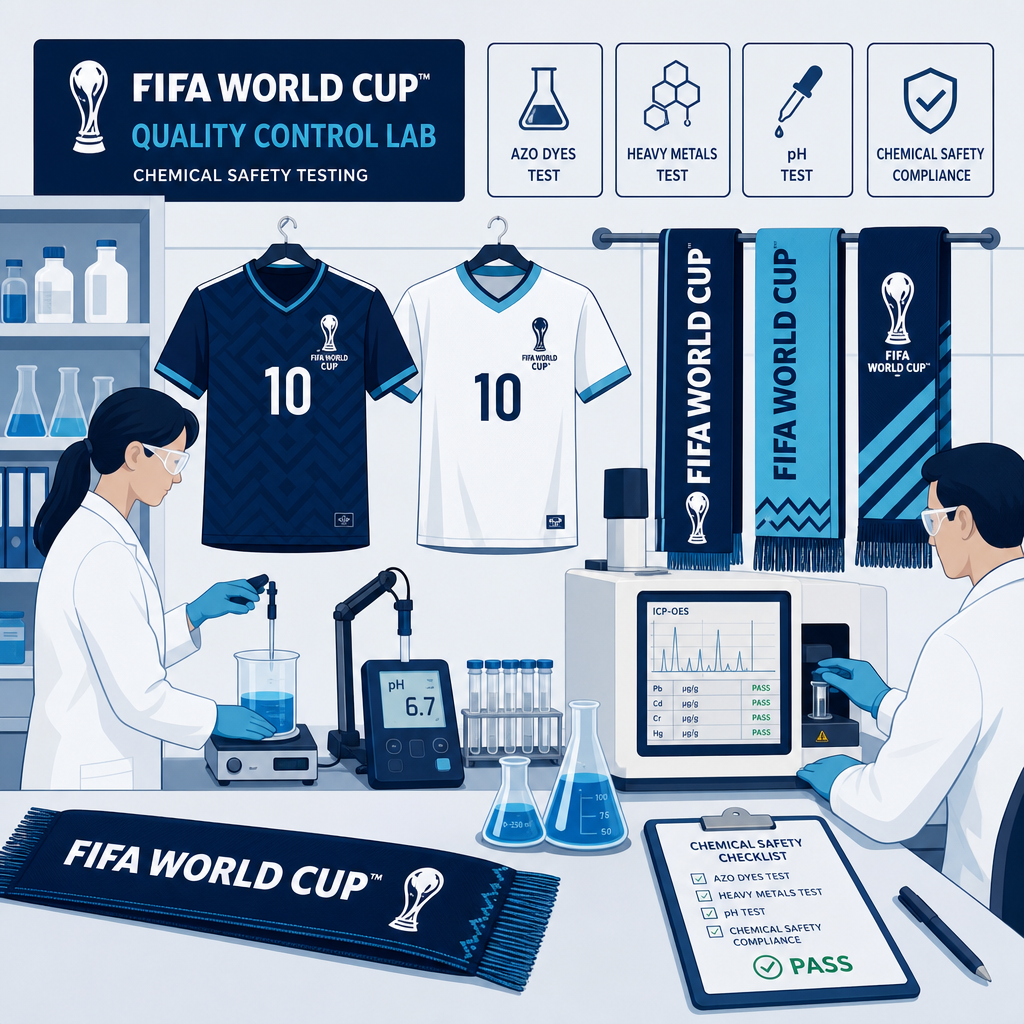
Chemical and Safety Compliance for World Cup Merchandise — REACH, CPSIA, and Flammability Tests That Prevent Customs Seizures 34% of World Cup souvenir shipments face customs delays for chemical compliance failures — not product quality Average customs hold: 18 days — enough to miss the entire tournament sales window www.
Chemical and Safety Compliance for World Cup Merchandise — REACH, CPSIA, and Flammability Tests That Prevent Customs Seizures
34% of World Cup souvenir shipments face customs delays for chemical compliance failures — not product quality
Average customs hold: 18 days — enough to miss the entire tournament sales window
www.cloudspects.com — Pre-Shipment Inspection & Quality Control
World Cup merchandise is not just about branding, stitching, and print quality. Every jersey, scarf, flag, plush mascot, and commemorative pin must pass chemical and safety regulations in the destination country — or face immediate customs seizure.
Most Chinese factories producing licensed sports merchandise source materials from multiple subcontractors. A scarf manufacturer might buy fabric from one supplier, dye from another, and printing services from a third. Each handoff is a potential compliance break. The factory's internal QC rarely tests for restricted chemicals, heavy metals, or flammability — because they do not have the equipment or the expertise.
Data point: In the 2022 World Cup cycle, EU customs rejected 312 shipments of textile-based sports merchandise for chemical non-compliance. The average value per seized shipment: $18,500. The most common violations: phthalates in printed designs, lead in metal components, and azo dyes in fabrics.
REACH Compliance for EU-Bound World Cup Merchandise
The EU's REACH regulation (Registration, Evaluation, Authorization, and Restriction of Chemicals) is the most comprehensive chemical safety framework affecting World Cup merchandise. It applies to all products sold in the EU — including jerseys, scarves, flags, and souvenir items.
REACH article 67 — restricted substances in textiles
✓ Azo dyes — banned in textiles that come into direct contact with skin. 22 specific aromatic amines are restricted to concentrations below 30 ppm. A single positive test means the entire product batch fails.
✓ Nickel release — applies to metal zippers, snaps, and buttons on jerseys. Migration limit: 0.5 µg/cm²/week. 15% of Chinese-sourced sports apparel zippers fail this test.
✓ Phthalates — restricted in flexible plastics used for commemorative pins, keychains, and mascot toys. Total of 6 phthalate compounds limited to 0.1% by weight. 28% of cheap PVC-based pins fail.
✓ Formaldehyde — limit varies by textile type. Direct skin contact (jerseys, scarves): 75 ppm. Non-contact (flags, banners): 300 ppm.
A pre-shipment inspection cannot run REACH tests in the field — that requires a laboratory. But the inspector can verify that the factory has valid REACH compliance certificates from their material suppliers, and collect random samples for lab testing before shipment. This is the difference between catching non-compliance before the container leaves vs. discovering it when EU customs holds your shipment.
CPSIA Requirements for US-Bound Sports Merchandise
For World Cup merchandise destined for US Amazon FBA or retail, the Consumer Product Safety Improvement Act (CPSIA) imposes mandatory third-party testing requirements. Unlike REACH, CPSIA has specific testing mandates that apply differently based on product category.
1. Total lead content. Products intended for children under 12 — including mini jerseys, plush mascots, and kid-size flags — must have total lead content below 100 ppm in accessible parts. Paint and surface coatings: below 90 ppm.
2. Phthalates in children's products. 8 specific phthalates restricted to 0.1% each (DEHP, DBP, BBP, DINP, DIBP, DPENP, DHEXP, DCHP). Focus on soft plastic parts of mascots and collectible figures.
3. Tracking labels. Each product must have a permanent tracking label with: manufacturer ID, date of production, batch/run number. 55% of Chinese sports merchandise factories skip this entirely.
4. Certificate of Compliance (GCC or CPC). A Children's Product Certificate (CPC) is required for kid-targeted items. The certificate must reference specific test results from a CPSC-accredited lab. Without it, customs can detain the full shipment.
The inspection angle: a field inspector can verify tracking labels exist, check that Certificates of Compliance are present and reference the correct product batches, and send random samples to a CPSC-accredited lab for pre-shipment lead testing. Catching a lead failure before the container departs saves 3–6 weeks of corrective action time compared to a customs hold in the US.
Flammability Testing for Textile-Based World Cup Items
Scarves, flags, and fabric banners are the highest-risk World Cup items for flammability violations. The US and EU have different standards, and both require specific testing before the product can be sold.
US CPSC 16 CFR Part 1610: Class 1 (normal flammability) is required for all textile apparel sold in the US. Class 2 or 3 means the product cannot be sold as apparel — it must be labeled as a decorative item. 12% of Chinese polyester scarves test at Class 2 due to high-surface-fiber construction.
✓ Test method: 50 mm/sec maximum flame spread rate for Class 1
✓ Common fail: fleece and high-pile fabrics used for souvenir scarves — 3× more likely to fail than flat-knit fabrics
✓ Fix: add flame-retardant treatment during finishing — adds $0.08–$0.15 per unit, but must be REACH-compliant
✓ EU EN 14878: 4× the test points vs US standard — scarves sold in the EU face stricter surface flash testing
Metal and Small Parts Compliance for Plush Mascots and Pins
World Cup plush mascots and commemorative pins fall into a higher-risk compliance category because they combine textiles, metal, and plastic components — each with its own testing requirements.
Small parts test (US 16 CFR 1501). Any component less than 31.7 mm in any dimension and capable of fitting into a small parts cylinder (simulating a child's throat). Buttons, eyes, and pin backs on mascots must be securely attached — torque test at 2 in-lb and tension test at 20 lb.
Metal content testing. Commemorative pins and coin medallions must comply with both CPSIA lead limits (100 ppm) and nickel release limits. Chinese suppliers often use zinc alloy base metals that can contain lead impurities up to 1,200 ppm — 12× the legal limit.
Packaging compliance. Poly bags for plush mascots need suffocation warnings and perforation. Blister pack cards for pins must use phthalate-free inks. 22% of pin blister packs from Chinese suppliers contain restricted phthalates in the card coating.
Battery compartments. Light-up mascots often include batteries. The battery compartment must require a tool (screwdriver) to open — a coin slot alone is not sufficient for children's products per ASTM F963.
The Pre-Shipment Inspection Role in Chemical Compliance
A standard pre-shipment inspection checks appearance, function, and packaging. But for World Cup merchandise with chemical compliance requirements, the inspection must go further.
1. Document verification. Inspector confirms the factory has REACH/CPSIA compliance certificates from all material suppliers, and the certificates cover the batches used in this production run.
2. Sample collection for lab testing. Inspector collects 5–10 random units per SKU, seals them in tamper-evident bags, and ships to a CPSC-accredited or ISO 17025 lab. Test results arrive in 5–7 business days — before the container departs.
3. Tracking label verification. Inspect each SKU for compliance tracking labels. Verify the date code and batch number match production records.
4. Packaging chemical check. Simple field tests for phthalate odor in poly bags and blister packs. Any strong plastic smell should trigger a lab test.
5. Flammability pre-check. While field flammability testing requires lab equipment, the inspector can identify high-risk fabrics (high-pile, fleece, brushed polyester) and prioritize them for lab flammability testing.
Cost of Non-Compliance vs Cost of Pre-Shipment Testing
Many importers skip chemical compliance testing because they see it as an extra cost. Here is the math that changes that calculation.
Customs seizure cost: Shipment value + freight + return logistics + restocking + missed sales window. A typical $30,000 World Cup merchandise shipment seized at customs costs $55,000–$78,000 in total losses when you include the opportunity cost of missed tournament sales.
✓ Pre-shipment inspection with lab sample collection: $169 per man-day (1-day inspection)
✓ REACH/CPSIA basic panel lab test: $180–$350 per product category
✓ Flammability test (US 16 CFR 1610): $75–$120 per fabric type
✓ Total compliance cost per product line: ~$349–$639
✓ Customs seizure cost if non-compliant: $55,000+
✓ ROI of compliance testing: 86:1 to 157:1
How to Set Up Chemical Compliance for Your World Cup Merchandise Shipment
Start by collecting material supplier certificates from your factory — REACH declarations for EU-bound goods, CPSIA certificates for US-bound goods. Then book a pre-shipment inspection that includes sample collection for lab testing. The total cost of $349–$639 per product line is less than 2% of a typical World Cup merchandise shipment value — and it protects you from a $55,000+ customs seizure.
At CloudSpects, our World Cup merchandise inspection package includes chemical compliance document verification, tracking label audit, sample collection for lab testing, and flammability risk assessment — all before your container leaves China.
#WorldCup #SportsMerchandise #ChemicalCompliance #REACH #CPSIA #FlammabilityTesting #PreShipmentInspection #CloudSpects #QualityControl #FBA
Related Articles
- World Cup Merchandise FBA Inbound — 6 Packaging and Labeling Checks That Stop 90% of Rejections
- World Cup Merchandise QC Inspection — Fabric Integrity, Print Durability, Stitching Standards, and FBA Packaging Requirements
- World Cup Merchandise QC — 5 Critical Inspection Points for Jerseys, Flags, Scarves, and Collectibles